 JiFeng Ceramics

In the landscape of modern industrial material engineering, Alumina Ceramic (Al₂O₃) has established itself as a cornerstone strategic material for the global B2B market. Particularly in environments where traditional metals and polymers fail due to extreme heat, wear, or corrosion, high-performance technical ceramics provide the necessary reliability.
With the global shift toward precision manufacturing, the evolution of alumina from structural components to active electronic parts—specifically the alumina ceramic heating plate (Metal Ceramic Heater or MCH)—has redefined thermal management efficiency in high-tech industries.This report provides an in-depth analysis of alumina ceramics from material science, engineering applications, and procurement decision-making perspectives.
Table of Contents
- 1. Technical Classification: From 75% to 99.7% Alumina
- 2. Core Performance: Hardness, Thermal, and Electrical Properties
- 3. Alumina Ceramic Heating Plate (MCH): Technological Revolution
- 4. Application Scenarios: Semiconductor, Medical, and Chemical
- 5. Engineering Guide: Tolerances, Roughness, and DFM
- 6. Industrial Procurement FAQ & Summary
1. Technical Classification: From 75% to 99.7% Alumina
Alumina ceramic is a technical material primarily composed of α-Al₂O₃ as the main crystal phase. In industrial B2B procurement, these ceramics are categorized by their aluminum oxide purity, which dictates their physical performance and cost-effectiveness.
| Grade Category | Al2O3Content | Density (g/cm3) | Max Temp (°C) | Typical Industrial Applications |
|---|---|---|---|---|
| 75 Alumina | 75% | 3.10 – 3.30 | 1100 | General industrial insulators, lining bricks. |
| 95 Alumina | 95% | 3.65 – 3.75 | 1600 | Mainstream industrial standard: mechanical seals, automotive parts. |
| 99 Alumina | 99% | 3.85 – 3.90 | 1650 | High-temperature crucibles, electronic substrates, electronic tools. |
| 99.7 Alumina (Corundum) | ≥99.7% | 3.90 – 3.98 | 1710 | Semiconductor manufacturing parts, laser cavities, medical implants. |
High-purity alumina ceramics (>=99.9%) exhibit near-ideal physical properties. By eliminating low-melting glass phases at grain boundaries, these materials maintain high mechanical strength and creep resistance at temperatures exceeding 1600°C.
2. Core Performance: Hardness, Thermal, and Electrical Properties
The reason alumina ceramic replaces metals in extreme environments lies in its superior physical response characteristics across multiple domains.
2.1 Superior Hardness and Wear Resistance
With a Vickers hardness ranging from 14 GPa to 18 GPa (1700 HV), alumina ceramic is over 15 times harder than carbon steel.
- Extended Wear Life: In mining and material transport, ceramic linings can extend the service life of pipes and valves from 2 months to over 2 years.
- Low Friction: Precision-polished surfaces (Ra < 0.2 um) exhibit extremely low friction, reducing energy consumption in high-speed shaft seals.
2.2 High Thermal Stability and Resistance
Alumina is one of the most widely used refractory materials, maintaining its shape and performance at high temperatures with less than 0.001% deformation.
- Thermal Shock Resistance: Standard alumina handles a temperature difference (ΔT) of 200°C to 250°C. Advanced versions (like A995S) can reach ΔT of 500°C to 650°C, replacing expensive silicon nitride in rapid-cycle environments.
- Thermal Conductivity: Grades like 995/998 offer thermal conductivity between 25.1 and 35.6 W/m·K at room temperature.
2.3 Electrical Insulation and Dielectric Strength
Alumina is an excellent insulator with a volume resistivity exceeding 10^14 Ω·cm. This high insulation, combined with dielectric strength (14-18 kV/mm), ensures safety in high-voltage electronic components and 5G communication substrates.
3. Alumina Ceramic Heating Plate (MCH): Technological Revolution
The alumina ceramic heating plate, or Metal Ceramic Heater (MCH), represents the next generation of electrothermal conversion, succeeding traditional alloy wires and PTC elements.
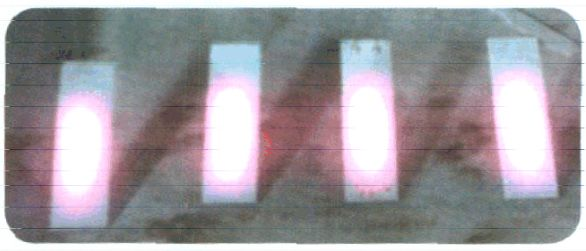
The heating characteristics of alumina ceramic sheets when subjected to electric current.
3.1 Key Engineering Advantages of MCH
- Rapid Heating: A 500W MCH component can reach 600°C within 20 seconds, with rated power reaching 200°C in under 10 seconds.
- High Power Density: MCH supports power densities , allowing for compact equipment designs.
- Environmental & Safety Compliance: MCH contains no lead, cadmium, or mercury, complying with EU RoHS standards. Its surface is electrically insulated, withstanding 3700V/1s dielectric testing.
- Stability: Since the resistor is sealed within the ceramic substrate, it avoids oxidation, ensuring long life and zero power attenuation.
4. Application Scenarios: Semiconductor, Medical, and Chemical
4.1 Semiconductor and Electronics
Utilizing 99.7% high-purity alumina, manufacturers produce Wafer Handling Arms and plasma-resistant etching chamber parts. Its high stiffness minimizes micro-vibrations, while low porosity prevent impurity release in cleanroom environments.
4.2 Precision Medical Devices
Alumina’s bio-inertness and precision finish (Ra < 0.1 um) make it ideal for metering pump plungers in drug delivery systems, ensuring dosing accuracy without metallic contamination. MCH technology is also widely used in medical instant-warmth devices.
4.3 High-End Chemical Processing
Ceramic valves and seals withstand concentrated sulfuric acid and liquid chlorine. In these corrosive fluid controls, alumina components offer a service life 5-10 times that of stainless steel.
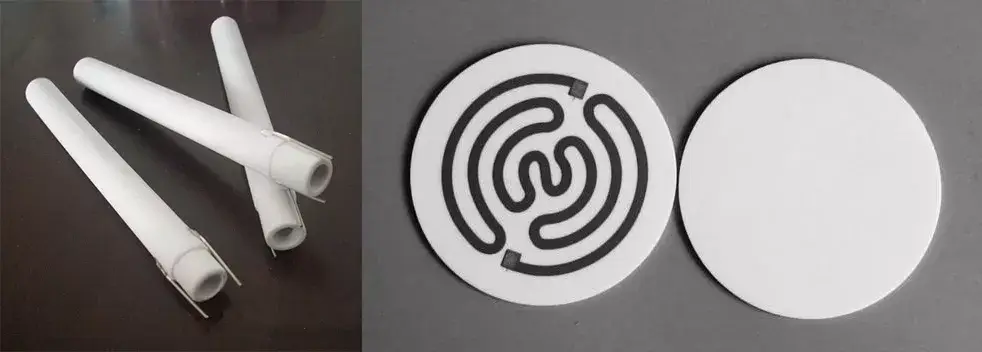
Alumina ceramic heating element
5. Engineering Guide: Tolerances, Roughness, and DFM
Designing with alumina ceramic requires balancing performance with the physical limits of ceramic processing.
| Processing Parameter | Typical Industrial Range | Precision Limit (Grinding) |
|---|---|---|
| Processing Tolerance | ±0.01 mm | ±0.005 mm |
| Surface Roughness (Ra) | 0.1 – 0.4 μm | ≤0.02 μm |
| Flatness | 0.02 mm | 0.005 mm |
5.1 Design for Manufacturing (DFM) Tips
- Avoid Direct Tapping: Ceramics cannot be easily threaded. The best practice is to use metal thread inserts (e.g., Helicoil), which increases joint strength by 300%.
- Wall Thickness: Recommended minimum wall thickness is ≥1.0−1.5 mm to prevent fracture during sintering.
- Fillet Radius: Adding an internal radius of R0.3−R0.5 mm can improve crack resistance by 20% to 40%.
6. Industrial Procurement FAQ & Summary
Q: Why do my alumina parts deform at 1000°C?
A: This typically occurs when using low-purity grades (like 75% or 85%). These contain more glass phases that lead to creep at high temperatures. For precision applications above 1000°C, specify >=95% alumina.
Q: Can MCH replace PTC heaters entirely?
A: MCH offers faster heating and higher temperatures but lacks the “self-limiting” temperature feature of PTC. Therefore, MCH must be paired with a PID temperature controller to prevent overheating.