 JiFeng Ceramics
Silicon Nitride Ceramics Materials
Silicon Nitride (Si₃N₄) ceramics can be described as extremely durable non-oxide structural ceramics that are formed with strong, covalent connections between nitrogen and silicon atoms. With their high hardness, superior strength, outstanding fracture toughness, and low density, and a remarkable thermoshock resistance, the Si3N4 is able to endure rapid temperature fluctuations of over 1000 °C without cracking. It is widely acknowledged as one of the most durable and most reliable advanced ceramics suitable for extreme thermal and mechanical environments.
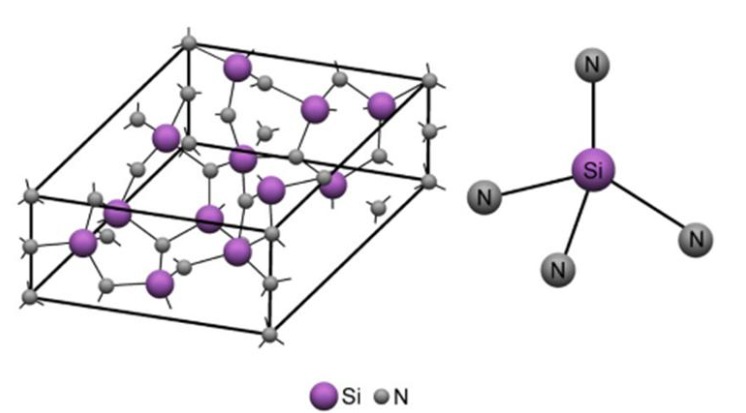
Crystalline Forms of Silicon Nitride (Si₃N₄)
Silicon Nitride (Si₃N₄) is believed to exist in two primary crystal structures:α-Si₃N₄ and β-Si₃N₄, and also an Amorphous phase. In the latter, α-Si₃N₄ is metastable in low temperature and β-Si₃N₄ is a most stable high temperature phase. The various types of silicon nitride display distinct distinctions in structure and property and determine their particular applications.
- α-Si₃N₄ has a trigonal crystal system with a complex, tightly packed structure. It is typically formed during low-temperature synthesis and is metastable at high temperatures. During sintering, α-Si₃N₄ readily transforms into β-Si₃N₄, promoting grain growth and densification. It has a high specific surface area and is often used as a raw material for producing high-performance β-Si₃N₄ ceramics.
- β-Si₃N₄ is a hexagonal crystal system that has a long columnar interlocking grain structure. It is the most stable thermodynamically with high temperatures, and has great strength, exceptional fracture toughness, excellent thermal shock resistance, as well as excellent oxidation resistance. It is the main crystallization phase of the majority of high-performance silicon nitride ceramics.
Silicon nitride ceramics, which have β-Si₃N₄ the main crystal, have high strength, toughness as well as excellent thermal shock resistance. This makes them the ideal material for engine parts, high-speed bearings or cutting equipment.
Advantages Of Silicon Nitride Ceramic
High strength, toughness
Flexural strength 600–1000 MPa, and it shows really good resistance to mechanical impact, kind of hard knocks you can say.
Better thermal shock resistance
It keeps working when ΔT >800 °C, so it’s pretty suitable for rapid heating/cooling cycles , without falling apart too easy.
Strong wear and corrosion resistance
It resists most acids and alkalis, plus oxidation too. That usually means longer service life , overall.
Low density, and high temperature stability
Lightweight material, maintains strength up to around 1200–1300 °C which is, quite something.
Applications of Silicon Nitride Material
Engine and automotive parts
Turbocharger rotors, valve seats, and combustion chamber liners.
Engine and automotive parts
High speed bearings, mechanical seal rings, and pump components.
Bearings and sealing
Ceramic cutting inserts, dies, and wear-resistant guide parts.
Semiconductor and aerospace
Wafer carriers, high temperature jigs, and heat exchangers.
