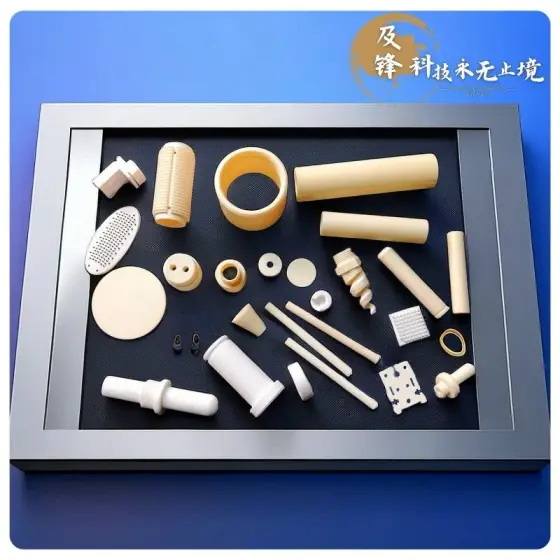
 Céramique JiFeng

Céramiques fonctionnelles (or electroceramics) are advanced materials whose physical properties (électrique, magnétique, optique, thermique) are exploited to fulfill specific functions in demanding environments. Unlike structural ceramics, valued for their mechanical robustness, functional ceramics are the pillar of innovation in electronics, énergie, et la défense.
Why Choose Technical Ceramics for Your Applications?
Thanks to their unique molecular structure, these materials offer unmatched stability against corrosion and extreme temperatures. Here is a detailed analysis of the 8 types of functional ceramics essential to modern industry.
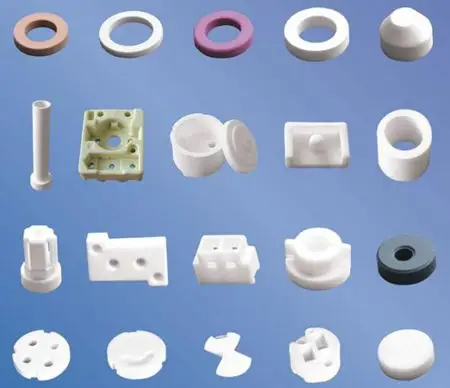
1. Céramiques Isolantes (Dielectrics)
Used primarily for the support and protection of electronic components, they offer high volume resistivity and excellent dielectric strength.
- Typical Applications: Integrated circuit substrates, bougies d'allumage, isolateurs haute fréquence.
- Key Advantage: Low loss factor even at high frequency.
2. Céramiques piézoélectriques
These materials convert mechanical energy into electrical energy (and vice versa). PZT (Lead Zirconate Titanate) is the reference material in this field.
- Typical Applications: Ultrasonic sensors, medical transducers, allumeurs à gaz.
- Performance: High sensitivity and thermal stability.
3. Céramiques semi-conductrices
Their electrical properties evolve during sintering, allowing the creation of components sensitive to environmental variations.
- Typical Applications: Thermistors (NTC/PTC), varistances, humidity and gas sensors.
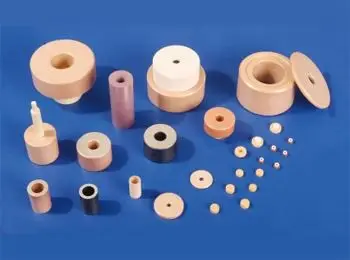
4. Céramique Magnétique (Ferrites)
Composed of iron oxides and rare earth or transition metal oxides, they exhibit high resistivity, limiting eddy current losses in high-frequency applications.
- Typical Applications: Radars, communication antennas, aerospace components.
5. Céramiques supraconductrices à haute température
These ceramics exhibit superconductivity at relatively high temperatures compared to metals, driving breakthroughs in energy transmission and storage.
- Typical Applications: Appareils à courant élevé, blindage magnétique, and superconducting technologies.
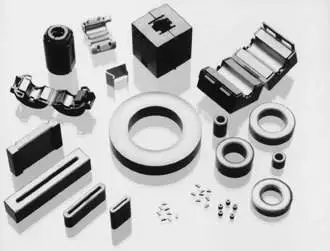
6. Nano-Functional Ceramics
Utilizing nanoscale structures to achieve enhanced surface area and reactivity.
- Typical Applications: Advanced filtration systems, photocatalytic purification, biomedical materials.
7. Céramique fonctionnelle transparente
Combining optical transparency with active functional properties.
- Typical Applications: Optical switches, solid-state lasers, electro-optic devices.
8. Céramiques diélectriques
Characterized by high insulation resistance and low dielectric loss, crucial for energy storage.
- Typical Applications: Condensateurs, composants de circuits micro-ondes, high-frequency filters.
Comparative Table of Functional Ceramic Properties
|
Ceramic Type
|
Dominant Property
|
Primary Application
|
|
Insulating
|
High Dielectric Strength
|
High-voltage electrical insulation
|
|
Piezoelectric
|
Piezoelectric Effect
|
Sensors and Transducers
|
|
Magnetic
|
Magnetic Permeability
|
Transformer Cores, Antennas
|
|
Semi-conducteur
|
Thermal/Chemical Sensitivity
|
Temperature and Gas Sensors
|
|
Transparent
|
Optical Transparency + Ferroelectricity
|
Optical Switches, Lasers
|
Frequently Asked Questions (FAQ)
What is the difference between a structural and a functional ceramic?
Structural ceramic is chosen for its mechanical resistance (hardness, toughness), while functional ceramic is selected for its active physical properties (conduction, magnetism, optical response).
How to ensure the reliability of ceramic components in corrosive environments?
The choice of material (par ex., YTZP Zirconia or Silicon Carbide) is crucial. Our manufacturing processes ensure controlled porosity and high chemical purity to resist strong acids and bases.
Do you offer custom solutions (Build-to-Print)?
Oui, we assist engineers in the development of customized ceramic components according to their CAD plans, with precision tolerances up to ±0.005mm.
Need technical expertise for your project?