 جيفينج سيراميك

عادةً لا يبدو اختيار المادة الخزفية الخاطئة بمثابة مشكلة صغيرة في البيانات. يتحول إلى جزء متصدع, ختم لا يحمل, أو أحد المكونات التي تم سحبها من الخدمة قبل أشهر من الخطة. Alumina and zirconia are basically the two ceramics you’ll see most often in engineering catalogs, but they act differently when they’re pushed—by load, by heat, and by wear. If you want a clear view for sourcing, it helps to compare them across the three points that decide most choices, namely raw cost, mechanical performance and the actual time they last in real operation.
Alumina vs Zirconia at a Glance
| ملكية | الألومينا (آل₂O₃) | زركونيا (Y-TZP) |
| صلابة (موس) | ~9 | ~8–8.5 |
| Fracture toughness | ~3–4 MPa·√m | ~5–10 MPa·√m |
| Flexural strength | ~300–400 MPa | ~900–1,400 MPa |
| Thermal conductivity | ~30 W/m·K | ~2–3 W/m·K |
| Relative raw material cost | Lower | 3–5x higher |
| The Most Well-known Trade Name | “Technical ceramic” workhorse | “Ceramic steel” |
The numbers already suggest the pattern: Alumina is more successful on thermal conductivity, hardness and price; zirconia is the winner on bending strength and toughness. The remainder of this article explains the reasons — and how each benefit is actually important.
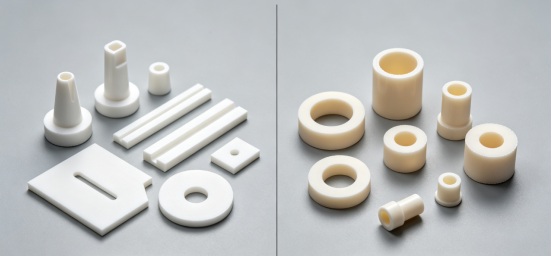
What Are Alumina and Zirconia Ceramics?
Alumina is a form of aluminum oxide(آل₂O₃) is one of the most advanced and widely used technical ceramics appreciated for its mix of electrical insulation, hardness and cost efficiency. It is the most popular option for general-purpose wear components or substrates, as well as insulators.
Zirconia can be described as zirconium oxide (زرو₂) that is almost always utilized in its yttria stabilized Tetragonal form (Y-TZP). Stabilizing zirconia by using the yttrium oxide results in the crystal structure, which gives zirconia the capacity to resist the propagation of cracks which is the reason for its common name, “ceramic steel.” In the case of alumina, which is a general-purpose choice, zirconia is the choice for parts are subjected to impacts or stress concentration, or repeatedly stretching.
مقارنة الأداء: صلابة, Toughness, and Thermal Behavior
صلابة ومقاومة التآكل
Alumina is at the highest point in the Mohs scale, which is located just below silicon carbide and diamond and silicon carbide, which is the reason it is the most popular choice for continuous sliding wear applications such as guides, bushings and handling abrasive media. Zirconia is a little softer, however it is extremely wear-resistant, which is why the actual difference is only relevant in the most demanding areas.
Fracture Toughness and Impact Resistance
This is the point where the two materials diverge most clearly. Alumina typically has crack toughness around 3–4 MPa·√m. لكن, yttria-stabilized zirconia can reach around 5–10 MPa·√m – in certain formulations, more than twice. The difference is due to transformation toughening. When cracks begin to form in zirconia, the strain creates a localized change in the phase within the surrounding grains, which expands a little and then effectively seals the crack before it has the chance to spread. Alumina is not equipped with a self-healing mechanism. This is the reason it works best under continuous compressive forces, but is more susceptible to breakage under sudden impact as well as edge pressure.
Thermal and Electrical Properties
Alumina’s thermal conductivity, عن 30 ث / م · ك, is about 10 times more than zirconia’s. This makes it the best choice for components that heat dissipate as well as electronic substrates. It’s also a great electrical insulator. It’s frequently used in feedthroughs and washers that are insulated. The low thermal conductivity of zirconia is ideal for applications requiring thermal barriers However, when combined with its greater temperature expansion causes zirconia more susceptible to shocks than alumina. This is a aspect that frequently irks customers who think that “tougher” automatically means “better in heat.”
Cost Comparison: Why Zirconia Costs More Than Alumina
Raw Material Cost
Alumina is made from Bauxite, a plentiful and low-cost raw material. Zirconia needs yttrium oxide for stabilizer, and yttrium is a rare earth element that has an distribution chain more limited and price-sensitive. This alone is the reason for a significant portion of the difference in prices between the two substances.
Machining and Processing Cost
The biggest cost driver but is often not considered zirconia’s density is higher than alumina and more dense ceramics are more difficult to grind, lap and polish until they reach the final tolerance. Some companies report zirconia pieces that take several times longer to grind than comparable Alumina components, which translate directly into higher machining costs and wear on equipment. For precision parts that are tightly toleranced the processing time not the cost of raw powder typically is the largest contributor to the cost of the final product.
The Total Cost of Ownership Perspective
A higher unit price doesn’t automatically mean a higher cost per year in service. If zirconia’s toughness prevents a part from failing prematurely in a stress-heavy application, the total cost of ownership can come out lower than a cheaper alumina part that needs replacing twice as often. This is the calculation that should drive material selection — not the quoted price per part alone.
خدمة الحياة: Which Material Lasts Longer in Real Applications
Service life depends less on which material is “better” and more on which one matches the part’s dominant failure mode.
Wear-Dominant Applications
In applications where the primary threat is continuous abrasive contact — bushings, الفوهات, القضبان التوجيهية, wear plates — alumina’s superior hardness typically delivers the longer service life at a lower cost per part.
Impact- or Stress-Dominant Applications
Where the dominant risk is chipping, edge cracking, or cyclic mechanical stress — small precision components, مكونات الصمام, structural parts under sliding contact stress, or thin-walled geometries — zirconia’s fracture toughness usually wins out, often extending service life well beyond what alumina can achieve in the same duty cycle.
Thermal Cycling Applications
For parts exposed to rapid heating and cooling, alumina’s higher thermal conductivity generally gives it better thermal shock resistance, despite its lower toughness. Zirconia can still be used in thermally cycled environments, but usually requires more conservative design margins to avoid cracking.
Thermal Cycling Applications
For parts that end up seeing quick heating and cooling, alumina’s higher thermal conductivity often ends up being the reason it handles thermal shock a bit better, even though its toughness is lower. Zirconia can still survive in thermally cycled setups, but most times it asks for more conservative design margins, so it doesn’t end up cracking.
How to Choose: Alumina or Zirconia by Application
العوازل الكهربائية, substrates, and heat-dissipating components → Alumina
Wear-resistant bushings, guides, abrasive handling items → Alumina
Smaller precision parts under sliding or impact stress (حلقات الختم, مكونات الصمام, الغطاسون) → زركونيا
Thin-walled pieces or edge-sensitive shapes that are prone to chipping → Zirconia
Medical implants, plus load-bearing structural ceramics → Zirconia
Cost-sensitive, high-volume standard parts → Alumina
If your application doesn’t fit neatly in just one box, the safest path is to send the drawing, the working temperature, the loading conditions and the chemical exposure all at once to a ceramic manufacturer. They can then weigh the trade-offs against your actual failure risk, instead of you guessing from general rules.
Matching the Material to the Failure Mode, Not Just the Price
Alumina and zirconia don’t really “compete” for the same job. They’re more like different answers for different engineering problems. Alumina brings along hardness, good thermal behavior, and cost efficiency for settings where wear , and heat are the main story. Zirconia brings toughness and strength for components that live and die by crack resistance and impact. So the right call is not just “which one wins” on the spec sheet it’s more about which material actually fits the way your part is likely to fail in real life.
Reference
- ASTM International. (2018). Standard test method for measurement of fracture toughness of advanced ceramics at room temperature(ASTM C1421-18). https://www.astm.org/c1421-18.html
- ASTM International. (2018). Standard test method for thermal shock resistance of advanced ceramics(ASTM C1525-18). https://www.astm.org/c1525-18.html
- ASTM International. (1975/2025). Standard specification for electronic grade alumina ceramic substrates(ASTM D2442-75R25). https://www.astm.org/d2442-75r25.html
- (n.d.). The structural paradox: A technical guide to zirconia ceramics[White paper]. https://pdf.benchchem.com/74/The_Structural_Paradox_A_Technical_Guide_to_Zirconia_Ceramics.pdf
- Ceramitec Europe. (n.d.). Technical ceramics selection guide. https://www.ceramitec-eu.com/technical-ceramics-selection-guide/
