 جيفينج سيراميك

مع التقدم المستمر في مجال التلسكوبات الفضائية, تكنولوجيا الليزر, أنظمة الطباعة الحجرية لأشباه الموصلات, وأنظمة الإلكترونيات الضوئية, هناك ضغط متزايد على المواد البصرية. These should be able to give optimum optical precision and thermal stability while retaining lightness and stiffness at very high temperatures and under high mechanical load conditions. Traditional optical materials such as glass ceramics and fused silica have shown good performances in terms of light transmittance and precision grinding, but their drawback is low thermal conductivity and light weight.
كربيد السيليكون (كربيد كربيد), a material that sits at the intersection of ceramics and semiconductors, is stepping up as a strong contender. With its high hardness, exceptional thermal conductivity, outstanding specific stiffness, and full environmental resistance, SiC is quickly becoming the go-to choice for large-aperture mirrors and high-precision optical components. It’s already making waves in aerospace and astronomy optics, and it’s proving just as valuable in high-power lasers, تصنيع أشباه الموصلات, and specialized optical environments. This article walks through SiC’s optical and material strengths, the main manufacturing routes, and real-world applications—backed by hard data and engineering insights—to show why it’s becoming the next-generation high-performance optical material.
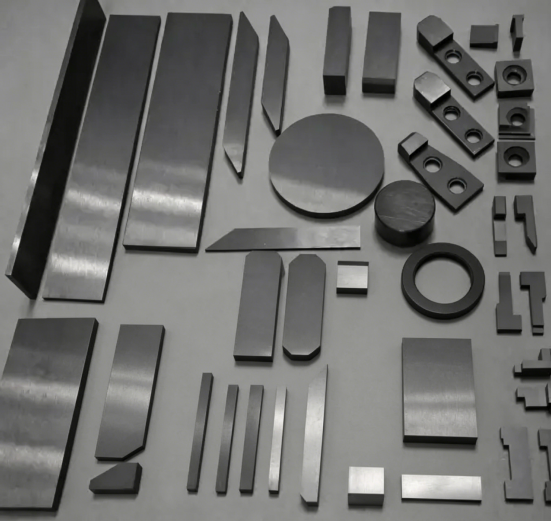
Material and Optical Advantages of Silicon Carbide
The distinguishing feature about silicon carbide is its special blend of properties in the optical sense. When it is compared to the conventional glass ceramics and fused silica, the superiority becomes quite apparent.
Mechanical Strength and Lightweight Performance
The hardness of SiC amounts to 20–30 GPa (فيكرز), which is considerably greater than those of glass-ceramic (Mohs 6–7) and fused silica (موس 7). It has the density of 3.1 جم/سم3; thus, the specific stiffness (ه / ص) of this material is almost four times greater than that of the latter. The mass of an SiC mirror with a certain aperture will be 70% lower than that of the glass mirror. This is a very important feature in terms of space and heavy electro-optical equipment.
Thermal Performance Edge
Conductivity reaches a level of 370 W/mK—a factor of two orders of magnitude greater than glass ceramics (1.5 W/mK) and fused silica (1.4 W/mK). Thermal expansion coefficient is 4.3×10⁻⁶/°C. This is higher than the zero expansion of glass ceramics but the ultrahigh conductivity compensates for this in terms of thermal deformation, which is only about 1/50 of that of glass mirrors. The SiC material can withstand temperatures as high as 1600°C, which is much higher than that of glass ceramics (800درجة مئوية) and fused silica (1100درجة مئوية).
Chemical and Environmental Toughness
SiC resists acids and alkalis (except HF), shrugs off radiation, and operates reliably from –200°C to 1650°C. That full-spectrum environmental resistance makes it a natural fit for space, nuclear, and highly corrosive settings.
Optical Capabilities
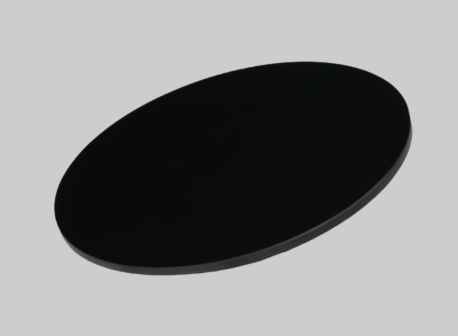
SiC usually needs a coating to perform optically. Once coated, it delivers high reflectivity from the visible into the infrared—often exceeding 99.5% at 1064 نانومتر. After precision polishing, surface roughness can reach Ra ≤ 0.5 نانومتر, and figure accuracy can hit λ/20 @ 632.8 نانومتر (RMS). The material’s inherent hardness and chemical stability help the optical surface stay reliable over the long haul.
Material Performance Comparison
| ملكية | كربيد السيليكون (كربيد كربيد) | Glass-Ceramics | Fused Silica |
| نوع المادة | سيراميك / أشباه الموصلات | Glass-ceramic | Amorphous silica |
| صلابة | 20–30 GPa (فيكرز) | Mohs 6–7 | موس 7 |
| الموصلية الحرارية | 370 ث/(م·ك) | 1.5 ث/(م·ك) | 1.4 ث/(م·ك) |
| مرض الاعتلال الدماغي المزمن | 4.3×10⁻⁶/درجة مئوية | ≈0 (near-zero) | 5.4×10⁻⁷/°C |
| Max Operating Temp | 1600درجة مئوية | 800درجة مئوية | 1100درجة مئوية |
| Chemical Stability | Acid/alkali resistant (except HF) | High-temp corrosion resistant | Acid resistant (except HF), softens at high temp |
| Lightweight Capability | عالي (~70% weight reduction) | Limited | Limited |
| Optical Performance | Requires coating | Good transmission | Excellent in UV |
| Machining Difficulty | Complex | Precision polishable | Easier but brittle |
| التطبيقات النموذجية | Space mirrors, أشباه الموصلات | Telescopes, gyroscopes | UV optics, labware |
| يكلف | عالي | واسطة | قليل |
All told, SiC pulls ahead in lightweight design, الاستقرار الحراري, and environmental toughness, making it a compelling alternative to conventional glass materials.
Manufacturing Routes and Technical Breakthroughs
The final performance of SiC optics depends heavily on how it’s made. The three main routes today are reaction-bonded SiC (رب-سيك), chemical vapor deposition SiC (الأمراض القلبية الوعائية-كربيد), and 3D printing combined with CVD densification. Each has its own strengths in density, lightweight potential, and surface quality.
- رب-سيك keeps costs lower and works well for large, هياكل خفيفة الوزن, though density is a bit lower and extra infiltration plus polishing are usually needed.
- الأمراض القلبية الوعائية-كربيد delivers full density, isotropic properties, and excellent surface finish—ideal for EUV lithography and ultra-precision mirrors.
- 3الطباعة د + CVD opens the door to highly optimized lattice structures and maximum weight savings, pointing the way toward future custom, ultra-light designs.
Technical breakthroughs include the production of big monolithics (ما يصل الى 4 meters), polishing technologies such as magnetorheological finishing and ion beam figuring, uniform coating technology, and strict full process control, including Zygo interferometry of figure and white-light profilometry of roughness, laser damage threshold, among others. The current state-of-the-art technology now allows mirror diameters of 10 mm to 1500 مم, with customized sizes up to 2 meters, with surface accuracy and roughness adhering to top international standards.
Typical Application Areas
SiC mirrors are already hard at work across several demanding fields.
Aerospace and Astronomical Optics
Primary and secondary mirrors for space telescopes, multispectral imagers on satellites, deep-space infrared optics, large ground-based electro-optical systems, and satellite laser communication terminals. The combination of low mass and thermal stability lets these mirrors hold precision through the extreme temperatures and radiation of space. A 2-meter-class CVD-SiC honeycomb primary, for example, can achieve figure accuracy better than 15 nm RMS while staying dramatically lighter than a glass equivalent.
High-Power Laser Systems
Focusing mirrors for laser cutting, cavity mirrors for fiber lasers, chirped mirrors for ultrafast lasers, beam-steering optics for directed-energy systems, and laser-fusion applications. The outstanding thermal conductivity largely suppresses thermal lensing even under kilowatt-class loads, and specialized coatings can handle power densities above 10 كيلوواط/سم².
Semiconductor and Precision Manufacturing
Mirror substrates for EUV lithography, interferometer mirrors for wafer inspection, infrared camera windows, and high-precision metrology references. Fully dense CVD-SiC with ultra-low roughness meets the extreme accuracy and cleanliness demands of semiconductor production.
Research and Harsh Environments
مرايا خط شعاع السنكروترون, neutron optics in nuclear reactors, and high-temperature industrial monitoring optics. Full environmental resistance keeps performance stable under radiation, حرارة, and corrosion.
على سبيل المثال:
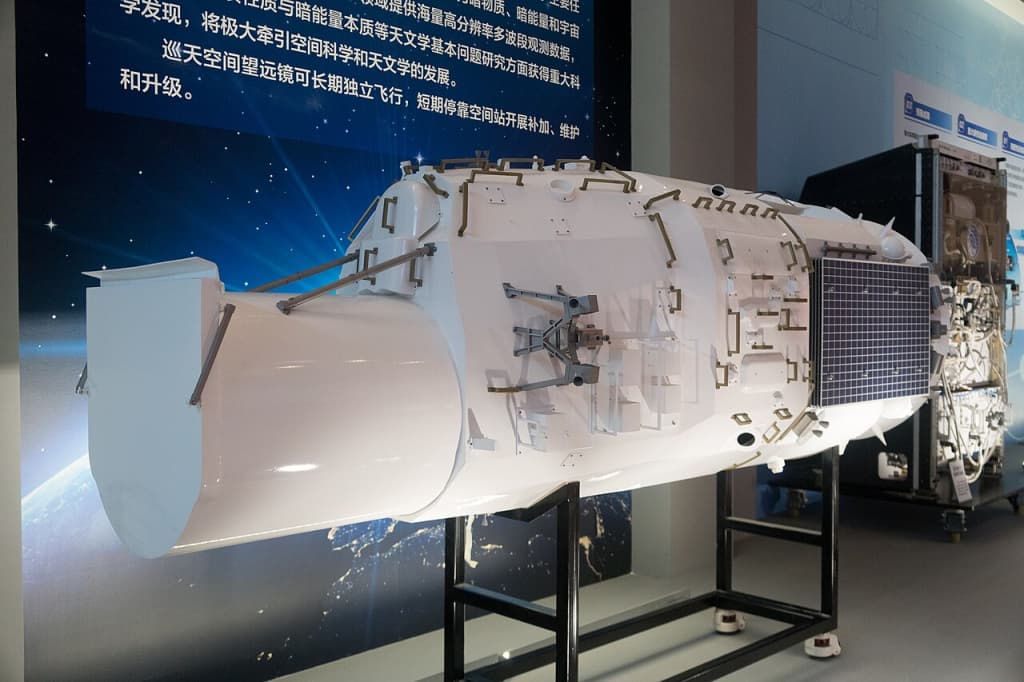
The primary mirror of China’s “Xuntian” space telescope employs a lightweight CVD-SiC honeycomb structure, achieves a surface figure accuracy of less than 15 nm RMS, and weighs only about 200 kg.
Left Image: Shujianyang, Wikimedia Commons, CC0 1.0
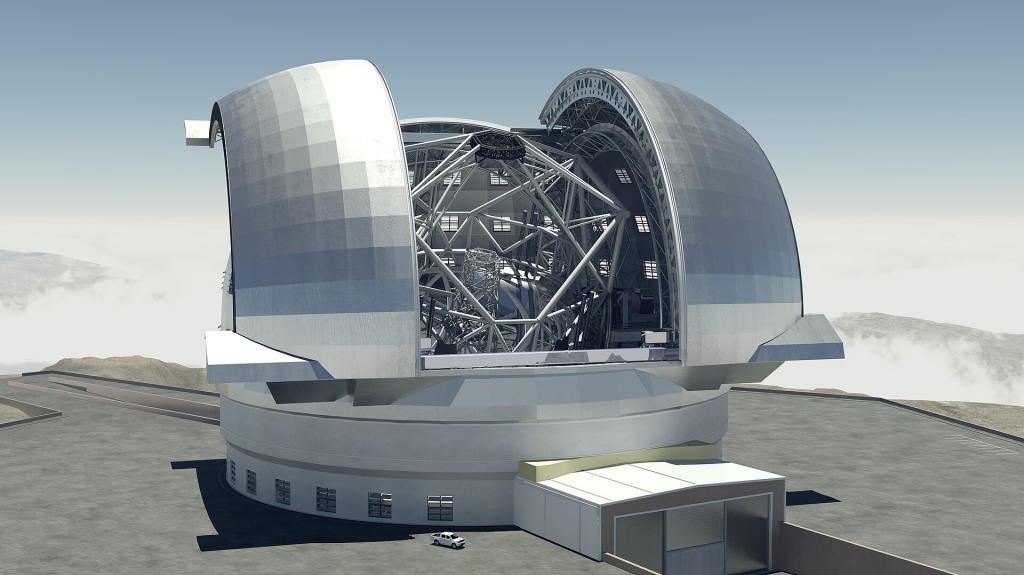
European Extremely Large Telescope: Utilizes Boostec silicon carbide, featuring a coefficient of thermal expansion matched to the primary mirror’s glass-ceramic, for use in high-stability adaptive optics systems.
Right Image: Swinburne Astronomy Productions/ESO, CC BY 4.0, via Wikimedia Commons
نتطلع إلى الأمام, SiC is also showing promise in integrated photonics (SiCOI platforms) and AR waveguide systems, where its high refractive index and nonlinear optical properties open additional opportunities.
التحديات, يكلف, and Development Trends
SiC optics still face real hurdles: the manufacturing process is complex, costs run higher than traditional glass, scaling fully dense large blanks with ultra-low roughness remains demanding, and coatings must deliver long-term stability under tough conditions. While the price tag is currently elevated, the combination of performance and lifecycle advantages makes SiC competitive for high-end applications.
نتطلع, several trends are clear:
- Hybrid processes (especially 3D printing + CVD) will mature and scale.
- Mirror sizes will push beyond 2 meters to serve next-generation telescopes.
- One-stop customization—from blank to polished, المغلفة, and assembled optic—will become standard.
- Domestic production will ramp up and costs will gradually come down, allowing SiC to move from pure aerospace/high-end use into broader industrial and research markets.
- The technology will evolve from individual mirrors toward complete optical system solutions, with deeper integration into photonics and quantum optics.
خاتمة
Silicon carbide has broken through the performance limits that traditional glass materials hit under extreme conditions. Its high hardness, exceptional thermal conductivity, strong lightweight capability, and full environmental resistance have made it a critical optical material for aerospace, high-power lasers, and precision manufacturing. Side-by-side material data and the maturation of multiple process routes further confirm both its engineering feasibility and its wide application potential.
As manufacturing techniques continue to improve and costs decline, SiC optical components will take on an even larger role in high-precision, high-reliability systems. Ongoing collaboration across materials, العمليات, and applications will help silicon carbide move from a high-performance option to a mainstream optical solution—supporting the next wave of optical technology advancement worldwide.
