 Céramique JiFeng
Matériau céramique en carbure de silicium
Carbure de silicium (SiC) ceramics are extremely hard carbide ceramics that have strong covalent bonding. They have extreme hardness, outstanding wear resistance, superior thermal conductivity, and exceptional high-temperature stability. With SiC having a Mohs harderness at 9.5 (second just in the world to diamond), SiC maintains stable mechanical properties for up to 1600°C, which makes it suitable for ultra-high temperatures wear, high heat-flux and high-wear applications. It is used extensively in the electronic, industrial and energy fields.
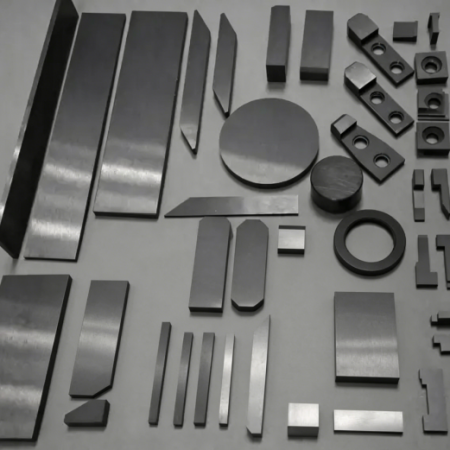
Crystalline Forms of Silicon Carbide (SiC)
Carbure de silicium (SiC) is believed to be found in over 200 polytypes, each with its own stacking sequences of the Tetrahedral structure. The most commonly used and significant is 3C-SiC (cubic) 4H-SiC and the 6H-SiC (hexagonal). Les différents types de carbure de silicium présentent des différences significatives dans leur structure et leurs propriétés qui déterminent les domaines dans lesquels ils sont utilisés..
- 3C-SiC est un système cubique qui a la structure d'un mélange de zinc. C'est le type de polytype le plus simple avec une mobilité électronique extrêmement élevée., très faible densité de défauts ainsi qu'une bonne résistance mécanique. Il est largement utilisé en épitaxie en utilisant des couches minces et comme substrats utilisés pour divers semi-conducteurs..
- 6Le H-SiC est une structure cristalline hexagonale avec une séquence d'empilement récurrente à 6 couches. Le polytype le plus fréquemment utilisé dans l'industrie des semi-conducteurs et offre une balance présentant une conductivité thermique élevée et une tension de claquage élevée., et une excellente qualité de cristal. C'est le matériau de choix pour les appareils électroniques haute puissance et l'électronique haute température..
- 4H-SiC montre un système cristallin hexagonal, et il a un 4 séquence d'empilement de couches. Cela se termine également par une bande interdite plus large, et une mobilité électronique plus élevée que le 6H-SiC, donc en pratique, il semble plus adapté aux utilisations à haute fréquence et à haute puissance., par exemple des diodes de puissance ou des MOSFET.
Céramiques de carbure de silicium , qui ont généralement du α-SiC comme phase cristalline principale (principalement des polytypes 6H/4H), fondamentalement, ils sont d'une dureté extrême. Ils offrent également une conductivité thermique élevée et une grande stabilité à des températures élevées, de sorte que les gens les choisissent souvent pour leurs composants résistants à l'usure., pièces de four à haute température, et même des substrats semi-conducteurs.
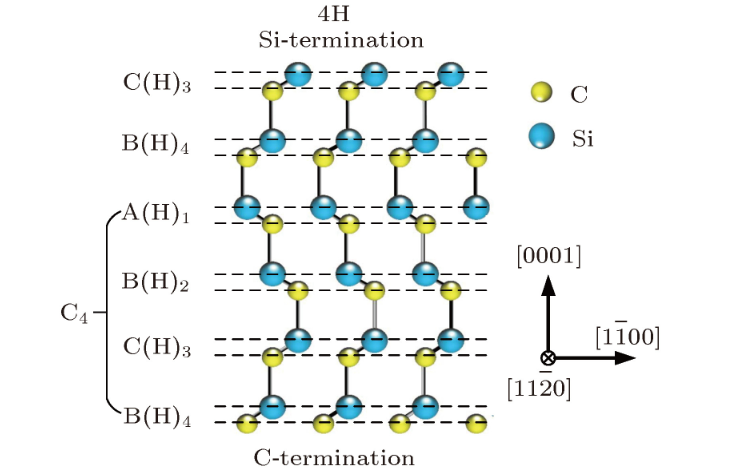
Avantages de la céramique au carbure de silicium
- Dureté extrême et résistance à l'usure solide, il possède Mohs 9.5, et oui, il résiste très bien à l'abrasion .
- Forte conductivité thermique, à faible expansion,donc il peut évacuer la chaleur rapidement; il gère également les chocs thermiques de manière assez stable.
- Stabilité étonnante à des températures très élevées: il combat l'oxydation et la déformation rampante, et ça peut marcher jusqu'à 1600 °C en service .
- Stabilité chimique solide également, il résiste aux acides, alcalis, et même des métaux en fusion, la durée de vie reste donc longue dans des conditions difficiles.
Applications du matériau en carbure de silicium
- Les composants résistants à l'usure incluent des éléments tels que des buses , joints de pompe, noyaux de valve, et plaques de revêtement .
- Pièces de four à haute température, comme des éléments chauffants, tubes de four, échangeurs de chaleur, et accessoires de four.
- Pour les semi-conducteurs et l'électronique, il est utilisé pour les porte-plaquettes, dissipateurs de chaleur, et plaques de base du dispositif d'alimentation.
- Dans les applications aérospatiales et énergétiques, ça apparaît dans les pièces de la turbine, tuyères de fusée, et des morceaux de cellules solaires.
