 Céramique JiFeng
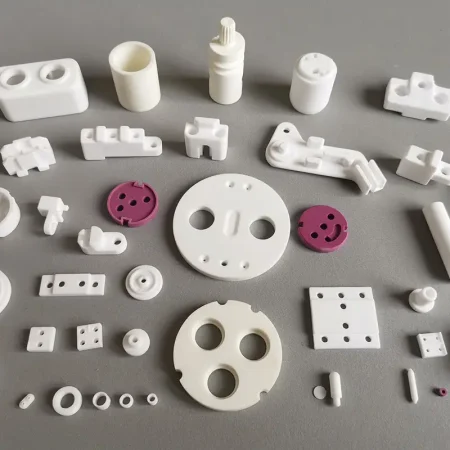
Matériaux céramiques de zircone
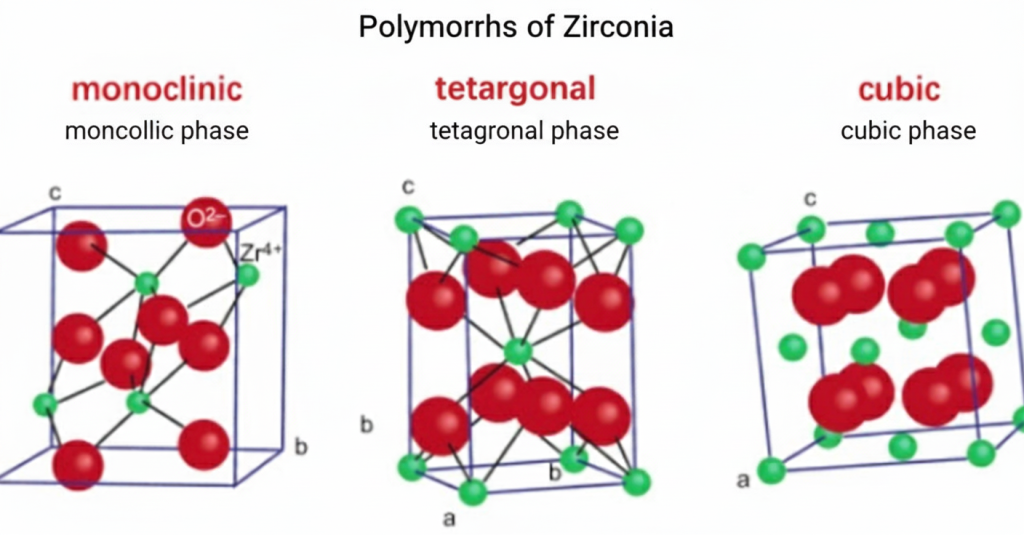
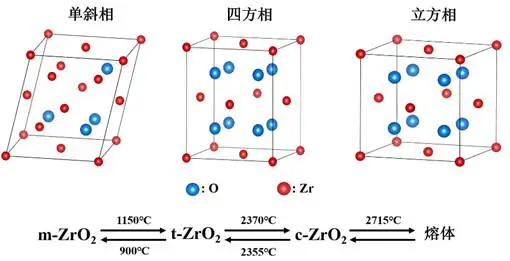
La zircone est un oxyde cristallin blanc composé de zirconium (Zr) et de l'oxygène (Ô), de formule chimique ZrO₂. La zircone pure existe en trois phases cristallines à différentes températures: monoclinique (m-ZrO₂), tétragonal (t-ZrO₂), et cubique (c-ZrO₂).
Le passage de la phase tétragonale à la phase monoclinique est suivi d'une augmentation de volume d'environ 3-5% ce qui pourrait provoquer des fissures dans les céramiques lors de leur refroidissement. Pour résoudre ce problème, les stabilisateurs (comme l'oxyde d'yttrium ET₂OU₃, oxyde de magnésium MgO oxyde de calcium CaO et ainsi de suite.) sont généralement utilisés pour stabiliser les cristaux à haute température, ce qui aboutit à la “trempe par transformation de phase” mécanisme et augmentant considérablement la résistance aux fractures du matériau.
Zircone (ZrO₂) céramiques en raison de leurs propriétés mécaniques exceptionnelles et de leurs propriétés physiques et chimiques distinctives, occupent une place essentielle dans le domaine des céramiques avancées. Ils sont également connus dans l'industrie sous le nom de “en céramique en acier,” il est largement utilisé dans les domaines de haute technologie comme l'aérospatiale, l'électronique et les communications biomédicales ainsi que les machines de précision, ce qui en fait l'un des matériaux essentiels utilisés dans la fabrication moderne.
Formes cristallines de zircone
- Structure cristalline: Appartient au groupe spatial P2₁/c, présentant une symétrie de structure cristalline relativement faible et un arrangement atomique relativement lâche. La cellule unitaire a une symétrie monoclinique.
- Conditions de stabilité:À température et pression normales, le dioxyde de zirconium existe en phase monoclinique, qui est la phase stable du dioxyde de zirconium à température ambiante.
- Propriétés physiques:La densité est d'environ 5.65-5.68 g/cm³, et il a une dureté relativement faible. La structure cristalline est sujette à la déformation sous contrainte.
- Structure cristalline:Un membre du groupe spatial P4₂/nmc et possède une cellule tétragonale, et un arrangement ordonné et régulier d'atomes, avec la plus haute symétrie des cristaux.
- Conditions de stabilité:Lorsque la température augmente jusqu'à environ 1150 ℃, la zircone monoclinique subit une phase d'allongement, qui se transforme en phase tétragonale. La phase tétragonale est stable sur la plage de température comprise entre 1 150 ℃ et 2 370 ℃..
- Propriétés physiques:La densité est d'environ 6.10 g/cm³, et la dureté et la résistance sont améliorées par rapport au monoclinique. La structure cristalline a une bonne stabilité à haute température .
- Structure cristalline:un membre du groupe spatial Fm3m et possède une cellule unitaire cubique idéale, et un arrangement extrêmement symétrique de particules, ce qui en fait la phase la plus homogène des cristaux de dioxyde de zirconium.
- Conditions de stabilité:Si la température augmente jusqu'à 2370℃, la partie tétragonale du dioxyde de zirconium se transforme en phase cubique. Il est stable sur la plage 2370℃-2715℃ (faire fondre le point).
- Propriétés: Il a une densité d'environ 6.27 g/cm³, et a la plus grande force, dureté et stabilité thermique en plus, sa structure présente des performances exceptionnelles même à des températures élevées.
Ces trois formes cristallines de zircone se transforment en quelque sorte en fonction de différentes températures et environnements chimiques., et à quoi ils servent, change beaucoup aussi, en fonction de la structure cristalline réelle. Si vous réglez la température , inclure des stabilisateurs, et utilisez quelques autres techniques, puis le cadre en cristal de zircone peut être modifié afin qu'il s'adapte aux exigences des tâches de différents domaines..
Performances et avantages du noyau en céramique de zircone
Propriété | Valeur typique | Unité | Remarques |
Densité | 5.85 – 6.05 | g/cm³ | Haute densité |
Dureté Vickers | 1200 – 1400 | HT | Excellente résistance à l'usure |
Résistance à la flexion | 900 – 1200 | MPa | Capacité de charge élevée |
Résistance à la rupture | 8 – 12 | MPa·m^1/2 | Caractéristique clé de “en céramique en acier” |
Module élastique | 200 – 220 | GPa | Bonne rigidité |
Au-delà des propriétés mécaniques, les céramiques de zircone ont une stabilité physico-chimique remarquable.
- Résistant aux hautes températures:Le point de fusion peut atteindre 2715 ℃. Fonctionnement stable dans des environnements à haute température.
- La résistance à la corrosion:Une forte résistance aux substances chimiques comme les acides, alcalis, ainsi que des sels adaptés aux conditions environnementales extrêmes.
- Conductivité thermique: La conductivité thermique peut être aussi faible qu'un simple 2-3 Avec(MK) Cela en fait une excellente isolation thermique.
- La dilatation thermique Coefficient: Environ 10.5 × 10⁻⁶/K, très proche du matériau métallique (par exemple. acier) et faciliter le collage des composites et le collage avec des matériaux métalliques.
- Biocompatibilité:Le matériau est non toxique et non irritant, il a une bonne biocompatibilité avec les tissus humains, ce qui en fait un produit biomédical parfait substance.
Tableau des propriétés de la céramique de zircone
Propriété | Unité | Z-100 | Z-200 | Z-300 | ZM-100 | ZB-100 |
|---|---|---|---|---|---|---|
Composition du matériau | – | ZrO₂-Y₂O₃ | ZrO₂-Y₂O₃ | ZrO₂-Y₂O₃ | ZrO₂-Y₂O₃ | ZrO₂-Y₂O₃ |
Couleur | – | Blanc | Blanc | Blanc | Jaune | Bleu |
Densité | g/cm³ | 6.00 | 6.03 | 6.04 | 5.70 | 6.03 |
Résistance à la flexion | MPa | 900 | 950 | 1100 | 450 | 1100 |
Résistance à la compression | MPa | 2100 | 2200 | 2300 | 1600 | 2300 |
Module élastique | GPa | 200 | 210 | 220 | 210 | 220 |
Résistance à la rupture | MPa·m¹/² | 9.0 | – | 9.0 | 5.5 | 7.0 |
Coefficient de Poisson | – | 0.3 | 0.3 | 0.3 | 0.3 | 0.3 |
Dureté (HRA) | HRA | 89 | 90 | 90 | 88 | 90 |
Dureté Vickers | HV1 | 1250 | 1450 | 1450 | 1240 | 1450 |
Coefficient de dilatation thermique | 10⁻⁶/K | 10 | 10 | 10 | – | 10 |
Conductivité thermique | Avec(m·K) | 3 | 3 | 3 | 3 | 3 |
Résistance aux chocs thermiques | ΔT°C | 400 | 400 | 400 | – | 400 |
Température d'utilisation maximale (Oxydant) | °C | 1000 | 1000 | 1000 | 850 | 1000 |
Température d'utilisation maximale (Réducteur/Inerte) | °C | 1000 | 1000 | 1000 | 850 | 1000 |
Résistivité volumique (20°C) | Oh·cm | 10¹³ | 10¹² | 10¹² | 5×10¹³ | 10¹² |
Rigidité diélectrique | kV/mm | 19 | 15 | 17 | 19 | 17 |
Constante diélectrique (1MHz) | – | 28 | 30 | 30 | 27 | 30 |
Perte diélectrique (bronzageδ) | – | 2×10⁻³ | 2×10⁻³ | 2×10⁻³ | 2×10⁻³ (1GHz) | 2×10⁻³ |
Comment sont fabriquées les céramiques de zircone?

- Acquisition de matières premières en zircone: La zircone est généralement extraite du zircon (ZrSiO₄) en utilisant des voies chimiques ou parfois des approches de type électrofusion. Tu sais, c'est un peu le flux de travail standard que les gens citent.
- Méthode chimique: Le zircon réagit avec des substances alcalines comme l'hydroxyde de sodium, donnant du zirconate de sodium, puis ça passe par l'acidification, précipitation, et calcination , se retrouver avec de la zircone. Les résultats sont généralement d'une grande pureté, mais l'ensemble du processus semble un peu compliqué, cela a également tendance à être complexe et coûteux.
- Méthode d'électrofusion: Le zircon est chauffé et fondu à très haute température dans un four à arc électrique et des agents réducteurs tels que le carbone sont ajoutés pour que la réaction puisse avancer.. Après cela, le zircon se décompose en zircone et en dioxyde de silicium. , et le dioxyde de silicium sort sous forme de gaz, qui concentre en quelque sorte la zircone. Cette approche est généralement moins coûteuse, et il s'adapte également mieux à la production à grande échelle.
- Pressage à sec: La poudre de zircone se mélange assez bien avec une quantité appropriée de liant et de lubrifiant, puis mis en moule et compressé à l'aide d'une presse, compacter, et pour lui donner la forme définitive. Dans l’ensemble, c’est un itinéraire assez simple et fonctionne mieux lorsque les pièces sont plutôt simples en géométrie et plus petites., mais l'uniformité de la densité du corps vert est, malheureusement, relativement faible.
- Pressage isostatique: La poudre est chargée dans un moule élastique puis placée dans un récipient haute pression. La pression est délivrée uniformément à travers un milieu liquide, de sorte que la poudre soit compactée et façonnée en même temps dans pratiquement toutes les directions.. Avec cette approche, vous avez tendance à obtenir des corps verts avec une densité plus constante., plus une résistance plus élevée aussi. Il a également tendance à s'adapter aux produits aux formes complexes et aux besoins de performances plus exigeants.
- Coulée par glissement: La poudre de zircone est mélangée à de l'eau, dispersants , et quelques autres additifs, fabriquer une pâte qui est ensuite coulée dans un moule en plâtre poreux. Comme le gypse absorbe l'eau, il draine lentement le lisier, tandis que les particules se déposent sur la paroi du moule, construire la forme prévue. Cette méthode est couramment utilisée lors de la fabrication de grandes pièces en céramique aux contours complexes., pourtant, la densité et la force du corps vert qui en résulte sont généralement inférieures.
- Coulée à chaud:À une température légèrement plus élevée, environ 60-100°C , la poudre de zircone est mélangée avec des liants comme la cire de paraffine pour obtenir une suspension. Ensuite, cette boue est poussée dans un moule métallique à l'aide d'air comprimé.. Après suffisamment de temps sous pression et en laissant refroidir, le moule en cire est retiré, et ensuite il est déciré pour laisser le corps vert. Dans l'ensemble, cette approche donne des corps verts de tailles assez précises, plus une bonne vitesse de production, mais cela a tendance à être un mauvais choix pour fabriquer de très gros composants.
- Coulée de bande:La poudre de zircone est mélangée en profondeur à des liants organiques, et aussi des plastifiants pour qu'il se transforme en une suspension plus visqueuse . Après cela, la suspension est répartie uniformément sur un tapis roulant équipé d'une racle afin que l'épaisseur reste contrôlée. Une fois le séchage terminé , vous vous retrouvez avec un corps vert de type couche mince. Cette technique est intéressante pour les matériaux en couches minces , même si cela dépend vraiment du contrôle des paramètres du processus, parce que de petits changements peuvent modifier le résultat final.
- Moulage par injection:La poudre de zircone est combinée à un liant thermoplastique pour que le mélange devienne une matière première pour le moulage par injection.. Il est ensuite injecté dans un moule par une machine de moulage par injection. L'avantage est que vous pouvez créer des objets avec une géométrie complexe et une précision assez élevée., et l'efficacité de la production est également forte, mais l'inconvénient est qu'il faut des matières premières bien qualifiées ainsi que des équipements fiables.
- Frittage sous pression:le corps vert résultant est placé dans un four à haute température, puis chauffé à une température spécifique (généralement 1300-1500℃) dans un cadre atmosphérique qui permet aux particules présentes dans le vert du corps de se déplacer et de se lier les unes aux autres et de se densifier. La technique de frittage la plus populaire, facile à réaliser, mais cela implique des températures élevées pour le frittage et une quantité importante d'énergie. Frittage sous pression à chaud La température et la pression sont toutes deux appliquées simultanément pendant le processus de frittage, permettant au vert du corps de se dilater plus rapidement sous pression.. Cette technique peut réduire la température de frittage et augmenter les performances et la densité du corps vert..
- Pressage isostatique à chaud (HANCHE):Une partie verte est placée dans le récipient à haute pression, et des températures élevées ainsi qu'une haute pression sont toutes deux appliquées simultanément pour permettre au vert du corps d'augmenter sa densité sous une pression uniformément dispersée.. Ce processus peut produire une haute densité, céramiques hautes performances.
- Frittage par micro-ondes: Cette technique utilise l'interaction du champ électromagnétique généré par les micro-ondes ainsi que le matériau afin de créer de la chaleur au sein du matériau., conduisant à un frittage rapide. Cette technique présente les avantages d'un chauffage uniforme et d'un temps de frittage court., et une consommation d'énergie réduite. Cependant, c'est un processus très exigeant en matière de matières premières ainsi qu'en paramètres de processus.
- Frittage au plasma étincelant (SPS):Le courant pulsé est utilisé pour créer une décharge entre les particules de poudre, entraînant des températures et des pressions élevées, ce qui permet à la partie verte du corps de se développer rapidement. Cette technique présente des températures de frittage basses ainsi que des temps de frittage plus courts., et vous permet de produire de la haute densité, céramique à grains fins.
- Après frittage , les céramiques de zircone peuvent nécessiter un peu plus de manipulation, comme broyer, polissage, coupe, forages, ou d'autres traitements, de sorte que la pièce finisse avec la bonne précision de taille et la bonne sensation de surface. Aussi, dans certains cas d'utilisation inhabituels, une couche de surface ou un processus de modification pourrait être nécessaire , pour booster la performance globale, et d'ajouter une fonctionnalité spécifique que la céramique devrait avoir.
Applications de la céramique de zircone
- Restaurations dentaires: Ceux-ci sont utilisés pour fabriquer des couronnes dentaires, ponts, incrustations, et même des implants, vous obtenez donc une grande biocompatibilité, jolie esthétique, haute résistance ainsi que résistance à l'usure. En pratique, ils remplacent une dent cassée, ramener la fonction de mastication, et redonner au sourire une apparence correcte.
- Articulations artificielles: Comme les articulations artificielles de la hanche ou du genou, ils reposent sur une résistance élevée et une solide résistance à l'usure, plus la biocompatibilité aussi, ce qui aide à réduire la réponse de rejet du corps à l’implant et contribue également à prolonger sa durée de vie, au fil du temps.
- Instruments chirurgicaux: certains outils chirurgicaux utilisent un matériau en céramique de zircone. Il est résistant à la corrosion et à la rouille et conserve son tranchant pendant longtemps, il s'adapte donc bien là où vous avez besoin d'une hygiène et d'une précision optimales pendant les opérations.
- Substrats de circuits intégrés: En tant que matériau isolant haute performance, il finit par être utilisé dans l'emballage et dans les substrats des circuits intégrés, avec une excellente isolation électrique, stabilité thermique, et une solide résistance mécanique. Cette combinaison, aide l'ensemble de l'appareil électronique à améliorer ses performances, et améliore également la fiabilité dans la pratique, même quand les conditions deviennent difficiles.
- Matériaux isolants haute fréquence: Dans l’électronique haute fréquence, comme les systèmes de communication 5G, ou un équipement radar - la céramique de zircone peut servir de couche isolante, ou même comme matériau diélectrique. Ceci est destiné à répondre aux exigences du transport de signaux haute fréquence, tout en réduisant la perte de signal et les interférences. C'est un moyen assez direct de garder le signal plus propre, et le résultat est plus stable.
- Céramiques piézoélectriques: En utilisant son comportement piézoélectrique, cela devient adapté à la fabrication de capteurs, transducteurs et actionneurs. Vous pouvez le voir dans les capteurs de pression, capteurs d'accélération, et transducteurs à ultrasons. Il est couramment appliqué dans le contrôle d’automatisation, diagnostic médical, et surveillance environnementale, car il réagit bien aux changements et permet la conversion de manière contrôlée.
- Composants du moteur:comme des pales de turbine , revêtements de chambre de combustion, et buses : misez sur leur résistance aux températures élevées, leur grande résistance, et leur faible densité, donc l'efficacité et la fiabilité du moteur augmentent , et en même temps le poids de l'avion est réduit.
- Systèmes de protection thermique:lorsqu'il est utilisé comme tuile thermique, ou comme revêtements de protection thermique, ils aident à protéger l'avion de l'érosion causée par le flux d'air chaud lors d'un vol à grande vitesse, ou lors d'une rentrée atmosphérique, assurer la sécurité de la structure de l'avion.
- Supports d'antenne satellite:en utilisant leur nature légère, haute rigidité, et stabilité dimensionnelle, ils sont transformés en boîtiers structurels pour les antennes satellite, ce qui améliore la précision de pointage de l'antenne et la stabilité globale.
- Composants du moteur: Par exemple, couronnes de piston, ainsi que des bagues de siège de soupape, exploiter la durabilité et l’isolation thermique supérieures de la céramique de zircone. Ils améliorent l'efficacité du moteur, efficacité énergétique, et efficacité énergétique, ainsi que prolonger la durée de vie des moteurs.
- Capteurs d'oxygène: Ils sont utilisés pour mesurer la quantité d'oxygène dans les gaz d'échappement des moteurs., permettant un contrôle précis du taux d'injection de carburant, augmenter l’efficacité de la combustion et réduire les émissions.
- Les composants du système de freinage comprennent: Les disques et plaquettes de frein de certaines des voitures haut de gamme utilisent de la céramique de zircone, avec une résistance à la température plus élevée, une résistance à l'usure et des performances de freinage, réduire la distance jusqu'au freinage, et améliorer la sécurité au volant.
- Roulements en céramique: Avec résistance à la corrosion, résistance à l'usure ainsi qu'à la résistance aux températures élevées et à l'autolubrification sans huile, ils conviennent aux systèmes de transmission mécanique à grande vitesse qui nécessitent une haute précision dans des environnements extrêmes, comme un petit ventilateur de refroidissement, instruments de haute précision machines-outils broches.
- Vannes en céramique:sont utilisés dans le pétrole, industries chimiques et métallurgiques pour contrôler la pression et le débit. Ils offrent des avantages tels que la résistance à la corrosion., résistance à l'usure, ainsi qu'une résistance aux hautes températures. Ils sont capables de remplacer les vannes métalliques conventionnelles, ce qui peut prolonger la durée de service.
- Outils de coupe, comme l'outil de coupe en céramique, des forets ou des fraises qu'ils ont solides, haute résistance et résistance à l'usure, ce qui les rend idéaux pour le traitement de matériaux de haute dureté tels que l'acier en fonte trempé, ainsi que les alliages haute température. Cela améliore l’efficacité du traitement et la précision.
- Piles à combustible à oxyde solide (SOFC) En utilisant leur conductivité aux ions oxygène comme électrolyte, les SOFC permettent une conversion efficace du carburant en plus de la production d'électricité, offrant des avantages tels qu'une conversion efficace de l'énergie, une grande flexibilité du carburant et une faible pollution environnementale..
- Séparateurs de batteries à semi-conducteurs: Appliqué dans les batteries à semi-conducteurs pour agir comme canal de conduction ionique ou couche de séparation pour les électrodes, ils présentent une stabilité mécanique et chimique et une conductivité ionique exceptionnelles, augmenter la densité énergétique et la sécurité de la batterie.
- L'utilisation du solaire thermique: un matériau isolant ou absorbant la chaleur pour les capteurs solaires, sa résistance aux températures élevées ainsi que sa résistance à la corrosion et sa conductivité thermique élevée augmentent l'efficacité de l'utilisation de l'énergie solaire.
- Ferrules à fibre optique & manches: utilisé à l'intérieur des connecteurs de fibre optique, ils sont fabriqués avec une grande précision, faible perte d'insertion, et une solide stabilité, pour que les signaux de fibre optique passent efficacement, et la connexion reste fiable. En pratique, ils deviennent en quelque sorte des éléments critiques pour les réseaux de communication optiques, Vous savez, comme les choses petites mais importantes qui font que tout fonctionne.
- Isolateurs et circulateurs optiques: les céramiques de zircone mettent en jeu les caractéristiques optiques et mécaniques. Ces composants sont réalisés pour que vous puissiez former un isolateur optique ou un circulateur, et cela aide les signaux optiques à se déplacer dans une direction, puis acheminez correctement, ce qui à son tour améliore les performances et la stabilité globale des systèmes de communication optiques.
Foire aux questions sur la céramique d'alumine
Quels sont les principaux avantages de la céramique zircone?
La céramique de zircone est appréciée pour sa haute résistance et sa ténacité à la rupture.
Par rapport à la plupart des céramiques techniques, il est plus résistant aux fissures et aux chocs.
Cela le rend adapté aux applications où la fiabilité mécanique est critique.
La céramique de zircone est-elle plus résistante que la céramique d'alumine?
La céramique de zircone a généralement une ténacité à la rupture plus élevée que la céramique d'alumine, ce qui signifie qu'il est moins fragile sous contrainte mécanique.
Alumine, cependant, peut offrir une meilleure résistance à l’usure et une meilleure stabilité thermique dans certaines conditions.
Le meilleur choix dépend de la manière dont le composant échoue en fonctionnement réel.
Qu'est-ce que la zircone stabilisée à l'yttria (YSZ)?
La zircone stabilisée à l'yttria est un oxyde de zirconium combiné à de l'oxyde d'yttrium..
Cette stabilisation améliore la stabilité de phase et la ténacité.
Il permet au matériau de conserver sa résistance sous charge et contrainte thermique..
La céramique de zircone peut-elle être utilisée dans des environnements à haute température?
La céramique de zircone fonctionne bien à des températures élevées et a une faible conductivité thermique.
Il est souvent utilisé là où une isolation thermique ou une stabilité thermique est requise.
Pour une exposition à long terme ou un cycle thermique rapide, les limites de fonctionnement doivent être soigneusement évaluées.
La céramique de zircone est-elle adaptée aux applications d'usure ou de glissement?
La céramique de zircone peut être utilisée dans les applications d'usure, surtout là où la résistance aux chocs est importante.
Pour des conditions d’usure purement abrasives, d'autres céramiques telles que l'alumine ou le carbure de silicium
peut offrir de meilleures performances en fonction de la conception du système.
Comment se comporte la céramique de zircone dans des environnements corrosifs?
La céramique de zircone présente une excellente résistance à la plupart des acides, alcalis, et produits chimiques industriels.
Cela le rend adapté au traitement chimique et aux environnements d’exploitation corrosifs
où les composants métalliques peuvent tomber en panne rapidement.
Les composants en céramique de zircone peuvent-ils être personnalisés?
Oui. Les composants en céramique de zircone peuvent être personnalisés en termes de qualité de matériau, taille, forme,
état de surface, et la tolérance.
La personnalisation permet de garantir un ajustement approprié et des performances stables dans des conditions de fonctionnement spécifiques.
