 JiFeng Ceramics

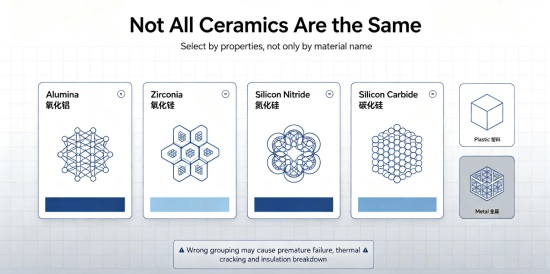
Many buyers view technical ceramics as if they’d look for a single type of material -as if “ceramic” were one option from plastics or metals. In reality, alumina zirconia, silicon nitride and silicon carbide, behave differently; grouping them results in costly selection errors that result in premature failure of parts as well as thermal cracking and the breakdown of insulation in service. Selecting the best technical ceramic doesn’t mean picking “a ceramic” — it’s about constantly looking at the mechanical thermal, electrical and chemical properties to the conditions of your operation.
Why Properties of Technical Ceramics Matter
Technical ceramics are a broad range of engineered materials, each one designed to excel under specific circumstances rather than perform in all conditions. Alumina provides a solid combination of toughness and electrical insulation with a low costs; zirconia trades some hardness for an incredibly tougher fracture the silicon nitride and carbide are designed to withstand extreme mechanical and thermal stress. The differences between these two materials in terms of wear resistivity, thermal strength and chemical endurance are typically more significant than the differences that you would find when comparing the different grades of aluminum or steel.
This is why property comparability -not recognition of material names should be the primary driver for selection. A material that is described as “ceramic” alone, without having specific properties that match the requirements’ mechanical loads or temperature range as well as chemical exposure is an unproven assumption. The best approach begins by finding out which properties are important to your specific application and then comparing the candidate materials against the benchmarks you have identified.
Mechanical Properties to Compare
Mechanical properties determine whether ceramic components can withstand their working environment or fails when under stress.
Hardness shows how strongly a material resists wear. This matters when a part faces sliding contact. It also matters with scraping and cutting actions. Alumina and silicon carbide are both hard ceramic materials. For that reason, people use them in cutting tools. They are also used for liners that must handle abrasion.
Flexural Strength
The strength of a material is measured by its ability to resist bending force prior to the material is fractured. This directly impacts a material’s load-bearing capability, which is especially crucial in components that are subject to the stress of assembly and in operation.
Fracture toughness measures resistance to crack propagation — essentially, how forgiving a material is once a small flaw exists. Zirconia is noteworthy in this regard as it has three to two times the strength of fractures as Alumina, which makes it the most preferred choice when impact resistance is more important than raw strength, despite the higher cost of its material.
Thermal Properties to Compare
Ceramics with thermal behavior are often distinguished which perform well from those that break or break under operating conditions.
Thermal Conductivity
Based on the purpose depending on the application, you might require an element that can conduct heat effectively (as in electronic substrates and heat sinks) and is resistant to the transfer of heat (as for thermal components).For instance, aluminum nitride offers substantially higher thermal conductivity than standard alumina, making it a common substitute in electronics cooling applications.
Thermal Expansion Coefficient
When ceramic components are joined with metal components — such as housings, seals, or bonded assemblies the wrong thermal expansion rates could cause stress fractures in cooling and heating cycles. The comparison of the expansion coefficients of candidate ceramics as well as mating materials is crucial to ensure long-term reliability.
Maximum Operating Temperature
Ceramics are highly valued for their high temperature stability, however the threshold varies considerably according to the material. Silica carbide and Nitride maintain the strength of their mechanical properties at temperatures far over what zirconia and alumina can handle, which makes them the preferred choice for furnace components as well as the high temperature industrial machinery.
Electrical & Chemical Properties to Compare
Two property categories are frequently overlooked by buyers focused only on mechanical strength — often to their cost.
Electrical Insulation
For electrical and electronic uses, the dielectric strength as well as electrical resistance are the most important elements. The excellent properties of insulating Alumina is precisely the reason it’s the standard in electronic substrates as well as insulating components used in equipment with high voltage.
Chemical and Corrosion Resistance
In the chemical production, processing and other environments that are corrosive, resistance to alkalis, acids and other reactive gases may be more important than the mechanical strength by itself. Zirconia and silicon carbide generally provide superior chemical resistance in comparison to alumina. This could be the difference between alumina and silicon in corrosive processing conditions.
Property Comparison at a Glance
| Material | Hardness | Fracture Toughness | Max. Operating Temp. | Electrical Insulation | Typical Applications |
| Alumina (Al₂O₃) | High | Moderate | ~1,600°C | Excellent | Electronic substrates, wear parts |
| Zirconia (ZrO₂) | Moderate–High | High | ~1,200°C | Good | Structural parts, cutting tools, seals |
| Silicon Nitride (Si₃N₄) | High | High | ~1,400°C | Good | Bearings, high-stress components |
| Silicon Carbide (SiC) | Very High | Moderate | ~1,600°C+ | Semiconducting | High-temperature, abrasive environments |
(The values are typical of the industry and may vary depending on the quality and manufacturing process. always verify exact specifications with the technical datasheets from your supplier. )
Matching Properties to Your Application
Instead of using this as a way to increase the effectiveness all aspects of the process, proper choice is about prioritizing properties most important to the specific application you are considering:
- Structure or wear-resistant components are rated for strength and toughness to fractures as high hardness by itself could mean brittleness when struck.
- High-temperature environments — prioritize maximum operating temperature and thermal shock resistance over cost savings on lower-grade materials.
- Electronic or insulating components — prioritize dielectric strength and thermal conductivity appropriate to heat dissipation needs.
- Chemical processing or corrosive environments — prioritize chemical resistance even where it means trading off some mechanical hardness.
Once these priorities are clearly defined the material selection becomes a much more narrow and evidence-based choice, instead of a guess based on the general perception.
The process of selecting the best technical ceramic begins with understanding it is “ceramic” is not a one-off material. It’s a collection of engineered solutions identified by a distinct mix of thermal, mechanical chemical, and electrical characteristics. The ability to compare candidates to the needs of your particular application and not settling on the most common material is what differentiates a component that lasts for years and from one that is prone to failure early. When you have applications that require exact manufacturing and material matching using a skilled technical ceramics producer like Jifeng Ceramics will help you translate these properties into a specific specification of the component that is tailored to your specific operational requirements.
