 JiFeng Ceramics

Metal components are widely used in industrial equipment because they generally offer high strength, good toughness, good machinability, and relatively mature manufacturing costs. For many applications, metals remain a practical and reliable material choice.
However, not all working environments are suitable for metal components. In working conditions that require high hardness and wear resistance, corrosion resistance, insulation, high-temperature resistance, and lightweight properties, and that do not involve strong impacts or plastic deformation, ceramic components should be used instead of metal components.
Ceramics (industrial ceramics/structural ceramics) far surpass most metals in hardness, corrosion resistance, and insulating properties, so replacing metals with them in specific scenarios can significantly improve equipment service life and safety. However, ceramics are highly brittle and have almost no plasticity, so there are clear boundary conditions for substitution.
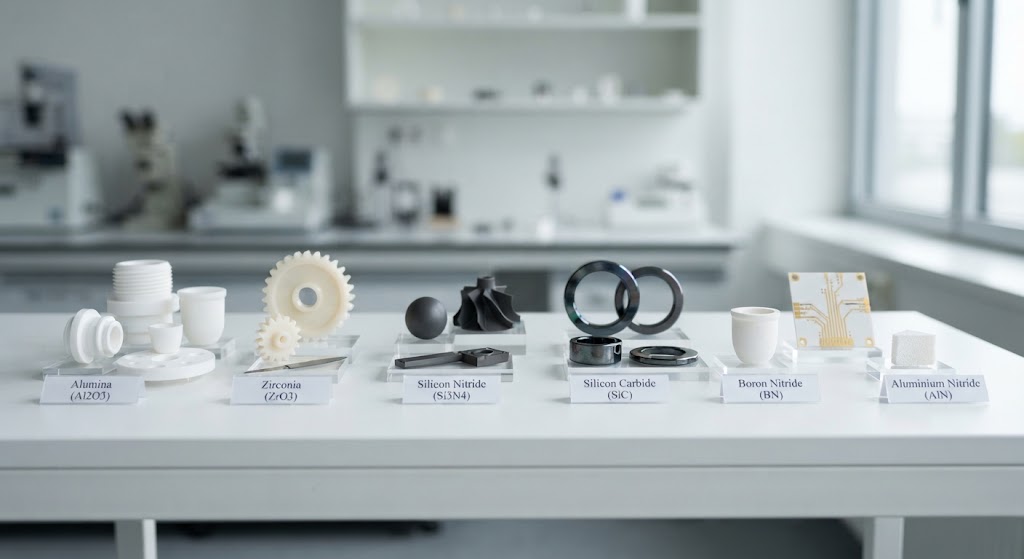
When Should You Consider Replacing Metal with Ceramic?
Ceramics are not a universal substitute for metals. Whether replacement is suitable mainly depends on the working environment of the component and the performance limitations currently faced by the metal material.
When an application has high requirements for wear resistance, corrosion resistance, electrical insulation, high-temperature resistance, or material stability, and mechanical impact is not the main load, technical ceramics are usually worth including in material selection.
Wear-resistant or erosion-resistant working conditions
For components subjected to long-term friction, sliding, or particle erosion, ceramics can be an alternative to metal wear-resistant parts.
For example, wear-resistant bushings, sliding shaft sleeves, guide sliders, and ceramic wear-resistant liners can be made from materials such as alumina, zirconia, and silicon carbide according to the specific working conditions.
In media such as mineral slurry, ash slag, and other substances containing solid particles, metal surfaces may be continuously subjected to abrasive particle erosion. High-hardness ceramics can reduce the wear rate of the material surface, so they are suitable for scenarios with high requirements for wear-resistant service life.
It should be noted that ceramic wear-resistant parts are more suitable for continuous friction and erosion than for strong impacts. If the working conditions also involve large impact loads, the ceramic material and structural design need to be re-evaluated.
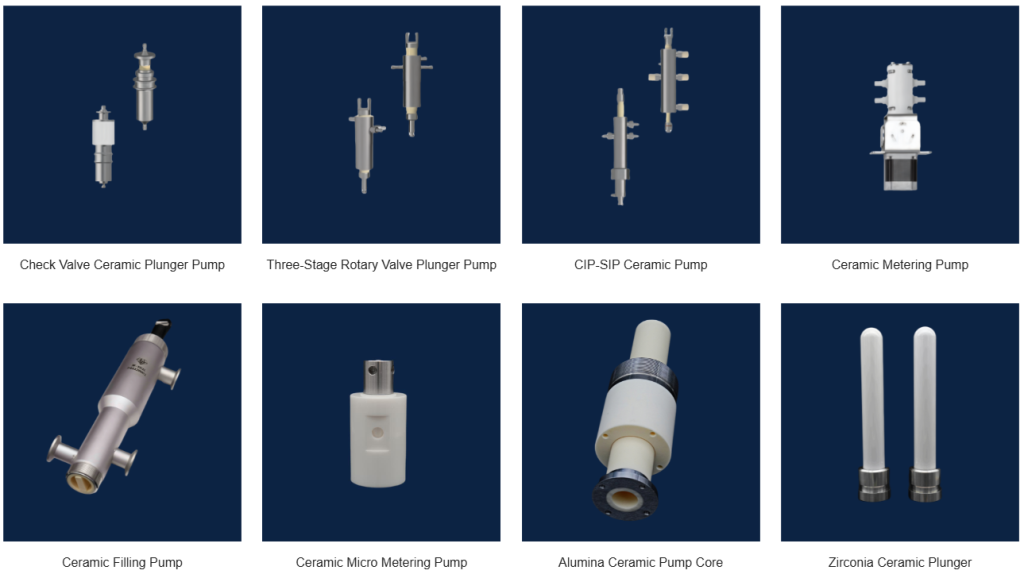
For precision moving parts such as ceramic plungers and pump cores, ceramics can also combine high hardness and precision machining capabilities, playing a role in applications with high requirements for wear resistance and dimensional stability, such as lithium battery slurry and pharmaceutical filling.
2. Corrosion-resistant or sealing working conditions
When components are exposed to corrosive media for a long time, metals may face problems such as corrosion, surface damage, and sealing failure.
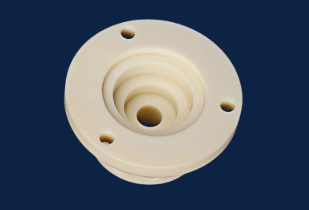
In such cases, ceramic sealing rings, valve cores, and structural parts made of materials such as silicon carbide and zirconia can be considered.
Ceramic materials have good chemical stability. Under suitable media and working conditions, they can reduce the impact of corrosion on the dimensions and surfaces of components.
Such applications are commonly found in chemical equipment, fluid control systems, pumps and valves, laboratory equipment, and some marine and harsh-environment equipment.
For precision seals, the corrosion resistance of the material itself is only one factor. Conditions such as flatness, surface roughness, fitting accuracy, pressure, temperature, and sealing medium also need to be considered at the same time.
3. Working conditions requiring electrical insulation
If metal components perform fixing, supporting, isolating, or positioning functions in equipment while also being in high-voltage or electrical environments, the conductivity of metal may become a limiting factor.
Many industrial ceramics have good electrical insulation properties, so they can be used for insulating terminals, supporting parts, isolating parts, insulating sleeves, and structural parts of high-voltage equipment.
In new energy, high-voltage electrical, electronic equipment, and semiconductor equipment, ceramics can provide electrical isolation while also performing mechanical support functions.
For structural parts that need to avoid leakage, short circuits, or unnecessary current conduction, ceramics often meet application requirements better than conductive metals.
4. Operating conditions requiring high temperature and dimensional stability
When components need to be exposed to high-temperature environments for a long time, or when temperature changes may affect equipment dimensions and positioning accuracy, suitable technical ceramics can be considered.
Some ceramic materials have good high-temperature stability and can maintain relatively stable performance in high-temperature environments. Therefore, they can be used for structural parts in semiconductor equipment, heat treatment equipment, vacuum equipment, and other high-temperature industrial equipment.
For example, materials such as aluminum nitride and silicon carbide can be used for high-temperature structural and insulating parts according to specific application requirements.
In addition, in precision equipment, if the thermal expansion of metal materials affects the clearance, positioning, or alignment between parts, ceramic materials can also be considered based on the coefficient of thermal expansion and working temperature.
It should be noted here that the high-temperature resistance of ceramics does not mean that all ceramics are suitable for extreme high-temperature environments. Practical applications also need to consider the temperature range, thermal cycling, mechanical load, and thermal shock conditions.
5. Operating conditions requiring lightweighting or special material properties
In aerospace, automotive, new energy, and high-end industrial equipment, components often need to simultaneously meet requirements for weight, temperature resistance, wear resistance, and dimensional stability.
In some specific structures, advanced ceramics can serve as a material solution other than metals to achieve lightweight design or improve high-temperature performance.
However, lightweight design is not the only reason to choose ceramics. Engineering design needs to comprehensively consider material density, strength, toughness, structural dimensions, and actual loads. It cannot simply be assumed that “ceramics are necessarily lighter than metals.”
6. Working conditions with special requirements for biocompatibility or metal ion release
In the medical field, some ceramic materials can be used for specific applications such as artificial joints and dental implants.
For example, materials such as zirconia have good biocompatibility and also have wear-resistant and corrosion-resistant properties. In certain applications that require reduced metal ion release or have special requirements for material compatibility, ceramics can be a material option.
Such applications usually have higher requirements for material purity, machining accuracy, and surface quality, so they need to be evaluated according to specific medical standards and usage environments.
When Should You Not Replace Metal with Ceramic?
Although ceramics offer distinct advantages in terms of wear resistance, corrosion resistance, electrical insulation, and performance in high-temperature environments, they are not suitable for all mechanical operating conditions.
If the primary function of a component involves withstanding impact, absorbing vibration, undergoing plastic deformation, or enduring significant tensile and torsional loads, metals generally still possess more suitable material properties.
For example:
| Prohibited Operating Conditions | Reasons |
| Subject to impact or heavy-load collisions | Ceramics are highly brittle and prone to chipping or cracking. |
| Applications requiring welding, or threaded connections subject to massive tensile and torsional loads | Ceramic threads have low strength and are difficult to weld. |
| Applications requiring plastic deformation or vibration absorption | Ceramics possess almost no plasticity. |
Furthermore, if the operating environment for the components is relatively mild—free from significant high temperatures, wear, corrosion, or specific insulation requirements—and metals already meet the necessary service life and performance standards, there is no need to force a switch to ceramics; traditional metal processing may well be more economical and convenient.
Ultimately, the decision to use ceramics should be based on actual performance requirements and the total cost of use, rather than a mere pursuit of material upgrades.
Customized Ceramic Structural Components for Industrial Applications
For many industrial equipment, standard ceramic parts may not fully meet the requirements in terms of size, tolerance, or performance. At such times, customized ceramic structural components can be used to meet the specific needs of the equipment or production process.
The typical manufacturing process for customization may include drawing evaluation, material selection, ceramic molding, sintering, precision machining, surface treatment, and size inspection.
When making inquiries, the purchasing personnel should preferably provide as complete information as possible, including product drawings or CAD files, dimensions, tolerances, working temperature, mechanical load, chemical environment, surface roughness requirements, and the estimated purchase quantity.
This information can help ceramic manufacturers evaluate suitable materials and manufacturing processes based on actual applications, rather than simply selecting based on the general performance parameters of the materials.
Summary
When the existing metal components are limited by factors such as high temperature, wear, corrosion, electrical conductivity, dimensional stability or contamination control, ceramic components can be considered as an alternative.
Meanwhile, if the application places greater emphasis on toughness, impact resistance, ease of traditional processing or cost, metal may still be a more suitable choice.
Therefore, the choice between metal and ceramic should not be based solely on the performance of a single material, but should take into account the complete working environment and component requirements comprehensively.
For industrial applications that require customized dimensions, strict tolerances or specific material properties, communication with professional ceramic manufacturers can be conducted to assess whether technical ceramics such as alumina, zirconia, silicon carbide or others are suitable for the application based on actual working conditions.
