 جيفينج سيراميك

المعدن يتآكل. يذوب البلاستيك. في مصانع أشباه الموصلات, المحركات النفاثة والمفاعلات الكيميائية, ومن المتوقع أن تتحمل المكونات درجات حرارة تتجاوز 1000 درجة مئوية للتآكل المستمر, وكذلك المواد الكيميائية المسببة للتآكل لعقود من الزمن دون فشل. هذه هي بالضبط الفجوة التي تم تصميم الأجزاء الخزفية التقنية لسدها. على عكس السيراميك الذي تراه موجودًا في خزانة المطبخ، فهي عبارة عن مكونات دقيقة متينة مصنوعة للبيئات الصناعية التي تتطلب الكثير من الجهد. يشرح هذا الدليل أساسيات ماهيتها وكيفية إنشائها ومكان استخدامها وأفضل طريقة لاختيار أفضل الموردين.
ما هي أجزاء السيراميك الفنية?
Ceramics are picked because they’re supposed to handle extreme heat. هكذا, it seems inconsistent for ceramic parts to crack during repeated temperature swings rather than long-term high heat exposure. Unfortunately, thermal cycling doesn’t fail ceramics solely through heat – rather, stress does the trick: every temperature change generates internal tension that eventually exceeds what the material can tolerate, leading to crack formation – understanding where this stress comes from is key for creating durable parts that last years instead of failing within weeks.
The Short Answer: Thermal Stress Exceeds the Material’s Fracture Toughness
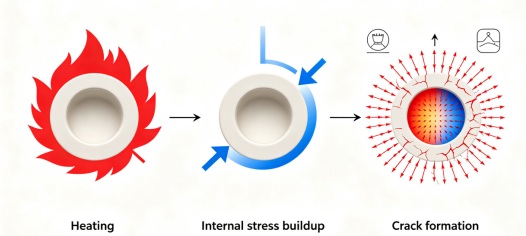
Ceramic parts break under thermal cycling as internal stresses build up more rapidly than the material is able eliminate them. If this pressure is greater than the component’s crack toughness, which is its inherent limit to stop crack growth – failure occurs. سيراميك, unlike ductile metals can’t bend or deform to withstand the impact. The result is sudden, often catastrophic cracking rather than gradual bending or warping. There are a variety of factors that determine when a component reaches its breaking point, such as the composition of the material, its microstructure as well as the history of machining and sintering as well as the general cooling or heating rate.
Why Ceramics Are Especially Vulnerable to Thermal Cycling
Brittle Fracture vs. Ductile Deformation
Metals take in thermal stress via plastic deformation. Atoms slide over one another and the metal part bends rather than breaking. Ceramics don’t have this slip mechanism. Their strong covalent and ionic bonding make them tough and rigid, however the same rigidity also means that stress can’t go anywhere beyond crack the beginning. Once a microcrack has begun the brittle material offers very little resistance to the propagation of the crack.
The Role of Thermal Expansion Coefficient (مرض الاعتلال الدماغي المزمن) Mismatch
Each material contracts and expands at a certain speed as temperatures change which is also known as their coefficient of thermal extension (مرض الاعتلال الدماغي المزمن). There are issues when different areas of a piece -or a ceramic component that is bonded to a fixture made of metal – expand at different rate. Alumina is a good example. It has a CTE about three times as high than silicon Nitride. If a ceramic piece joins with metal or if one part of a part is heating more than the other and this causes localized stress concentrations right the place where cracks are most likely to begin.
The Main Mechanisms Behind Thermal Cracking
Thermal Shock Resistance Limits
Each ceramic has a minimum temperature differential (DT) that it is able to tolerate before cracking. This is the reason for its resistance to thermal shock. Rapid cooling or heating that is caused by heating a hot object in cold conditions can push the core and surface temperatures apart more quickly than heat is able to pass through the material. The surface expands or contracts and the core stays behind and causes tensile stress on the point where cracks often begin.
Microstructural Defects and Porosity
Ceramics with high-quality materials can contain tiny imperfections, such as residual pores and grain boundary irregularities or inclusions resulting during the sintering procedure. These imperfections act as stress concentration factors. A solid, well-intergrown piece with a low porosity distributes the stress much more evenly than a piece that has voids that are hidden. This is the reason why control of sintering and post-sinter inspection is in the same way as choosing the right material.
Residual Stress from Sintering or Machining
Sintering rates that cool during sintering and mechanical stresses created by CNC cutting or grinding may result in residual stress being in a part that is not released to the outside. This stress is not visible under normal conditions, but it adds directly onto the thermal strain created during cycling, making the part’s safety margin, which is lower than the theoretical toughness of fracture.
Geometry and Stress Concentration
Internal corners that are sharp, abrupt variations in wall thickness and tiny drilled holes add stress much higher than an even and gradually changing geometric. A piece with a consistent cross-section is often able to withstand thermal cycling, which can cause a fracture in a part with a sharp edge or a thin section.
أيّ مواد السيراميك Handle Thermal Cycling Best?
The performance of thermal cycling varies greatly across different ceramic families, and is largely driven by CTE and thermal conductivity and the strength of fractures.
| مادة | مقاومة الصدمات الحرارية | Typical Use Case |
| الألومينا (آل₂O₃) | Moderate | Cost-effective insulators, ارتداء أجزاء |
| زركونيا (زرو₂) | Lower — sensitive to rapid ΔT | High-strength structural components |
| نيتريد السيليكون (Si₃N₄) | عالي | الفضاء الجوي, high-cycle industrial parts |
| كربيد السيليكون (كربيد كربيد) | عالي | High-temperature, high-conductivity environments |
| نيتريد الألومنيوم (آل ن) | Moderate-high | Thermal management, semiconductor equipment |
Silicon carbide and silicon nitride generally outperform zirconia and alumina in thermal cycling because they have lower CTE and better thermal conductivity that lets heat flow evenly across the component faster and lessens the temperature gradient which causes cracking.
How to Prevent Cracking From Thermal Cycling
Cracking is usually not due to a single cause. This means that prevention is addressing the material, process and design
- Select materials that have lower CTE and better fracture toughness in applications that have high or frequent temperature fluctuations.
- Control cooling and heating rates to remain within the material’s limits for thermal shock instead of over-extending the limits of DT.
- Improve part geometry to reduce sharp edges and abrupt thickness changes that cause stress.
- Apply stress-relief measures like controlled cooling profiles while sintering to ease residual stress before the part goes into service.
- Sintering should be kept in tight as well as quality monitoring because of the high porosity and a consistent grain structure can increase the resistance against thermal fatigue.
When to Consult a Ceramic Manufacturer Before Finalizing Your Design
Design of the material, its structural and sintering procedure are not separate d material that has excellent thermal shock resistance could fail if its geometry focuses stress or if sintering leaves a lot of porosity. Engineering teecisions. Aams achieve the most effective outcomes by working with a company that has in-house R&د, sintering and high-precision machining capabilities during the early design process, and not trying to fix broken parts after production has begun.
التعليمات
Can all ceramics withstand rapid temperature changes?
لا. Thermal shock resistance varies widely by material — silicon nitride and silicon carbide generally tolerate rapid ΔT far better than alumina or zirconia.
What is the term thermal shock resistance of ceramics?
It’s the largest temperature difference an object can endure without cracking, as measured using its thermal conductivity CTE, elastic modulus and crack toughness.
Does the thickness of the ceramic affect cracking risk in thermal cycling?
نعم. Thicker sections cause more intense internal temperature gradients when it comes to rapid cooling or heating which can cause stress, compared with smaller geometric shapes that are more uniform.
Does silicon nitride perform better than Alumina in applications for thermal cycling?
In most high-cycle or rapid-temperature-change environments, yes – its lower CTE and higher thermal conductivity reduce the stress generated during each cycle.
Thermal cracking is ultimately the product of material properties, part geometry, and manufacturing precision working together — or against each other. If you’re specifying ceramic parts for a demanding thermal environment, جيفينج سيراميك’ in-house R&د, تلبيد, and precision machining capability can help you select the right material and design before production begins. Get a quote to discuss your application.
