 Céramique JiFeng

Les composants céramiques avancés deviennent indispensables dans les nouveaux équipements énergétiques. Alors que la transition énergétique mondiale s’accélère, batteries lithium-ion, production d'énergie photovoltaïque, systèmes d'énergie à hydrogène, et les véhicules électriques exigent des matériaux capables de résister à des conditions extrêmes. Céramiques avancées, avec leur résistance supérieure à l'usure, résistance à la corrosion, isolation électrique, et stabilité à haute température, remplacent de plus en plus les métaux traditionnels dans les nouveaux équipements énergétiques critiques.
Pourquoi les céramiques avancées sont essentielles pour les équipements liés aux nouvelles énergies
Les nouveaux équipements énergétiques doivent généralement fonctionner pendant une longue période dans des conditions complexes telles que des températures élevées., haute pression, friction à grande vitesse et corrosion chimique. Les pièces métalliques traditionnelles sont sujettes à des problèmes tels que l'usure, corrosion, problèmes de conductivité électrique et contamination par des particules métalliques, ce qui peut affecter la stabilité et la qualité de l'équipement.
En revanche, céramique avancée ont les avantages suivants:
- Excellente résistance à l'usure, ce qui peut prolonger considérablement la durée de vie des composants et réduire la fréquence de maintenance des équipements.
- Résistance exceptionnelle à la corrosion, capable de résister aux acides, alcalis, électrolytes et divers milieux chimiques.
- Bonnes propriétés d'isolation électrique, répondre aux exigences de sécurité d’isolation des équipements des énergies nouvelles.
- Stabilité à haute température, maintenir de bonnes propriétés mécaniques et une précision dimensionnelle dans les environnements à haute température.
- Faible contamination par les particules, réduisant la génération d'impuretés pendant le processus de production et améliorant la cohérence du produit.
- Coût total du cycle de vie réduit, même si l'investissement initial est élevé, grâce à une longue durée de vie et moins d'entretien, cela peut réduire les coûts d’exploitation globaux.
Ces caractéristiques font des céramiques avancées un matériau important pour améliorer la fiabilité et l’efficacité de production des nouveaux équipements énergétiques..
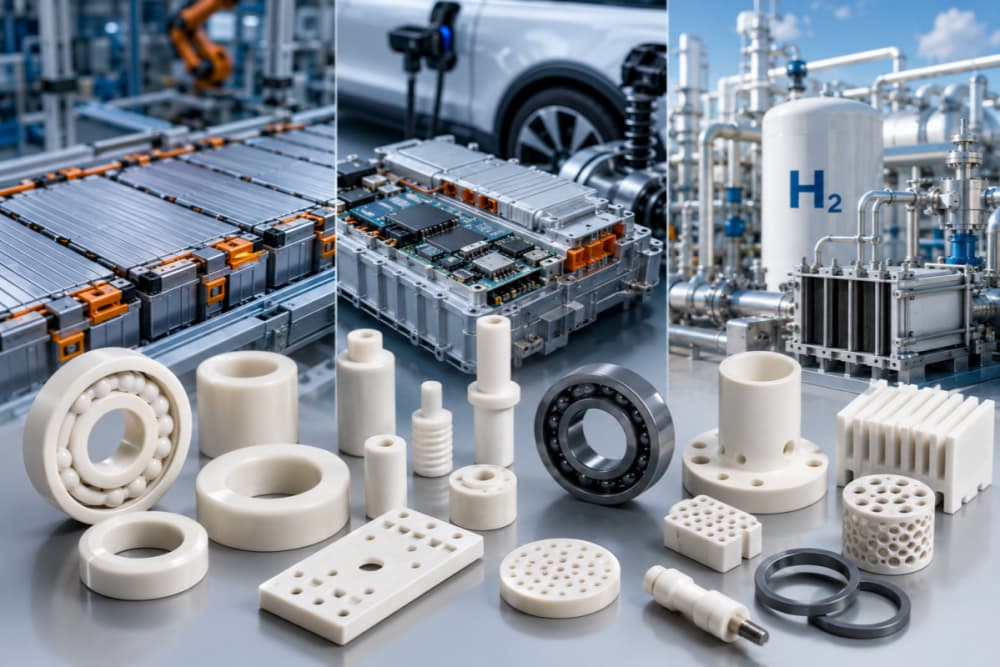
Applications clés des céramiques avancées dans les équipements de nouvelles énergies
Les céramiques avancées couvrent de nombreux domaines clés de la nouvelle industrie énergétique, jouer un rôle important dans l’amélioration des performances des équipements et assurer la stabilité de la production.
| Nouveau secteur énergétique | Principales applications | Valeurs |
| Batteries lithium-ion | Rouleaux de guidage, buses, pistons en zircone, matériaux de revêtement de diaphragme, électrolytes solides | Améliorer la précision de la production, réduire la pollution, et améliorer la durée de vie et la sécurité |
| Photovoltaïque (PV) | Supports en céramique de carbure de silicium, plaques d'aspiration en alumine, substrats céramiques cuivrés | Améliorer la précision du traitement des plaquettes de silicium, prolonger la durée de vie de l'équipement, et améliorer la fiabilité de l'onduleur |
| Véhicules électriques (VÉ) | Roulements en nitrure de silicium, Substrats céramiques IGBT, isolateurs en céramique, condensateurs | Répondre aux exigences de la haute tension, haute température, et densité de puissance élevée, et améliorer la dissipation thermique et les performances d'isolation |
| Énergie hydrogène | Isolateurs de cellules électrolytiques, électrolytes de zircone, joints en céramique, garnitures mécaniques | Améliorer la résistance à la corrosion, performances d'étanchéité, et stabilité opérationnelle à long terme |
Alors que les technologies d’énergie propre continuent de progresser, la gamme d’applications céramiques devrait encore s’élargir.
Comment choisir le bon matériau céramique avancé pour les nouvelles applications énergétiques
Face à une grande variété de céramiques avancées, comment effectuer des sélections précises basées sur des scénarios d'application spécifiques est une question clé dans la mise en œuvre de l'ingénierie. Au moment de choisir, les dimensions fondamentales suivantes doivent être prises en compte de manière globale:
Indicateurs clés de performance
- Conductivité thermique: Pour les scénarios de dissipation thermique à haute puissance, nitrure d'aluminium (170–230 W/mK) ou du nitrure de silicium à haute conductivité thermique doit être sélectionné.
- Résistance mécanique et ténacité: Lorsqu'il est soumis à des vibrations, impact, ou cycle de température, nitrure de silicium (résistance à la flexion de 600 à 1 000 MPa, haute ténacité) est supérieur au nitrure d’aluminium et à l’oxyde d’aluminium.
- Coefficient de dilatation thermique (CTE): Il doit correspondre à des copeaux ou des composants métalliques pour réduire le stress thermique. Le CTE du nitrure de silicium est d'environ 3,0–2×10⁻⁶/℃, proche du SiC; le CTE du nitrure d'aluminium est d'environ 4,5 × 10⁻⁶/℃, qui correspond mieux au silicium.
- Isolation électrique et propriétés diélectriques: Pour les scénarios d'isolation haute tension, une résistance élevée aux pannes et une faible perte diélectrique sont requises.
- Résistance à la corrosion et stabilité chimique: Dans des environnements tels que les batteries, piles à combustible, et l'énergie éolienne offshore, ces aspects doivent être soigneusement examinés.
- Coût et transformabilité: L'alumine a le rapport coût-performance le plus élevé et une technologie de traitement mature; le nitrure d'aluminium et le nitrure de silicium ont des coûts plus élevés mais de meilleures performances.
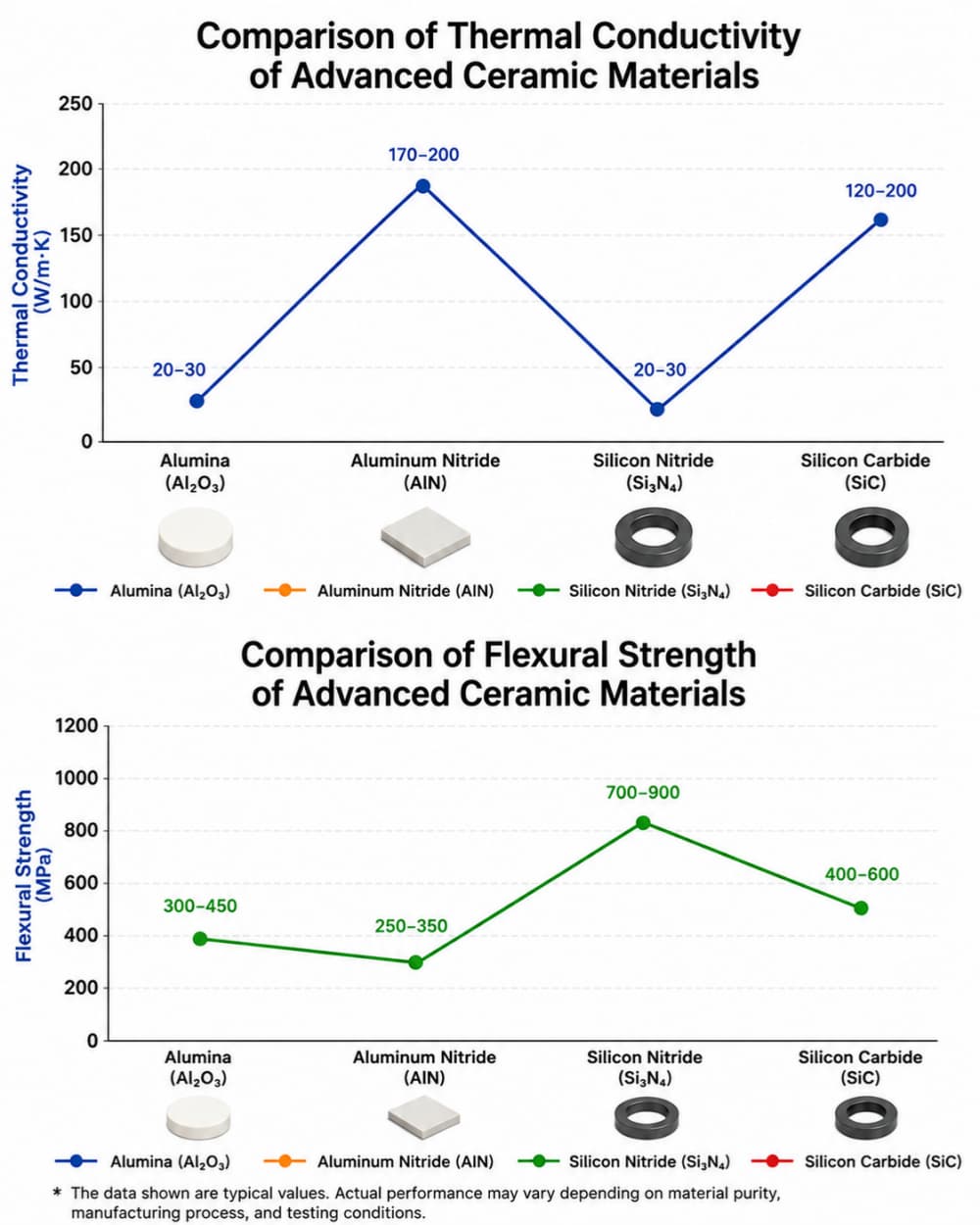
Comparaison et recommandation de matériaux communs
| Matériels | Conductivité thermique (W/m·K) | Résistance à la flexion (MPa) | Principaux avantages |
| Alumine | 20–30 | 300–400 | Faible coût, processus mature |
| Nitrure d'aluminium | 170–230 | 250–350 | Conductivité thermique extrêmement élevée, compatible avec le silicium |
| Nitrure de silicium | 60–90 | 600–1000 | Haute résistance, haute ténacité, résistant aux chocs thermiques |
| Carbure de silicium | 120–200 | Haut | Résistance aux hautes températures, résistance à l'usure, conductivité thermique élevée |
| Oxyde de zirconium | Inférieur | Haute ténacité | Conductivité ionique, stabilité chimique |
Lors de la sélection des matériaux, facteurs tels que la température de fonctionnement, milieu chimique, charge mécanique, exigences d'isolation électrique, et la précision du traitement doit être prise en compte de manière globale pour obtenir les meilleures performances globales.
Tendances de développement futures
Alors que le secteur mondial des nouvelles énergies continue de se développer, le marché des céramiques avancées maintient une croissance constante. Les nouvelles énergies sont devenues l’un des domaines d’application les plus prometteurs.
À l'avenir, les céramiques avancées auront plus d'opportunités de développement dans les directions suivantes:
- Piles à semi-conducteurs: Favoriser le développement des électrolytes solides, matériaux de revêtement de séparateur, et équipements de fabrication à haute température.
- 800V plateforme de véhicules à énergie nouvelle: Stimuler la croissance continue de la demande de dispositifs d'alimentation SiC, substrats en céramique, et matériaux isolants.
- Industrie de l'hydrogène vert: Équipement de base tel que SOFC, OSEC, et les électrolyseurs PEM élargiront encore l'application de matériaux céramiques avancés comme la zircone et le carbure de silicium..
- Fabrication intelligente: La demande de composants céramiques de haute précision et à longue durée de vie sur les lignes de production automatisées et numériques est en constante augmentation.
Alors que les nouveaux équipements énergétiques continuent d’évoluer vers une plus grande efficacité, durée de vie plus longue et plus grande fiabilité, les céramiques avancées joueront un rôle de plus en plus important tout au long de la chaîne industrielle.
Conclusion
Les céramiques avancées ne constituent pas seulement une partie importante des nouveaux équipements énergétiques, mais ce sont également les matériaux clés qui conduisent à la modernisation technologique de la nouvelle industrie énergétique. Des piles au lithium, de la fabrication photovoltaïque aux véhicules à énergie nouvelle et aux équipements énergétiques à hydrogène, céramique avancée, avec leurs excellentes propriétés telles que la résistance à l'usure, résistance à la corrosion, résistance aux hautes températures et isolation électrique, fournir de solides garanties pour le fonctionnement stable de l'équipement et la qualité des produits.
À l'avenir, alors que la transition énergétique mondiale se poursuit et que la nouvelle industrie énergétique se développe rapidement, les céramiques avancées seront appliquées dans des équipements plus haut de gamme, fournir des solutions matérielles plus fiables et efficaces pour le développement de haute qualité de la nouvelle industrie énergétique.
