 Céramique JiFeng

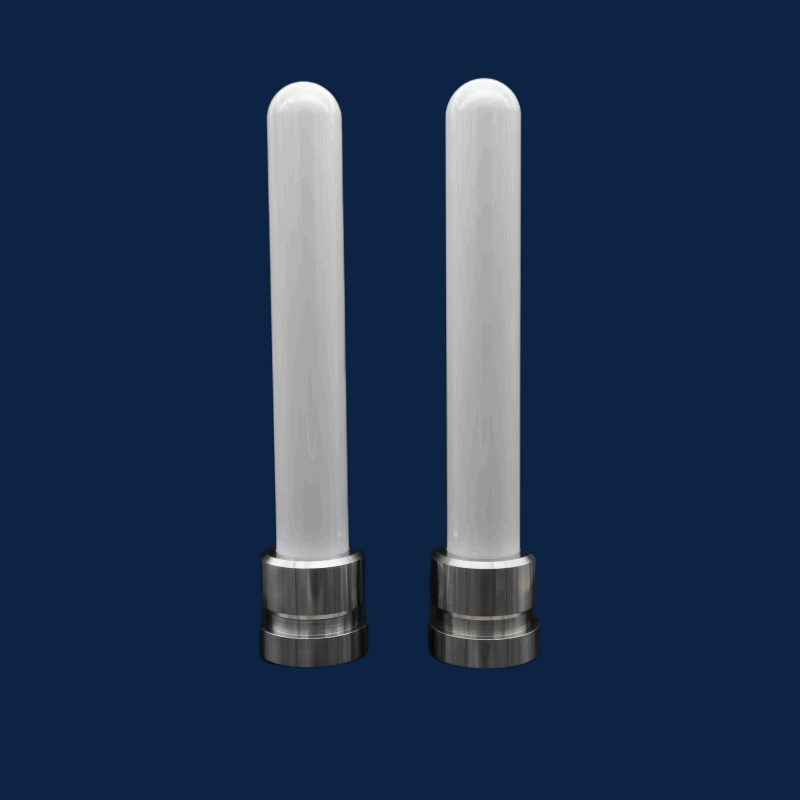
La majorité des personnes qui dépannent une pompe haute pression défectueuse examinent d'abord le corps de la pompe et les joints., or even the pump’s motor. Très rarement, ils commencent par regarder le piston. Pourtant dans une pompe alternative, the plunger is what’s performing the most work. It’s doing many thousands of high-pressure strokes every day, continuous interaction with sealing surfaces, and direct contact with whatever fluid is moving. If leaks or precision drifts begin to appear in the material of the plunger, it’s usually the reason. This is why more pumps that are high-pressure and precise-dosing are constructed around ceramic plungers rather than metal.
Why the Plunger Is the Most Stressed Part in a High-Pressure Pump
A plunger doesn’t just push fluid — it slides back and forth against a seal thousands of times per hour, holding pressure on one stroke and drawing fluid in on the next. That constant reciprocating friction, combined with the fluid it’s in direct contact with, makes it the component most likely to wear, corrode, or lose dimensional accuracy over time. And because plunger diameter directly determines the volume delivered per stroke, even a few microns of wear can shift a pump’s output — a serious problem in metering and filling applications where dosing accuracy is the entire point. Autrement dit, the plunger’s material isn’t a minor spec. It’s the variable that decides how long the pump holds its performance.
The Core Properties That Make Ceramic Plungers Perform Under Pressure
Exceptional Hardness and Wear Resistance
Technical ceramics such as alumina and zirconia rank at or near the top of Mohs hardness scale — typically around 9, just behind diamond — thus offering greater resistance against wear that rounds off metal plungers over time. This allows longer intervals between plunger replacements despite continuous high-cycle operation.
Chemical Inertness Against Aggressive Media
Metal plungers are prone to corrosion and pitting when exposed to solvents, acids or aggressive dosing chemicals and corrosive substances. The damage begins at the microscopical level and continues to grow until the seal can no longer hold pressure properly. Ceramics have chemically impervious properties over many different media, which is the reason they appear frequently in dosing pumps that handle corrosive chemical fluids which will slowly reduce the quality of stainless steel.
Dimensional Stability Under Pressure and Thermal Cycling
The expansion and deformation of ceramic materials is much less contract smaller than metals under repeated temperature and pressure cycling. In the case of a filling or metering pump, this stability keeps the flow of liquid constant stroke after stroke every month, instead of slipping when the plunger’s dimensions alter with wear and thermal expansion.
Smooth, Low-Friction Surface Finish
A properly-finished ceramic plunger has less friction with the seal than many metals, reducing wear and tear on the seals at both ends of contact. Aussi, it reduces the amount of particulate matter leaking into the stream — an aspect that is vitally important in cases where the purity of the product is a must.
Ceramic vs Metal Plungers: What Actually Changes
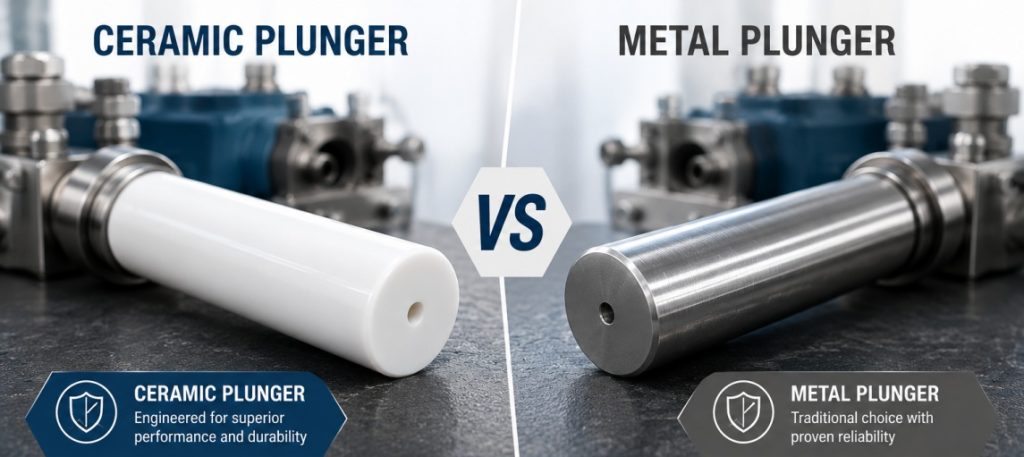
Metal plungers are prone to failure in various predetermined ways: pitting corrosion caused by aggressive chemicals or galling as two hard metal surfaces are pushed against one the other under pressure, and eventually wear which allows fluid to escape the seal when pressures are higher. Each of these signs appear in the same way of decreased accuracy of the pump and a decrease in the accuracy of the pump is evidently damaged. Ceramic plungers tackle wear and corrosion failure modes directly via material toughness and chemical resistance and can largely prevent galling since ceramic-on-ceramic or ceramic-on-elastic contact operates quite differently from metal-on-metal. Ceramics are more brittle than metal and less resilient to stress or improper installation. This is the reason why the design of the plunger and the precision of machining are more than the choice of material.
Where Ceramic Plungers Matter Most in Real Applications
- Semiconductor high-precision dispensing: at this level, dosing tolerances can be measured in microliters, and any dimensional shift in the plunger will translate directly into a dispense that is not in compliance with the specifications. Dimensional stability isn’t something you can get, as it’s the main need.
- Pharmaceutical filling — Dosing accuracy and contamination control are both regulatory requirements, not preferences. A plunger that resists wear and won’t shed particulate into the product is a baseline requirement here, not an upgrade.
- Chemical dosing — Many dosing fluids are acidic, alkaline, or solvent-based. Ceramic’s chemical resistance keeps the plunger — and the accuracy it’s responsible for — intact over years of exposure that would corrode metal.
- Food and cosmetics manufacturing — Cleaning-in-place (CIP) and sterilization-in-place (SIP) cycles subject components to repeated chemical and thermal stress. Ceramic plungers hold their tolerances through this cycling far better than metal alternatives.
Matching Plunger Material to Pump Design
Material is only half the equation — pump architecture determines how that material performs in practice. A check-valve plunger pump, a metering pump, and a micro-metering pump all place different demands on the plunger: dosing volume, cycle speed, and sealing configuration all vary by design. Choosing ceramic solves the wear, corrosion, and precision problems at the material level, but getting full value from it means pairing the right ceramic grade — alumina for general wear and corrosion resistance, zirconia where higher toughness under pressure is needed — with a pump design built around the specific fluid, pression, and dosing accuracy required.
The plunger is the part of a high-pressure pump under the most continuous stress, and it’s usually the first place performance quietly starts to slip. Ceramic materials address the three failure modes that matter most — wear, corrosion, and dimensional drift — at the same time, which is why they’ve become the standard choice wherever high pressure, aggressive media, and tight dosing tolerances all show up together. For applications where a pump’s accuracy has to hold steady for years rather than months, the plunger material is the detail worth getting right first.
