 JiFeng Ceramics

With the rapid development of semiconductors, medical devices, optics, aerospace, and high-end automation equipment, more and more precision components require processing accuracy down to the micrometer level. For advanced ceramics, a size tolerance of ±0.001mm (±1μm) has become an important indicator for some high-end applications.
However, unlike metals, advanced ceramics have characteristics such as high hardness, high brittleness, and difficulty in processing. Achieving such high processing accuracy cannot be simply accomplished by relying on high-end equipment; instead, it requires coordinated control of materials, processes, equipment, environment, and testing.
So, how is the precise processing of precision ceramics able to consistently achieve a tolerance of ±0.001mm? This article will take you to understand the key technologies involved.
What Does a ±0.001 mm Tolerance Mean?
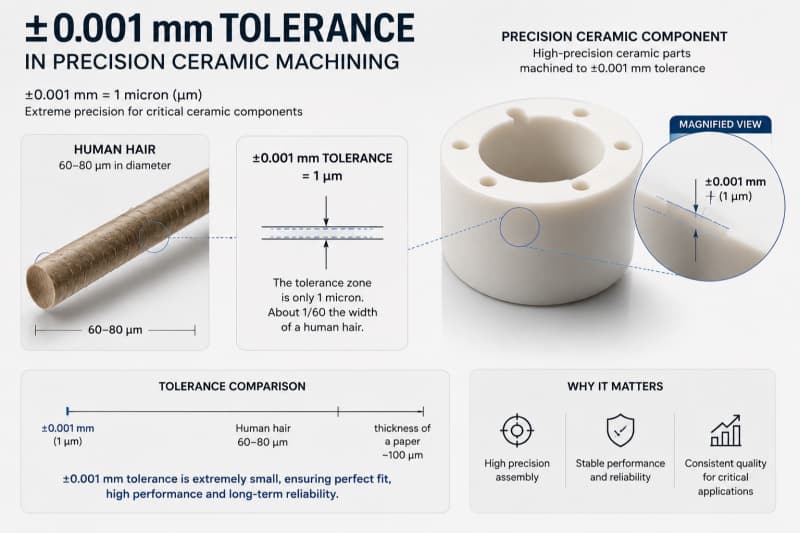
±0.001mm is equivalent to 1 micrometer (1μm). As a reference, the diameter of a human hair is typically around 60 to 80 micrometers. That means, an error of ±0.001mm is only about one-sixth of the diameter of a hair.
For ordinary mechanical parts, such precision might not be necessary. However, for locating pins in semiconductor equipment, supporting structures in optical systems, precision parts in medical devices, and high-precision automated equipment, a micrometer-level dimensional error can directly affect the equipment’s positioning accuracy, product yield, and long-term operational stability.
Therefore, more and more high-end manufacturing fields are beginning to adopt precision ceramic components to meet extremely high requirements for dimensional consistency and long-term stability.
Why Is Precision Ceramic Machining So Challenging?
Compared to metal materials, the processing of advanced ceramics is much more difficult.
Firstly, advanced ceramics have extremely high hardness. Technical ceramics such as alumina, zirconia, silicon nitride, and silicon carbide typically have hardness much higher than ordinary steel, and some materials even approach natural diamond. Therefore, the common cutting methods in traditional metal processing, such as turning and milling, are not applicable to ceramics after sintering.
On the other hand, ceramics are a typical brittle material. During the processing, if the grinding parameters are not properly controlled, edge breakage, micro-cracks, and even local fractures are likely to occur. These defects that are difficult to be detected by the naked eye may gradually expand in the subsequent use process, ultimately affecting the reliability of the components.
In addition, after the sintering of advanced ceramics, there is almost no plastic deformation ability. Once the size deviation exceeds the allowable range, it is difficult to correct it through subsequent processing. Therefore, from raw materials to sintering and finally to grinding, every step must be strictly controlled.
Four Key Technologies Behind ±0.001 mm Precision
The ability to consistently achieve micron-level processing accuracy does not merely rely on a single high-precision equipment; rather, it is the result of the combined efforts of the entire manufacturing process.
1. Post-Sintering Hard Machining
For ceramic parts with extremely high dimensional accuracy requirements, the industry typically adopts the post-sintering hard machining process. After sintering, the ceramics have reached the final hardness and dimensional stability. Then, using diamond grinding wheels for precise grinding can more accurately control the final dimensions.
In contrast, for some complex parts, they are processed in the un-sintered state first, and then sintered. Although this method has higher processing efficiency, during the sintering process, a certain proportion of shrinkage is usually generated. The amount of shrinkage is affected by factors such as the material, sintering temperature, and process conditions, so the control of final dimensions is more challenging.
Therefore, for precision components that require a tolerance of ±0.001mm, post-sintering precision grinding is usually a more reliable processing method.
2. Diamond Grinding Technology
Due to the extremely high hardness of advanced ceramics, ordinary cutting tools cannot maintain stable processing over a long period. Therefore, diamond grinding wheels or diamond abrasives must be used for grinding.
Unlike traditional cutting, ceramic processing is more similar to a process of removing small amounts of material. By reasonably controlling the grinding speed, feed rate, cutting depth, and cooling conditions, it is possible to effectively reduce processing stress, minimize chipping and micro-cracks, and improve dimensional accuracy and surface quality.
For high-end ceramic parts, the surface roughness after grinding is usually at a relatively low level, providing a reliable guarantee for subsequent assembly and long-term operation.
3. High-Precision CNC Equipment
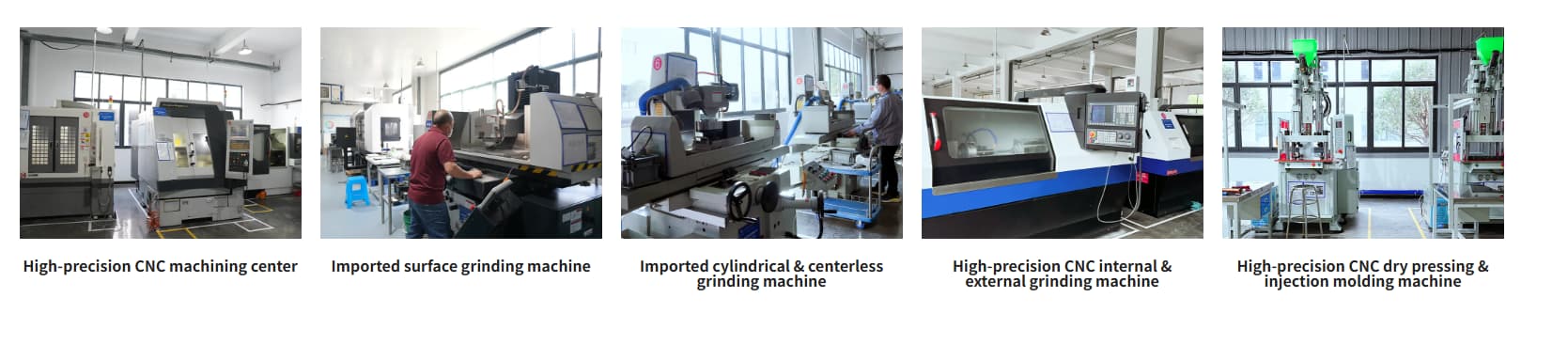
The precision of machining equipment directly affects the final dimensions of ceramic parts. Currently, micron-level ceramic machining typically employs high-rigidity CNC grinding machines, multi-axis machining centers, and high-precision ceramic grinding equipment. These machines possess stable positioning control capabilities, effectively reducing vibration and machining errors.
Meanwhile, high-precision spindles, precision guideways, and automatic compensation systems further improve repeatability, ensuring high consistency across each product in batch production.
For industries such as semiconductors and medical devices, this stable batch consistency is often more important than individual piece precision.
4. Strict Environmental and Process Control
Many people believe that as long as the equipment is advanced enough, high-precision processing can be achieved. In fact, the processing environment is equally crucial.
Even a slight change in the environmental temperature can cause thermal deformation in the machine tool, thereby affecting the control of micrometer-sized dimensions. Therefore, professional ceramic processing enterprises usually adopt constant-temperature processing workshops and use adequate cooling and thermal compensation technologies to reduce the impact of temperature changes.
At the same time, from raw material inspection, sintering control, grinding processing to final size measurement, each process requires strict implementation of quality management procedures to ensure that the products meet the design requirements.
Factors That Affect Ceramic Machining Accuracy
Besides the processing equipment, many other factors can affect the final tolerance control.
| Influencing factors | Impact on processing accuracy |
| Material purity | Determines sintering stability and dimensional consistency |
| Grain size | Influences surface quality and mechanical properties |
| Sintering process | Affects shrinkage rate and final size |
| Diamond grinding process | Determines dimensional accuracy and surface roughness |
| Precision of CNC equipment | Determines positioning accuracy and repeatability processing capability |
| Temperature control | Reduces thermal deformation and improves processing stability |
| Testing equipment | Ensures that the product meets the design tolerance |
It can be seen that the micrometer-level tolerance is not determined by a single process, but is the result of comprehensive control throughout the manufacturing process.
Industries That Require ±0.001 mm Ceramic Components
With the development of precision manufacturing, more and more industries have begun to adopt high-precision ceramic components.
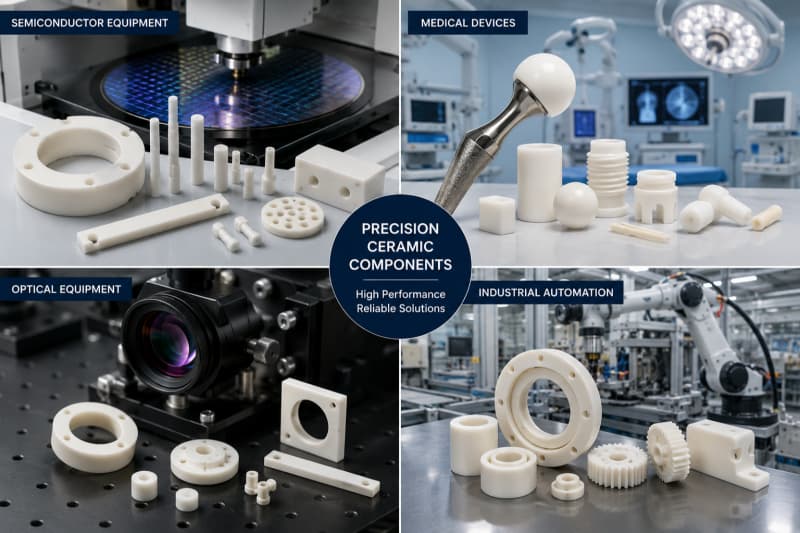
In semiconductor equipment, ceramic positioning pins, wafer handling components, and vacuum system parts need to maintain stable dimensions over a long period to ensure processing accuracy.
In optical equipment, high-precision ceramic structural components can reduce errors caused by thermal expansion and improve system stability.
The precision parts in medical equipment also need to take into account size accuracy, corrosion resistance, and long-term reliability.
In addition, fields such as aerospace, automation equipment, high-end detection instruments, and new energy equipment are increasingly relying on advanced ceramic components with micrometer-level processing capabilities.
Choosing a Precision Ceramic Machining Partner
For procurement personnel, achieving a tolerance of ±0.001mm not only depends on the material itself, but also on the overall capabilities of the manufacturer.
It is necessary to pay attention to whether the enterprise has a complete advanced ceramic manufacturing process, including material development, molding, sintering, precision grinding, and inspection.
And it is also necessary to understand whether the enterprise has complete precision processing equipment and inspection capabilities, such as high-precision CNC grinding machines, three-coordinate measuring machines (CMM), roundness gauges, surface roughness measuring instruments, etc., to ensure the consistency of dimensions and quality.
The quality management system is also important. Obtaining ISO 9001 and other quality system certifications, and establishing a complete production process control and traceability mechanism, usually means that the enterprise can provide high-quality products continuously and stably.
For OEM customers who need long-term cooperation, an integrated supplier with the ability to select materials, perform precision processing, and provide application support often provides more technical support during the project development stage, helping customers shorten the research and development cycle and reduce overall costs.
Conclusion
Achieving ±0.001mm precision ceramic machining is not achieved through a single piece of equipment or process, but rather through the combined effects of material properties, sintering processes, diamond grinding, high-precision CNC equipment, a constant temperature environment, and rigorous quality control.
As semiconductor, medical, optical, and high-end equipment manufacturing continue to advance towards higher precision, advanced ceramics are becoming increasingly important materials for critical components. For companies, in addition to selecting suitable ceramic materials, choosing a partner with precision manufacturing capabilities and engineering experience is crucial to truly leverage the advantages of advanced ceramics in high precision, high reliability, and long lifespan, providing continuous assurance for product performance and market competitiveness.
