 JiFeng Ceramics

Advanced ceramic components are becoming indispensable in new energy equipment. As the global energy transition accelerates, lithium-ion batteries, photovoltaic power generation, hydrogen energy systems, and electric vehicles demand materials that can withstand extreme conditions. Advanced ceramics, with their superior wear resistance, corrosion resistance, electrical insulation, and high-temperature stability, are increasingly replacing traditional metals in critical new energy equipment.
Why Advanced Ceramics Are Essential for New Energy Equipment
New energy equipment usually needs to operate for a long time under complex conditions such as high temperature, high pressure, high-speed friction and chemical corrosion. Traditional metal parts are prone to problems such as wear, corrosion, electrical conductivity issues and metal particle contamination, which can affect the stability and quality of the equipment.
In contrast, advanced ceramics have the following advantages:
- Excellent wear resistance, which can significantly extend the service life of components and reduce the frequency of equipment maintenance.
- Outstanding corrosion resistance, capable of withstanding acids, alkalis, electrolytes and various chemical media.
- Good electrical insulation properties, meeting the insulation safety requirements of new energy equipment.
- High-temperature stability, maintaining good mechanical properties and dimensional accuracy in high-temperature environments.
- Low particle contamination, reducing impurity generation during the production process and improving product consistency.
- Lower total life cycle cost, although the initial investment is high, due to long service life and less maintenance, it can reduce overall operating costs.
These characteristics make advanced ceramics an important material for enhancing the reliability and production efficiency of new energy equipment.
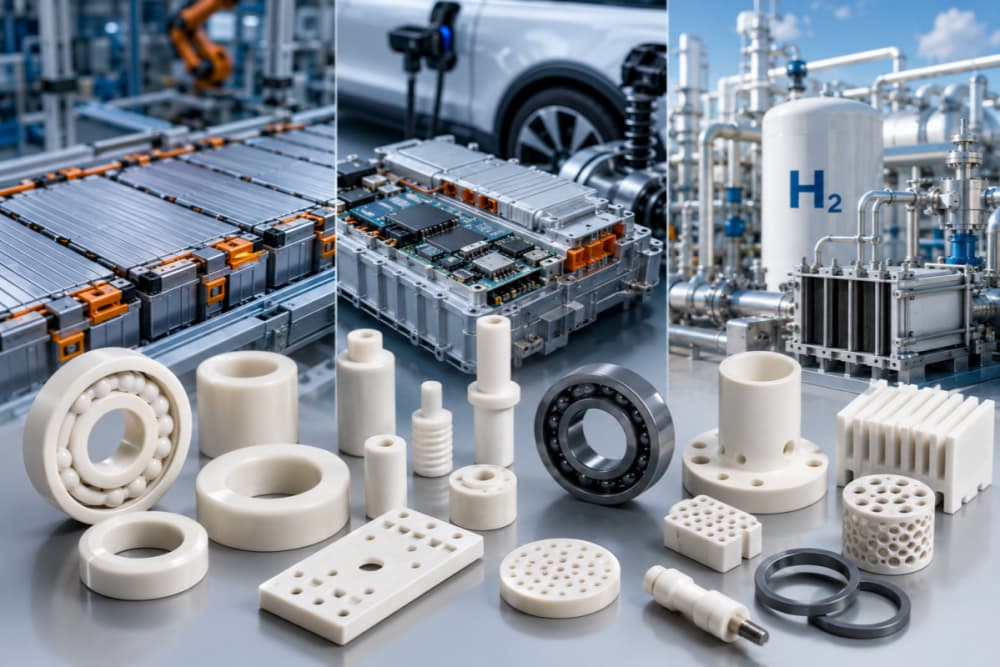
Key Applications of Advanced Ceramics in New Energy Equipment
Advanced ceramics have covered many core areas of the new energy industry, playing an important role in improving equipment performance and ensuring production stability.
| New energy sector | Main Applications | Values |
| Lithium-ion batteries | Guide rollers, nozzles, zirconia plungers, diaphragm coating materials, solid electrolytes | Improve production precision, reduce pollution, and enhance cycle life and safety |
| Photovoltaics (PV) | Silicon carbide ceramic carriers, alumina suction plates, copper-clad ceramic substrates | Improve silicon wafer processing precision, extend equipment life, and improve inverter reliability |
| Electric Vehicles (EVs) | Silicon nitride bearings, IGBT ceramic substrates, ceramic insulators, capacitors | Meet the demands of high voltage, high temperature, and high power density, and improve heat dissipation and insulation performance |
| Hydrogen Energyt | Electrolytic cell insulators, zirconia electrolytes, ceramic seals, mechanical seals | Improve corrosion resistance, sealing performance, and long-term operational stability |
As clean energy technologies continue to advance, the range of ceramic applications is expected to expand even further.
How to Choose the Right Advanced Ceramic Material for New Energy Applications
When faced with a wide variety of advanced ceramics, how to make precise selections based on specific application scenarios is a key issue in engineering implementation. When choosing, the following core dimensions need to be comprehensively considered:
Key performance indicators
- Thermal conductivity: For high-power heat dissipation scenarios, aluminum nitride (170–230 W/mK) or high thermal conductivity silicon nitride should be selected.
- Mechanical strength and toughness: When subjected to vibration, impact, or temperature cycling, silicon nitride (bending strength of 600–1000 MPa, high fracture toughness) is superior to aluminum nitride and aluminum oxide.
- Thermal expansion coefficient (CTE): It needs to match with chips or metal components to reduce thermal stress. The CTE of silicon nitride is approximately 3.0–2×10⁻⁶/℃, close to SiC; the CTE of aluminum nitride is about 4.5×10⁻⁶/℃, which is better matched with silicon.
- Electrical insulation and dielectric properties: For high-voltage insulation scenarios, high breakdown strength and low dielectric loss are required.
- Corrosion resistance and chemical stability: In environments such as batteries, fuel cells, and offshore wind power, these aspects need to be carefully examined.
- Cost and processability: Alumina has the highest cost-performance ratio and mature processing technology; aluminum nitride and silicon nitride have higher costs but better performance.
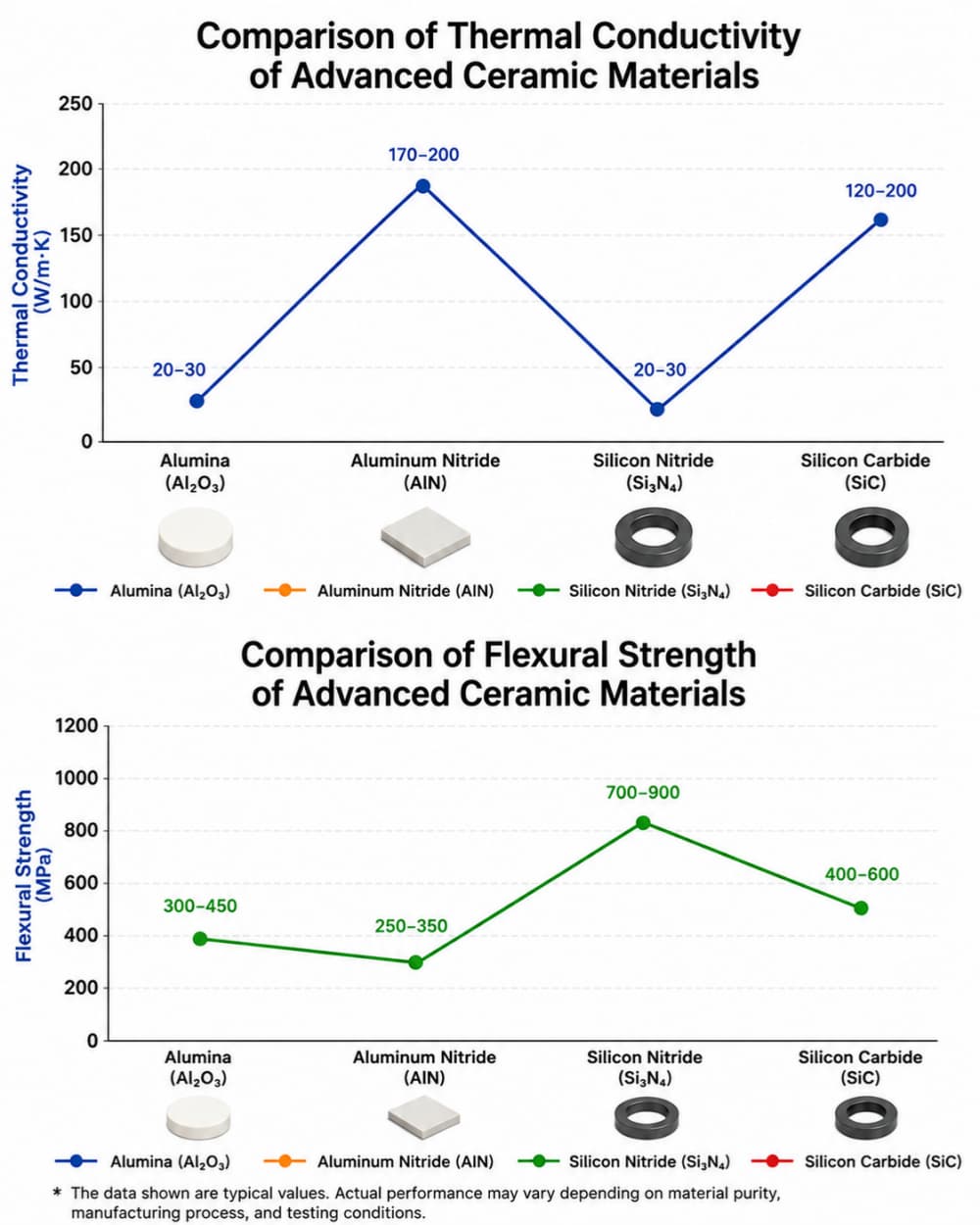
Common Material Comparison and Recommendation
| Materials | Thermal conductivity (W/m·K) | Flexural strength (MPa) | Main advantages |
| Alumina | 20–30 | 300–400 | Low cost, mature process |
| Aluminum nitride | 170–230 | 250–350 | Extremely high thermal conductivity, compatible with silicon |
| Silicon nitride | 60–90 | 600–1000 | High strength, high toughness, resistant to thermal shock |
| Silicon carbide | 120–200 | High | High temperature resistance, wear resistance, high thermal conductivity |
| Zirconium oxide | Lower | High toughness | Ion conductivity, chemical stability |
When selecting materials, factors such as operating temperature, chemical medium, mechanical load, electrical insulation requirements, and processing precision should be comprehensively considered to obtain the best overall performance.
Future Development Trends
As the global new energy industry continues to expand, the advanced ceramics market is maintaining steady growth. New energy has become one of the most promising application fields.
In the future, advanced ceramics will have more development opportunities in the following directions:
- Solid-state batteries: Promoting the development of solid-state electrolytes, separator coating materials, and high-temperature manufacturing equipment.
- 800V new energy vehicle platform: Driving the continuous growth in demand for SiC power devices, ceramic substrates, and insulating materials.
- Green hydrogen industry: Core equipment such as SOFC, SOEC, and PEM electrolyzers will further expand the application of advanced ceramic materials like zirconia and silicon carbide.
- Intelligent manufacturing: The demand for high-precision and long-life ceramic components on automated and digital production lines is constantly increasing.
As new energy equipment continues to evolve towards higher efficiency, longer lifespan and greater reliability, advanced ceramics will play an increasingly important role throughout the entire industrial chain.
Conclusion
Advanced ceramics not only constitute an important part of new energy equipment, but also are the key materials that drive the technological upgrading of the new energy industry. From lithium batteries, photovoltaic manufacturing to new energy vehicles and hydrogen energy equipment, advanced ceramics, with their excellent properties such as wear resistance, corrosion resistance, high-temperature resistance and electrical insulation, provide strong guarantees for the stable operation of equipment and product quality.
In the future, as the global energy transition continues and the new energy industry develops rapidly, advanced ceramics will be applied in more high-end equipment, providing more reliable and efficient material solutions for the high-quality development of the new energy industry.
