 JiFeng Ceramics

A designer specifies “99% alumina” on an illustration, gets an estimate that’s significantly more expensive than anticipated and then discovers that an item made by a competitor — working fine for years- actually utilized less pure. The desire to believe that “higher purity is safer” is logical but often it’s incorrect, and often costly. Let’s look at what’s different between the four most commonly used alumina grades: 95 percent, 99%, 99.5 percent 99.9%, and 99.9 percent — and then how to choose the correct one for your specific application, instead of settling for the highest value in the spec sheet.
What Does “Alumina Purity Grade” Actually Mean?
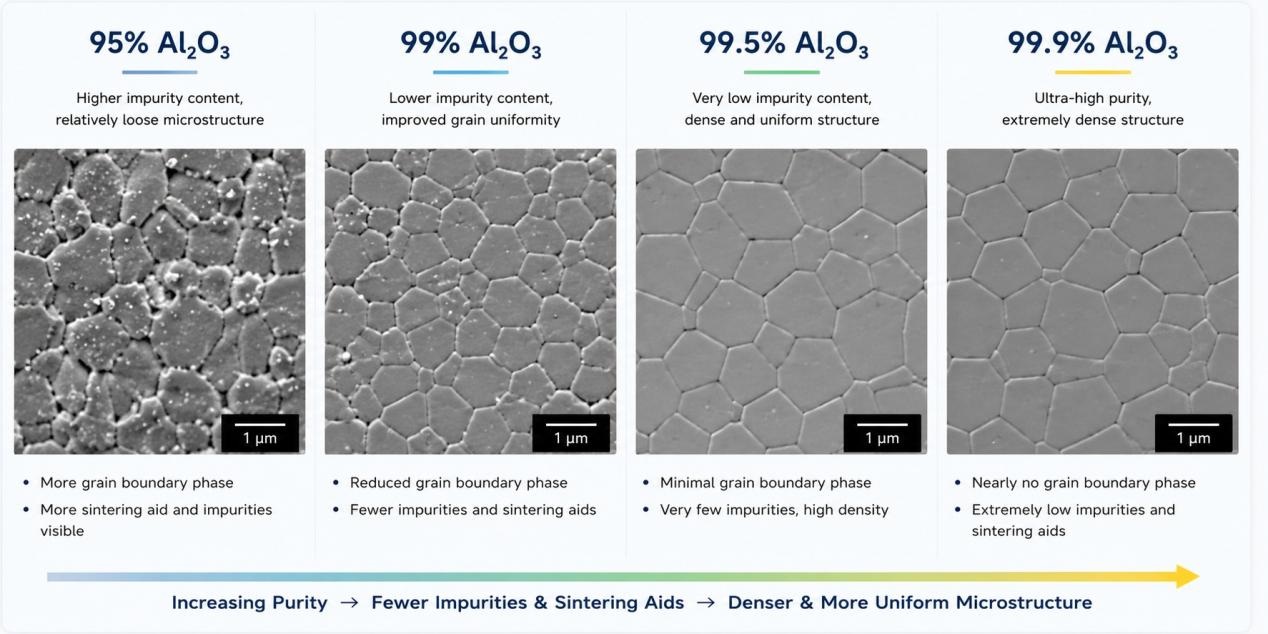
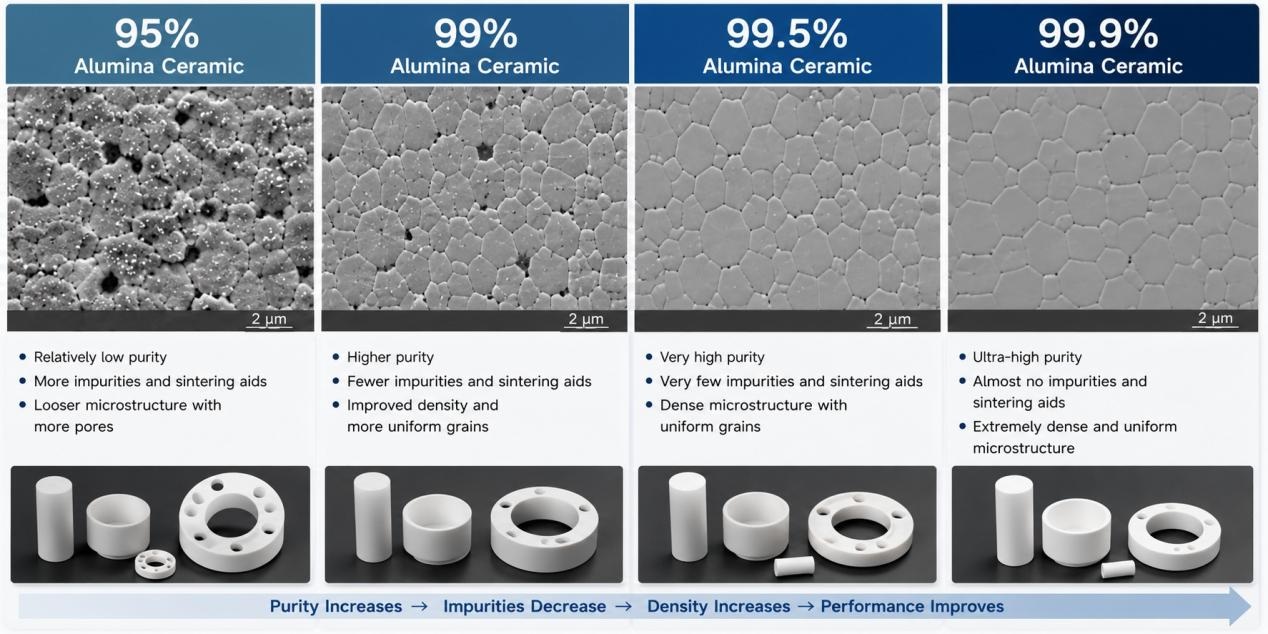
Purity grade is the percentage of Al₂O₃ within the body of the ceramic and the rest is comprised of Sintering aids like SiO2, MgO or CaO.These additives aren’t impurities in the negative sense — they control grain growth and densification during firing. This means moving between grades isn’t simply “more pure equals better,” it’s a genuine shift in microstructure that affects strength, insulation, and machinability differently at each level.
95% Alumina: Properties and Best-Fit Applications
95% alumina sits at the accessible end of the range, with a coarser grain structure from its higher additive content. At this purity, dielectric strength runs around 10 kV/mm with thermal conductivity near 24 W/(m·K) — solid but not top-tier insulation performance. It’s typically used for general-purpose electrical components, insulators, and metallized parts where the grain size is larger and assists in bonding during brazing. For industrial applications that are cost-sensitive but not excessive thermal or electrical requirements 95% is usually the most suitable choice.
99% Alumina: Properties and Best-Fit Applications
Moving to 99% reduces the glassy secondary phase significantly, improving mechanical strength and insulation resistance. The typical flexural strength for typical alumina grades ranges from 300 to 400 MPa; the compressive strength is often more than 2,000 MPa. 99% grades fall towards the higher end of this range. This grade is a popular middle ground choice for seals for pumps as well as textile guides and precise mechanical components in which wear resistance is more important than the dielectric performance.
99.5% Alumina: Properties and Best-Fit Applications
99.5% is where electrical and thermal performance meaningfully step up. At 99.5 % quality, the dielectric force can reach approximately 15 kV/mm, with thermal conductivity of around 30 W/(m·K), which is an increase of over 95 percent grade. This makes it a common option for electronic substrates and semiconductor components for equipment, as well as insulation in highly electrical environments such as EV power modules, in which both heat and electrical isolation dissipation are equally important.
99.9% (High-Purity) Alumina: Properties and Best-Fit Applications
At 99.9%, the glassy phase is nearly eliminated, producing the finest achievable grain structure and highest chemical inertness in the alumina family. Commercial alumina grades can reach up to 99.95% purity, with higher purity generally correlating with increased hardness. This grade is intended for the most demanding applications including semiconductor wafer handling ultra-high vacuum components, as well as precision optics, where even the smallest dielectric loss or contamination isn’t acceptable — and where the cost is justified by application, not only the specification sheet.
Grade | Dielectric Strength | Thermal Conductivity | Typical Best-Fit Use |
95% | ~10 kV/mm | ~24 W/(m·K) | General insulators, wear parts, brazed assemblies |
99% | Improved over 95% | Improved over 95% | Pump seals, textile guides, mechanical wear parts |
99.5% | ~15 kV/mm | ~30 W/(m·K) | Electronic substrates, EV power module insulators |
99.9% | Highest | Highest | Semiconductor handling, high-vacuum, precision optics |
Does Higher Purity Alumina Always Mean Better Performance?
Not necessarily — and the evidence here is genuinely counterintuitive. Research on brazed alumina joints found that 96% alumina consistently outperformed 99.7% alumina in joint strength, despite similar flexural strength and microstructure in the base ceramic, because of how secondary phases interacted with the braze material at the joint interface. In other words, purity alone doesn’t determine real-world performance — how the material behaves in your specific process (brazing, machining, thermal cycling) matters just as much. Specifying the highest available grade “to be safe” can add cost without adding reliability, and in some joining or bonding applications, it can even underperform a lower grade.
How to Pick the Proper Alumina Grade for Your Application
First, figure out what the part really has to endure: electrical insulation duties, mechanical wear or load, chemical exposure, or this ultra clean semiconductor/medical kind of need. If the application involves brazing or metallizing, grain structure and secondary-phase behavior may matter more than raw purity percentage. Budget matters too — jumping to 99.9% for a mechanical wear part that never sees high voltage or vacuum conditions is rarely worth the added machining cost and lead time.
Common Mistakes When Specifying Alumina Purity
The two most frequent mistakes occur in opposite directions by over-specifying 99.9 percent for simple mechanical components that perform the same with 96% or 99% or 99%, and under-specifying 95-96% when it comes to high-frequency electronics and vacuum environments in which outgassing or loss of dielectric is a major issue. Another, less obvious error is to assume that purity percentage alone can predict the performance of brazed or bonded assemblies, where the process compatibility may be more important.A third, subtler mistake is assuming purity percentage alone predicts performance in bonded or brazed assemblies, when process compatibility can matter more.
FAQ
Can 99% Alumina be more powerful than 95% of alumina?
In general, yes in the compressive and flexural strength, however the distinction is dependent on the grain structure and the quality of sintering, not just purity.
What’s the real practical difference between 99% and 99.5% alumina
In practice, 99.5% usually brings noticeably better dielectric strength and better thermal conductivity, so it becomes the default selection for more demanding electronics.
Which alumina grade is commonly chosen for semiconductor equipment?
Typically, 99.5% up through 99.9% depending on whether the part needs normal electrical isolation or ultra-clean, low contamination behavior.
Are higher-purity aluminas more difficult to process?
Yes, finer grain structure and better hardness typically increase the duration and cost to 99.5 percent and over.
Can 95% alumina serve as electrical insulation?
Yes, you can use general-purpose insulation. High-frequency or higher voltage applications usually have a minimum of 99% to ensure sufficient dielectric performance.
The process of selecting an alumina grade isn’t about selecting the highest grade but rather making sure that the purity, microstructure and price to what your specific application requires. Jifeng Ceramics manufactures custom alumina components in the complete 95 percent to 99.9% purity ranged our engineers will help you determine which one best meets your particular electrical, mechanical or environmental needs before you sign a specification.
