 Цзифэн Керамика

Используется техническая керамика, поскольку она более устойчива к нагреву., износ и коррозия, чем у большинства металлов. Таким образом, когда керамическая деталь ломается, сколы или преждевременный износ, неудача часто становится неожиданностью – и дорогостоящей, учитывая возможность простоя, contamination risk or safety exposure.The reality is that ceramic failure is rarely arbitrary. It usually traces back to one of a handful of recurring root causes. We go through the 7 most typical ones, how to tell them apart, and what to examine before the following part enters into solution.
Ceramics Are Hard but Brittle — Why That Matters for Failure
Comprehending ceramic failure begins with comprehending what makes porcelains various from metal. Materials like alumina, цирконий, and silicon carbide offer exceptional solidity, высокотемпературная стабильность, и химическая стойкость– residential or commercial properties steels battle to match.. But that comes at a cost: ceramics are brittle. They can not bend or mould to take sudden stress like steel or aluminium can. Once a crack occurs at a flaw or stress concentration point, it propagates almost immediately with little or no warning. That one mechanical fact – high strength and low fracture toughness – helps to explain why the causes below matter so much more for ceramics than for most metal components.
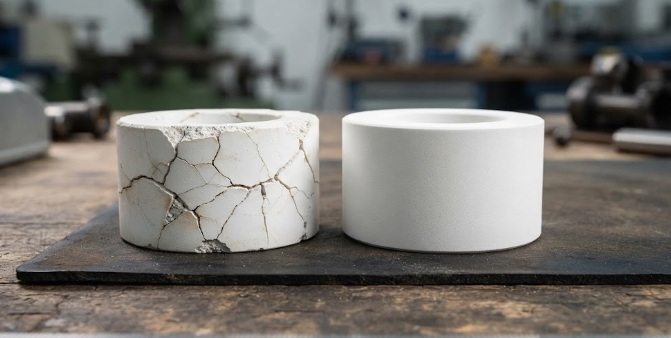
7 Common Causes of Ceramic Part Failure in Service
1. Wrong Material Grade for the Application
Not all ceramics respond equally to heat, chemical exposure or load. Different thermal shock resistance, fracture toughness and corrosion behaviour are found for alumina, цирконий, нитрид кремния и карбид кремния. A part specified for a mild environment but deployed in a more aggressive one — higher temperature swings, stronger acids, or higher mechanical load than assumed — is set up to fail regardless of manufacturing quality. Material selection should be validated against actual operating conditions, not just catalog specifications.
2. Manufacturing Defects
Interior porosity, inclusions, or irregular thickness from irregular sintering develop hidden tension focus factors inside the part. These flaws are often unnoticeable to the naked eye and just expose themselves when the component is packed in service. This is why reputable manufacturers perform density measurement, dimensional inspection, and batch testing — defect-related failures are largely preventable at the production stage, not something users can catch after the fact.
3. Poor Component Design
Sharp internal edges, quantum leaps in wall surface thickness, or geometry that neglects brittle-fracture auto mechanics all produce anxiety risers. In a ductile metal, these style defects might reduce tiredness life gradually. In a ceramic, they can be the exact point where a crack starts and fails suddenly. Design reviews with an engineer familiar with ceramic behavior — not just metal design conventions — significantly reduce this risk.
4. Installation and Handling Damage
It is amazing that a large percentage of ceramic part failures occur before the part ever reaches full operating conditions. Over-tightening fasteners or uneven mounting surfaces or a component dropped or knocked during installation can introduce microcracks too small to see. The part may run for days or weeks before the crack propagates to full failure, making the true cause easy to misattribute to “material weakness” when it was actually handling damage.
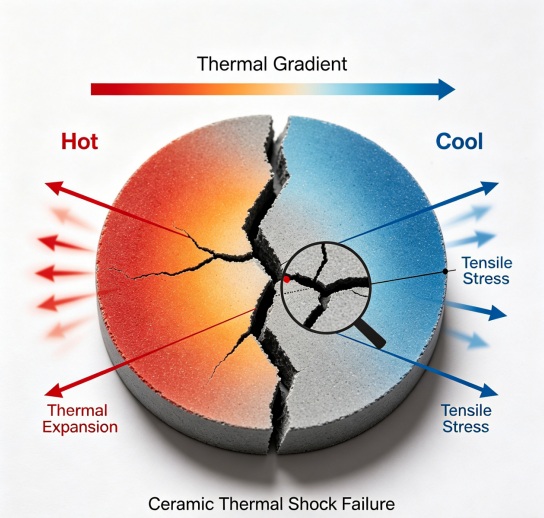
5. Thermal Shock and Thermal Cycling
Ceramics can take the heat, but not sudden changes in temperature. Repeated heating / cooling cycles or a sudden temperature swing outside of the thermal shock resistance of the material . These create internal stresses which accumulate with each cycle . Silicon nitride and silicon carbide generally handle thermal cycling better than alumina. This is one reason why material selection (Cause #1) and thermal profile go hand-in-hand.
6. Mechanical Overload or Impact
Because ceramics can’t deform plastically like metal, an impact or overload event that a steel part would simply dent or bend under can shatter a ceramic one outright. Overload failures are often traced to unplanned events — a process upset, an equipment jam, or a load spike outside the part’s design envelope — rather than a chronic design or material issue.
7. Chemical or Abrasive Wear Beyond Design Limits
A part designed for one chemical environment can degrade quickly if actual process conditions shift — a different pH, an unanticipated abrasive slurry, or contact with a reagent the original specification didn’t account for. Gradual surface erosion of this kind is easy to miss until dimensional tolerances are compromised and failure follows.
How to Identify Which Cause Applies to Your Failure
Crack evaluation is the most trusted means to work backwards from a failed part to its cause. Designers normally take a look at the crack origin factor (where the fracture started), the fracture pattern (a single sharp break indicate overload or influence, while a network of fine cracks recommends thermal cycling or fatigue), and whether wear is consistent (constant with abrasive/chemical destruction) or local (consistent with a layout or setup concern). Keeping the failed component undamaged– instead of discarding it– and sending it back to the manufacturer for failing analysis is just one of the most beneficial diagnostic actions offered, and it’s a service several recognized ceramic vendors use as part of high quality support.
How to Reduce the Risk of Ceramic Part Failure
Most of the causes above are preventable with a few consistent practices: confirming material grade against real operating data rather than assumptions, requesting inspection and test certificates for each batch, following documented torque and handling procedures during installation, and re-validating material choice whenever process conditions change. None of these require exotic engineering — they require treating ceramic components with the same rigor applied to critical metal parts, if not more, given the lack of a warning stage before failure.
What to Look for in a Ceramic Manufacturer to Prevent Repeat Failures
Recurring failures are often a signal to look more closely at the supply chain itself. A manufacturer that controls the full process in-house — from raw material formulation through sintering and precision grinding — is generally better positioned to maintain consistent quality than one relying on multiple subcontracted vendors. Batch-level testing (плотность, твердость, dimensional inspection) with certificates available on request is another indicator worth checking, along with engineering support at the drawing-review stage, before a part is ever produced.
Часто задаваемые вопросы
Does ceramic failure always mean the material was defective?
Нет. Manufacturing defects are only one of several causes — design, установка, and operating conditions are just as often responsible.
Can a cracked ceramic part be repaired, or must it be replaced?
In nearly all cases, cracked ceramic components should be replaced. Because cracks propagate rapidly under stress, repairs are unreliable for load-bearing or sealing applications.
How can I tell if failure was caused by installation rather than the material itself?
Look at the fracture origin: damage originating at a mounting surface or fastener contact point, rather than mid-body or along a flow path, generally points to installation stress.
Ceramic components fail for identifiable reasons, not by chance. Working through these seven causes — starting with material selection and ending with supplier quality control — turns a frustrating failure into a specific, fixable problem. If a recent failure doesn’t clearly match one of these patterns, a manufacturer’s engineering team can typically review the part and operating conditions to pinpoint the cause.
