 JiFeng Ceramics

Two suppliers quote on the same ceramic drawing and are miles apart in their pricing. Neither one is necessarily wrong. Price Custom technical ceramic parts are priced according to what happens at each stage of production: material, forming, sintering, grinding, inspection and volume. Design choices have the greatest impact on the most expensive cost of all – finishing the part after firing. This guide walks you through all of the cost drivers in a production order, shows you where your money is going and tops it off with a checklist for getting quotes that you can actually compare.
Short Answer: Here are 6 Reasons to Get a Quote.
| Cost driver | Typical impact | Where it bites | Your lever |
| Material | High | SiC, Si₃N₄, AlN | Choose by duty, not worst case |
| Tolerance and surface finish | High | Micron-level fits, polished faces | Tighten only functional surfaces |
| Geometry | Medium to high | Thin walls, deep holes, sharp corners | Simplify the shape |
| Forming and tooling | Medium | Small custom batches | Match the method to volume |
| Sintering and yield | Medium | Large or thin parts | Even walls, generous radii |
| Testing and quantity | Medium | Regulated industries, prototypes | Specify only what you need |
Impact levels are general patterns. Your drawing decides the real ranking.
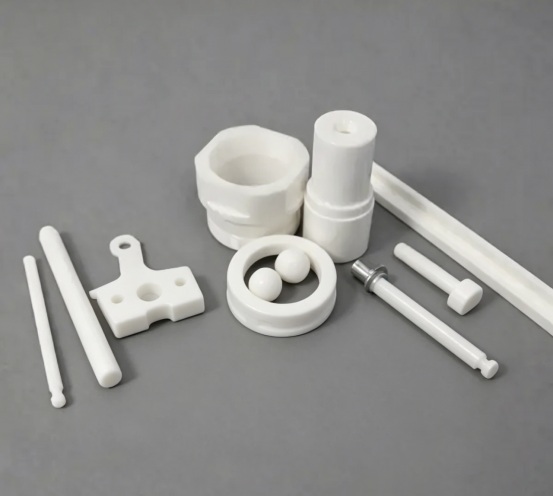
Start With the Material
Material cost is more than powder price. Harder, denser ceramics need hotter, more tightly controlled firing, and they are slower to finish. One supplier’s data sheet for solid-state sintered silicon carbide lists a peak firing temperature of about 2,110 °C in a controlled-atmosphere cycle.
A practical way to choose:
- Alumina often covers room-temperature wear and electrical insulation.
- Zirconia adds toughness when impact or bending loads matter.
- Silicon carbide, silicon nitride and aluminum nitride earn their price in high-heat, high-stiffness or high-conductivity jobs such as semiconductor equipment.
JiFeng works with alumina, zirconia, silicon carbide, silicon nitride, aluminum nitride and boron nitride. Picking the cheapest material that survives your real conditions is the first saving.
Geometry and Tolerance: Where Quotes Are Won or Lost
Fired ceramic is extremely hard, so it is shaped with diamond tools, and the diamond wheel itself wears down as it cuts, which adds to machining cost. That is why finishing weighs so heavily on price. Published estimates vary with the part and material:
- A U.S. Department of Transportation report on cost-effective ceramic machining put machining at roughly 20% to 70% of manufacturing cost, depending on the component.
- Trade press has cited machining at up to about 50% of component cost.
- Purdue researchers noted that diamond grinding can exceed 75% of the cost of making a part.
The wide range is the point: it depends on your design. Three things push grinding time up:
- Tight tolerances. Each extra micron means slower, lighter passes.
- Awkward features. Thin walls, deep or small holes, internal grooves and sharp inside corners are slow to machine and easy to chip.
- Surface finish. Polishing and lapping add whole operations.
Ask one question of every dimension: does this surface truly need that tolerance? Holding tight limits on mating faces and relaxing the rest is the single most effective design saving. JiFeng’s precision machining team can review a drawing before you commit to numbers.
Forming, Tooling and Sintering
Before grinding, a part is formed from powder and then sintered. Forming methods such as die pressing, isostatic pressing and injection moulding trade tooling investment against per-piece cost. Tooling works like a one-time entry fee: it hurts on ten parts and disappears into the price on ten thousand.
Sintering adds its own cost because the part shrinks. One industry overview puts typical linear shrinkage at 15–20%, depending on starting density, and silicon carbide powder data sheets list roughly 18% and roughly 16% for two grades. Uneven walls shrink unevenly, so they warp or crack, and scrapped parts are paid for by the good ones. That hidden yield cost is why designers are asked to keep walls uniform and add radii. Our related reading covers why ceramic parts crack in thermal cycling and common causes of service failure. See also JiFeng’s forming and sintering process.

Testing and Documentation
Inspection scales with your requirements. Checking dimensions on a sample is one thing; full-lot measurement, material reports and traceability for semiconductor, medical or aerospace work is another. Decide which checks protect your application and request only those. Details on JiFeng’s approach are on the quality and testing page.

Quantity and Lead Time
Prototypes carry the highest unit price because setup, programming and tooling are spread over very few parts. Small batches fall in between, and production runs benefit from amortised tooling and steadier yields. Rush orders disrupt scheduling, and fragile parts need protective packaging for export. Planning ahead and consolidating similar part numbers into one order are cheap ways to cut cost.
Eight Ways to Lower Cost Without Losing Performance
- Apply tight tolerances only to functional surfaces.
- Add radii to inside corners.
- Keep wall thickness even.
- Avoid very thin walls and very small deep holes.
- Choose the least demanding material that meets the duty.
- Reuse standard sizes or existing tooling where possible.
- Combine similar specifications in one order.
- Ask for a manufacturability review before the drawing is final.
What to Put in Your RFQ
A complete request prevents padded quotes and slow back-and-forth. Include:
- Drawing with critical dimensions and tolerances
- Material or operating conditions (temperature, load, media)
- Quantity, annual volume and target delivery
- Surface finish requirements
- Inspection and documentation needs
- Packaging and destination
You can send these through JiFeng’s quote form.
Comparing Quotes Fairly
A low price is not always a low cost. Ask each supplier:
- Which stages happen in-house, and which are outsourced?
- What inspection method backs the stated tolerance?
- Are material reports and batch traceability provided?
- How are rejected parts handled?
- Will engineers give design feedback?
A supplier that handles research, sintering, machining and testing under one roof, as JiFeng describes its operation, usually has more control over quality and lead time. Compare quotes on these points, not on the bottom line alone.
FAQ
Why are technical ceramic parts more expensive than metal ones?
Hard materials need high-temperature firing and diamond finishing, both slow and costly. Longer service life and less downtime can offset the price over time.
How much does a custom ceramic part cost?
There is no standard price. Material, tolerance, geometry, quantity and testing set it, so supply a full drawing and requirements for a real quote.
Does a tighter tolerance always cost more?
Usually yes, because it lengthens grinding. Limit tight tolerances to surfaces that need them.
Is alumina cheaper than silicon carbide?
Generally, but the right choice depends on duty. A cheaper material that fails early is the more expensive option.
Final Thoughts
Cost is not one number but a chain of choices, and many are yours. Take your drawing, run it through the six drivers above, and pick the two or three most likely to raise your price. Then take those to your supplier before finalising the design.
