 Céramique JiFeng

Céramique de zircone se démarquer parmi les céramiques techniques avancées par leur ténacité exceptionnelle. Alors que la plupart des céramiques sont intrinsèquement fragiles, la zircone atteint des valeurs de ténacité à la rupture de 8 à 12 MPa·m¹/² — nettement supérieures aux 3 à 5 MPa·m¹/² typiques des céramiques d'alumine. Dans certaines qualités hautes performances, sa ténacité se rapproche même de celle de certains métaux. Cette combinaison unique de haute résistance et de haute ténacité a valu à la zircone le surnom industriel d'« acier céramique ».
La clé de cette performance réside dans un ensemble sophistiqué de mécanismes de renforcement, centré sur le durcissement par transformation de phase et soutenu par plusieurs techniques auxiliaires et techniques. Cet article explique ces mécanismes en détail et montre comment ils permettent aux propriétés mécaniques exceptionnelles de la zircone..
Les trois structures cristallines de la zircone
Zircone (ZrO₂) existe en trois phases cristallines principales en fonction de la température:
- Phase cubique (c-ZrO₂): Stable au dessus de 2370°C jusqu'au point de fusion (~2715°C). Symétrie et stabilité thermique maximales.
- Phase monoclinique (m-ZrO₂): Stable à température ambiante dans des conditions de pression normales. Densité et déformabilité inférieures.
- Phase tétragonale (t-ZrO₂): Stable entre des températures d'environ 1150°C et 2370°C. Densité et résistance supérieures à celles de la phase monoclinique.
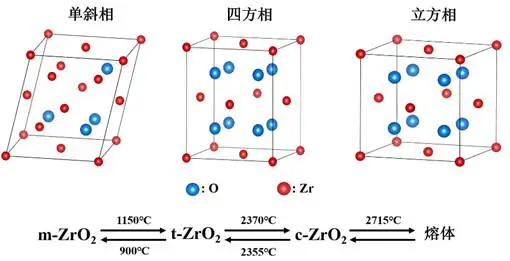
La transformation de tétragonal en monoclinique s'accompagne d'une augmentation de volume de 3 à 5 %. Sans contrôle, ce changement de volume peut provoquer des fissures lors du refroidissement. Les scientifiques des matériaux ont résolu ce problème en ajoutant des stabilisants, qui conservent la phase tétragonale à haute température à température ambiante et transforment le changement de phase en un puissant mécanisme de trempe.
La principale source de la haute ténacité de la zircone: Trempe de transformation de phase
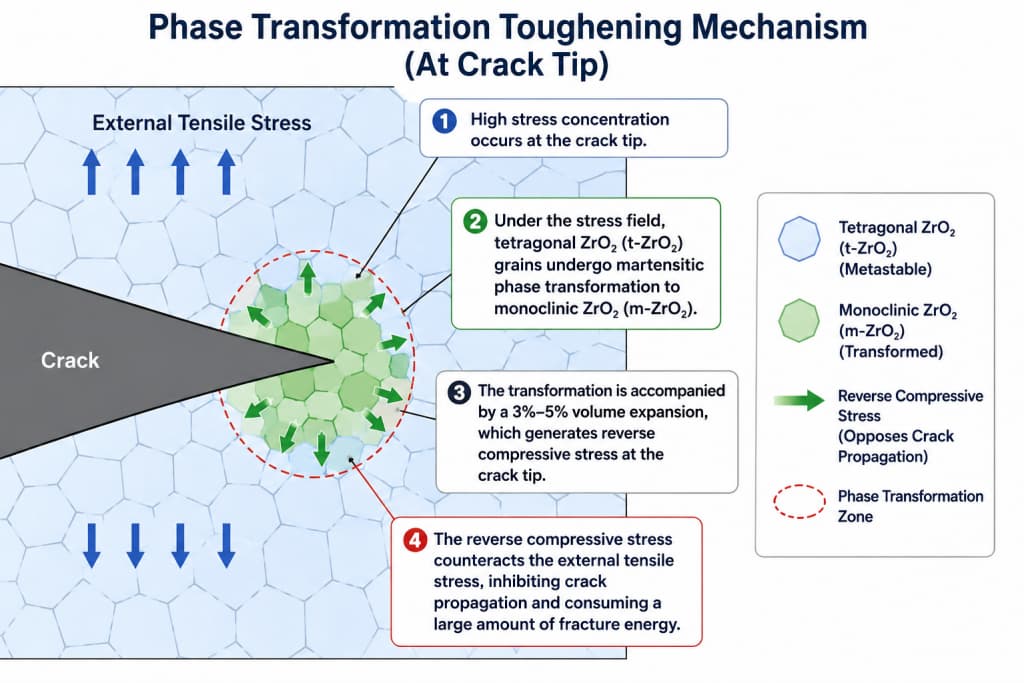
La grande avancée en matière de ténacité de la zircone consiste essentiellement à conserver une phase tétragonale métastable., c'est t-ZrO₂, traîner exprès à température ambiante. Cela se fait en ajoutant des stabilisants comme l'oxyde d'yttrium Y₂O₃, ou oxyde de cérium CeO₂, et puis on laisse un peu la microstructure faire le reste.
Lorsque le matériau est soumis à une force externe et que des fissures se produisent, la concentration de contraintes au fond de fissure déclenchera la transformation de phase martensitique des particules de phase tétragonale métastables, les convertir en phase monoclinique (m-ZrO₂). Ce processus accompagne une expansion de volume de 3 % à 5 %, qui applique avec précision une contrainte de compression inverse à la surface de la fissure, contrecarrer les contraintes de traction externes et directement “holding” la pointe de la fissure pour empêcher son extension ultérieure. En même temps, le processus de transformation de phase consomme une grande quantité d'énergie de fracture, améliorant considérablement la résistance à la rupture du matériau.
Cette transformation de phase induite par la contrainte est la principale raison pour laquelle la zircone peut atteindre une ténacité bien supérieure à celle des céramiques ordinaires..
Mécanismes de renforcement auxiliaires qui fonctionnent en synergie
En plus de la transformation de phase induite par la contrainte centrale pour améliorer la ténacité, il existe deux autres mécanismes importants qui améliorent conjointement la ténacité de la zircone:
Durcissement des microfissures
Pendant le processus de transformation de phase, l'expansion volumique au sein du matériau génère un grand nombre de microfissures fines et dispersées de tailles bien inférieures à la fissure critique. Lorsque la fissure principale s'étend à cette zone, il subira une déviation de trajectoire et une bifurcation, augmentant considérablement la consommation d’énergie pour l’expansion, et simultanément libérer la contrainte concentrée au fond de la fissure de manière dispersée.
Durcissement sous contrainte résiduelle
En contrôlant soigneusement le processus de refroidissement et la composition des phases, les fabricants peuvent introduire des contraintes de compression résiduelles bénéfiques à la surface ou aux joints de grains. Ces contraintes résiduelles augmentent le seuil d'initiation et de propagation précoce des fissures., nécessitant une énergie externe supplémentaire avant qu'une fissure puisse commencer à se développer.
Techniques de trempe artificielle supplémentaires utilisées dans l'industrie
La production industrielle combine souvent les mécanismes naturels ci-dessus avec des méthodes de renforcement techniques pour optimiser davantage les performances pour des applications spécifiques.:
- Durcissement des particules: Des particules de durcissement compatibles sont mélangées à la poudre de zircone. Cette approche améliore la ténacité tout en améliorant également la résistance à haute température et la résistance au fluage..
- Fibre / Durcissement des moustaches: Les fibres ou moustaches introduites dans la matrice créent un pontage des fissures et une dissipation de l'énergie de friction lors de l'extraction., empêcher efficacement l'avancée des fissures.
- Auto-durcissement: Les processus de frittage contrôlés génèrent des grains allongés ou en forme de colonne avec une orientation privilégiée. Les fissures doivent dévier à plusieurs reprises autour de ces grains, allongement du chemin de fissure et augmentation de la ténacité.
- Renforcement composite: Deux ou plusieurs mécanismes de trempe sont délibérément combinés pour obtenir un équilibre personnalisé entre ténacité et résistance pour différentes conditions de fonctionnement..
- Nano-durcissement: Les phases à l'échelle nanométrique affinent la structure des grains et créent une microstructure composite « intra-granulaire ». Cela favorise la fracture transgranulaire au lieu de la fracture intergranulaire, améliorant encore la ténacité globale.
Résultats de performance et applications pratiques
La combinaison d'une ténacité et d'une résistance élevées permet à la zircone de servir dans des applications exigeantes où les céramiques conventionnelles échoueraient.:
- Restaurations et implants dentaires (couronnes, ponts, piliers)
- Articulations artificielles (composants de hanche et de genou)
- Roulements et garnitures mécaniques de précision résistants à l'usure
- Composants structurels à fortes contraintes dans les équipements aérospatiaux et industriels
Son coefficient de dilatation thermique relativement élevé (proche de celui de nombreux métaux) rend également la zircone adaptée aux conceptions composites céramique-métal.
Comment JiFeng Ceramics optimise la ténacité de la zircone
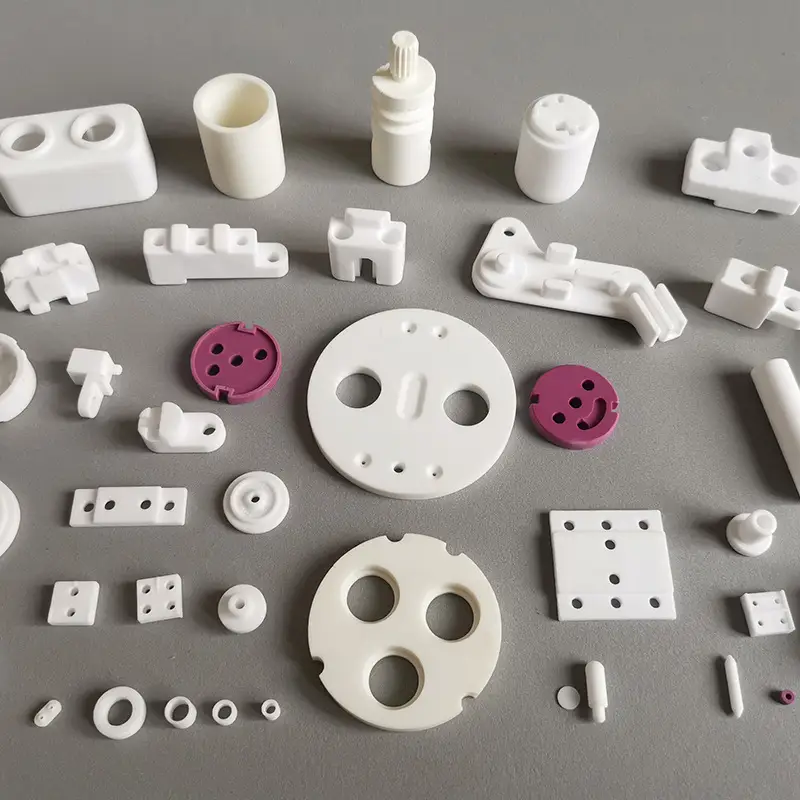
À Céramique Jifeng, nous obtenons l'effet maximum des mécanismes de trempe par transformation de phase et de trempe auxiliaire en contrôlant avec précision la teneur en stabilisants, propriétés de la poudre, paramètres de frittage (y compris pressage isostatique à chaud), et procédures de post-traitement. Notre équipe d'ingénieurs peut recommander la qualité de zircone optimale ou personnaliser la solution de trempe en fonction de votre température spécifique., charger, et exigences environnementales.
Conclusion
L'excellente ténacité de la zircone n'est pas accidentelle mais découle d'un mécanisme de trempe par transformation de phase bien compris., complété par de multiples voies complémentaires de dissipation d'énergie. En conservant la zircone tétragonale métastable et en concevant des voies de trempe supplémentaires, les scientifiques en matériaux ont réussi à créer des matériaux céramiques dotés d'une résistance élevée et d'une excellente résistance à la rupture.
Si votre application nécessite une ténacité élevée tout en tenant compte de la résistance à l'usure, résistance à la corrosion, ou biocompatibilité, la zircone est souvent un choix idéal.
