Aluminum Nitride Ceramics Materials
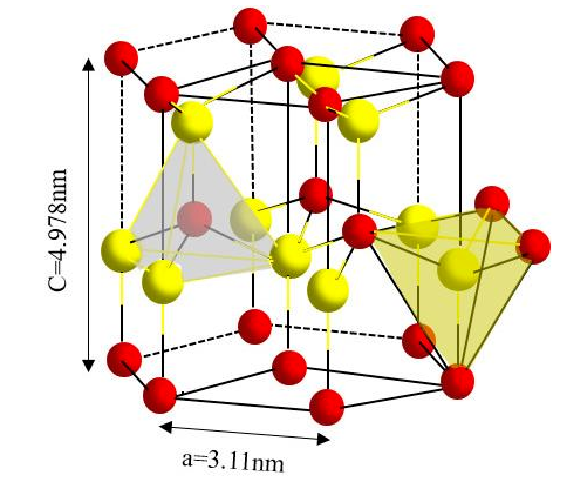
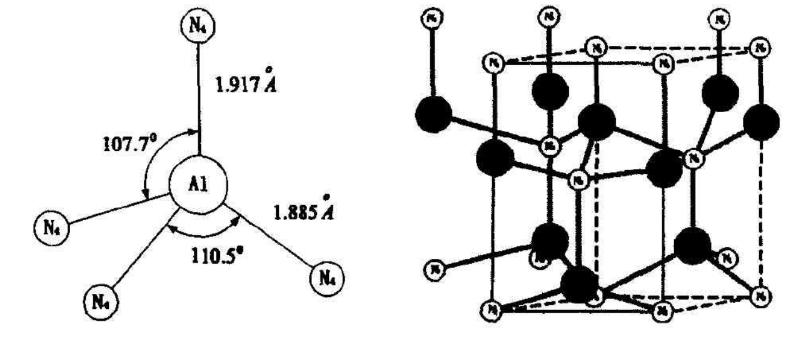
窒化アルミニウム ( AlN) is an organic compound that has an hexagonal wurtzite crystal. The lattice constants of the compound are a = 0.3110 Nm as well as c = 0.4978 num. The aluminum atoms are placed in a hexagonal closed-packed structure with nitrogen atoms taking up the majority of the interstitial tetrahedral sites. Distorted tetrahedrons [AlN4] are formed by the interaction of aluminum atoms and nitrogen atoms. The length of the Al-N bond along the C-axis of 0.1917 nm. The length of the Al-N bonds in the three other directions are 0.1885 nm. Pure aluminum nitride ceramics are colourless and translucent, however they are colored in different shades due to the doping of impurities, typically gray, off-white or light yellow.
Crystalline Forms of Aluminum Nitride
AlN ceramics have excellent thermal properties: its theoretical thermal conductivity is 320 付き(m・K), close to non-toxic beryllia, with a thermal expansion coefficient similar to silicon. It is a good insulator at room temperature, with resistivity 10⁻¹⁶ Ω·m, breakdown voltage 15 kV/mm, 低い誘電損失. Mechanically, it has 12 GPa hardness, 300 MPa flexural strength, and stable strength at high temperatures. Chemically, it resists high temperature and corrosion, oxidizes at 700~800℃, and needs dry storage to avoid reaction with water vapor.
- Lattice constant: a=0.3110nm, c=0.4978nm
Space group: P6₃mc
- Al atoms are arranged in hexagonal close packing, and N atoms occupy half tetrahedral interstitial sites. Each Al atom forms distorted [AlN₄] tetrahedral coordination with four N atoms. The Al-N bond length along c-axis is 0.1917 nm, そして 0.1885 nm in other three directions.
- Aluminum nitride is primarily characterized by covalent bonding, with partial ionic bonding characteristics, belonging to the group III-V nitrides.
This crystal structure for aluminum nitride has some really good properties , like high thermal conductivity, 良好な電気絶縁性, and a low coefficient of thermal expansion . So it ends up being used a lot in electronic packaging, for heat dissipation substrates , and in related uses too.

Figure 1: Crystal Structure of Aluminum Nitride (AlN)

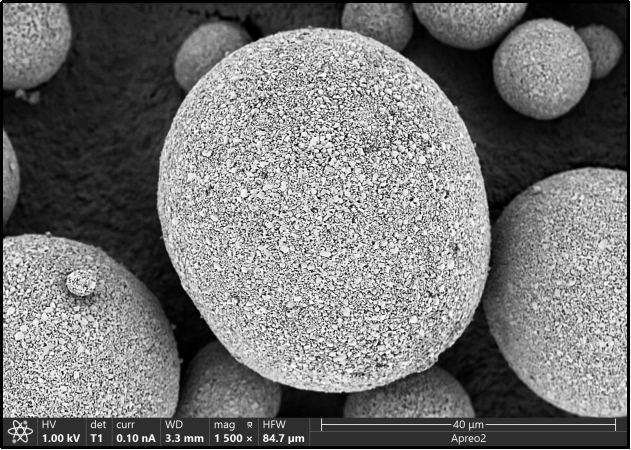
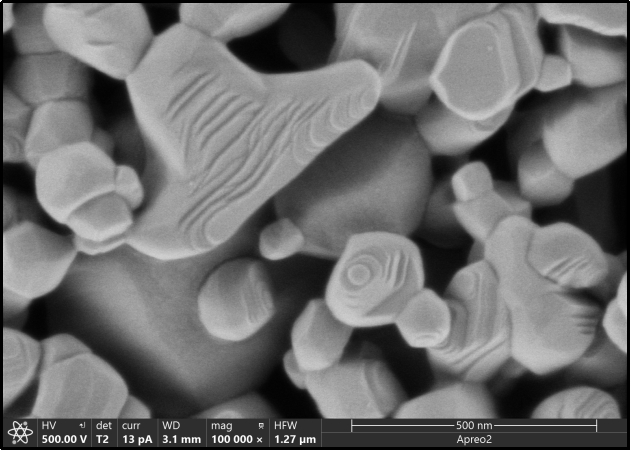
Figure 2: Microstructure of Sintering Aid Y₂O₃ Powder.
(Top) Secondary spherical structure; (Bottom) Microstructure of primary particles.
Figure 2 shows the microstructure of Y₂O₃ powder, which presents a quasi-spherical structure composed of numerous primary particles with large pores between them, resulting in low density. After high-magnification observation, many growth steps formed during sintering are visible on the surface of the primary particles.


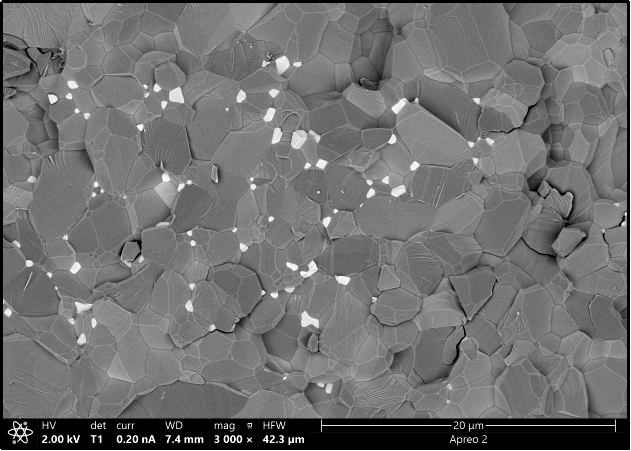
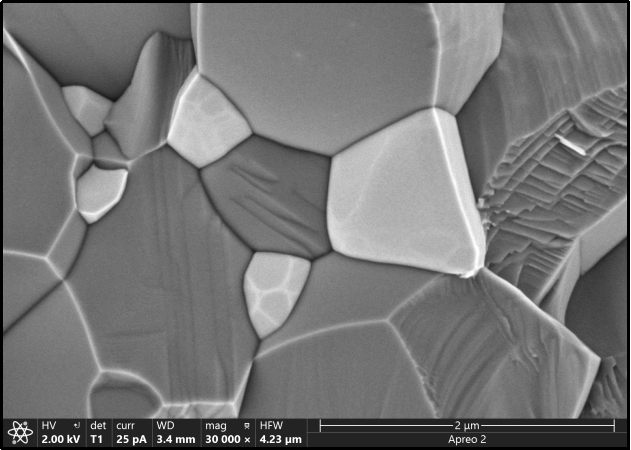
Figure 3: Microstructure of Sintered AlN Ceramics (white particles denote sintering aid Y₂O₃)
Figure 3 shows AlN ceramics that were sintered with the addition of Y₂O₃ as a sintering aid. The grains appear closely packed, and the bulk density is high. In other words, the Y₂O₃ particles are well filled in between the AlN grains, this setup helps raise the ceramics density and it also improves their thermal conductivity even more.


Advantages of Aluminum Nitride(ALN) Ceramics
Excellent Thermal Conductivity
AlN ceramics have ultra high thermal conductivity, about 140 に 220 W/m·K, honestly much better than alumina ceramics. This speeds up heat transfer for high power electronic devices and helps with thermal management, and that can really improve overall system reliability, plus longer service life.
Superior Electrical Insulation
Even with the strong thermal conduction, AlN still keeps good electrical insulation and dielectric strength. That’s why it fits well as electronic substrates and also for insulated heat dissipation parts. It’s like, the heat moves fast but electricity stays controlled.
Low Thermal Expansion Coefficient
The thermal expansion coefficient is close to silicon semiconductors, so thermal stress from temperature swings gets reduced. In practice, this supports more reliable packaging devices, fewer micro stress issues, and better durability over time.
High Temperature Resistance
AlN ceramics maintain stable mechanical and thermal properties at high temperatures and possess excellent thermal shock resistance in harsh working conditions.
Great Corrosion and Plasma Resistance
It delivers strong resistance against molten metals, corrosive gases and plasma environments, perfectly applicable to semiconductor and vacuum process equipment.
Aluminum Nitride Material Properties
As a new generation of advanced ceramics, 窒化アルミニウム (AlN) is famous for its ultra-high thermal conductivity (5-7 times that of alumina) and thermal expansion coefficient highly matched with silicon (そして). It is an ideal heat dissipation and packaging material for high-frequency and high-power electronic components.
According to different thermal conductivity (W/m·K) and application focus, AlN materials are mainly classified into the following grades:
熱伝導率 (W/m·K) | Material Grade / Type | 主な特徴 | 代表的な用途 |
≥ 230 W/m·K | Ultra-High TC AlN | Extremely high heat conduction efficiency close to the theoretical limit; 高い機械的強度, extremely low dielectric loss and excellent thermal stability | Aerospace electronic packaging, military-grade radar heat dissipation parts, core components of advanced semiconductor manufacturing equipment, high-end laser bases |
200 – 220 W/m·K | High-Performance AlN | Excellent heat dissipation capacity and high dielectric strength; eco-friendly perfect substitute for traditional toxic beryllium oxide (BeO) ceramics | IGBT power modules for new energy vehicles and high-speed railways, high-frequency microwave communication substrates, high-power RF device packaging |
170 – 180 W/m·K | Standard AlN | Combines good thermal conductivity and high insulation voltage resistance; well-matched thermal expansion coefficient with silicon wafers; most cost-effective AlN grade | High-power LED heat dissipation substrates, common optoelectronic device packaging, large-scale integrated circuit bases, general heat sinks |
Customized on demand | Structural Grade AlN for Semiconductors | Ultra-high purity and superior halogen plasma corrosion resistance; prioritizes corrosion resistance and high purity rather than extreme thermal conductivity | Cavity parts of semiconductor etching equipment, such as electrostatic chucks (ESC), wafer heaters and gas distribution plates |
Applications of Aluminum Nitride Ceramics
Electronic Packaging & Heat Sink Substrates
Ideal substrates for power semiconductors, ICs, high-power LEDs and lasers. It accelerates heat dissipation to ensure stable operation, widely used in automotive electronics, communication stations and aerospace fields.
Semiconductor Substrates
Perfect epitaxial base for GaN, AlGaN and other wide bandgap semiconductors. It features good thermal matching and chemical stability to lower defects, fit for high-frequency power devices and UV optical components.
High Temperature Corrosion Resistant Parts
Made into crucibles, furnace liners and protective tubes for metal smelting and semiconductor production under harsh high-temperature working conditions.
圧電 & SAW Devices
AlN thin films deliver excellent piezoelectric performance, applicable for MEMS sensors, actuators and surface acoustic wave filters.
Thermal Conductive Composites
Used as thermal filler in epoxy resin and plastics to boost thermal conductivity and mechanical strength, widely used for electronic thermal management products.
How Are Aluminum Nitride Manufactured?
窒化アルミニウム (AlN) ceramic forming methods include dry pressing, 静水圧プレス, powder injection molding, そしてテープキャスティング.
焼結 (PS)
Traditional and easy to operate at 1600-2000℃, sintering aids are necessary for dense AlN ceramics.
Hot Press Sintering (HPS)
Reduces sintering temperature and time, producing high-density fine-grain AlN with good thermal performance.
Spark Plasma Sintering (SPS)
Features rapid heating and uniform grains, ideal for high-purity high-performance AlN materials.
Microwave Sintering
Realizes integral heating with high efficiency. Proper additives help gain AlN ceramics with favorable thermal conductivity.
Sintering aids selection & ratio
Proper aids boost densification, optimize microstructure and improve overall properties.
Temperature and duration control
Moderate heating facilitates densification, while excessive temperature causes deformation.
Sintering atmosphere adjustment
Specific atmospheres restrain thermal decomposition and optimize material performance effectively.
FAQ about Aluminum Nitride (AlN) セラミックス
Q1: What is the thermal conductivity of AlN ceramics?
A: Commercial AlN features thermal conductivity of 170-230 W/m·K, 5-7 times higher than alumina. The value varies by purity and sintering process. We supply graded materials per your heat dissipation demands.
第2四半期: Can AlN fully replace beryllium oxide (BeO)?
A: はい. It delivers comparable high thermal conductivity and is non-toxic and RoHS compliant, serving as the best eco-friendly substitute for BeO in high-power electronic packaging.
Q3: How about the CTE of AlN?
A: Its CTE is around 4.5×10⁻⁶/℃, well matched with silicon and GaAs. It effectively reduces thermal stress and improves packaging reliability of high-frequency high-power modules.
Q4: Do you offer non-standard customization and precision machining?
A: はい. We provide CNC machining, laser drilling, scribing, grooving and polishing. Please offer CAD or 3D drawings for tolerance evaluation and quotation.
Q5: Can AlN substrates be metallized?
A: はい. We support DPC, DBC, AMB and thick film printing processes to meet welding and circuit conduction needs.
Q6: What are standard sizes and thicknesses?
A: Standard thickness: 0.25mm, 0.38mm, 0.5mm, 0.635mm, 1.0mm. Common blank sizes include 2/3/4-inch and 114×114mm, 120×120mm. Custom cutting is available.
Q7: Does AlN have good insulation and voltage resistance?
A: Excellent. It is a superior insulator with dielectric strength over 15 kV/mm and high volume resistivity, ensuring safe operation of high-voltage electronic devices.
Q8: Why is AlN more expensive than alumina?
A: It requires complex powder synthesis and high-temperature sintering under nitrogen atmosphere. Its high hardness also causes heavy wear of diamond tools during processing, leading to higher overall costs.
Q9: Is there MOQ requirement?
A: Flexible order quantity is available. Standard substrates support small-batch sample orders. MOQ for custom processed parts will be calculated separately based on production cost and material utilization.
吉峰陶磁器