 Цзифэн Керамика

Нитрид алюминия (АлН) керамика occupy a unique position among technical ceramics: they deliver high thermal conductivity while remaining excellent electrical insulators. Commercial polycrystalline grades typically achieve 170–230 W/m·K at room temperature—roughly 5–8 times that of 96% alumina—combined with volume resistivity above 10¹⁴ Ω·cm, dielectric strength of 14–17+ kV/mm, and a coefficient of thermal expansion (КТР) of approximately 4.3–4.8 ppm/K that closely matches silicon, Карбид кремния, and GaN. These attributes make AlN the material of choice for demanding power electronics, high-power optoelectronics, RF modules, и оборудование для обработки полупроводников.
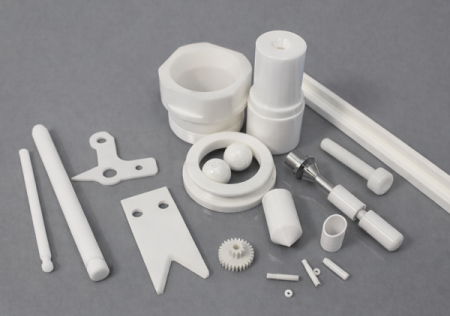
Successful selection, однако, is not about maximizing thermal conductivity in isolation. It requires systematic matching of material grade, powder quality, process route, структурный проект, and cost to the actual thermal, электрический, механический, and environmental demands of the application. Over-specification wastes budget; under-specification risks reliability. This guide provides a practical framework for electrical and electronics engineers, semiconductor and power-electronics manufacturers, technical procurement specialists, and ceramic materials R&D professionals.
First Step: Determine Whether AlN Is Truly Required
Before specifying AlN, perform a necessity screen to avoid performance and cost waste.
- Prefer глинозем (Al₂O₃) when operating temperatures are moderate, heat flux is modest (typically below ~10 W/cm²), and budget is constrained. Alumina is mature, widely available, and costs a fraction of AlN. It fully covers ordinary LED lighting, low-to-medium power supplies, sensors, and many control circuits.
- Specify AlN only when junction-temperature margin is tight и electrical isolation plus thermal conductivity must be satisfied simultaneously. Typical justifying applications include 800 V automotive SiC traction inverters, photovoltaic and energy-storage converters, IGBT half-bridge modules, 1.6 T optical-module laser submounts, and 5G RF power amplifiers.
- Учитывать нитрид кремния (Си₃N₄) when mechanical impact resistance, large-substrate reliability under severe thermal cycling, or vibration resistance is paramount (например, rail-transit power modules). Si₃N₄ offers substantially higher flexural strength (600–900 MPa) и вязкость разрушения (6–7 MPa·m½) at the expense of lower thermal conductivity (typically 70–90 W/m·K).
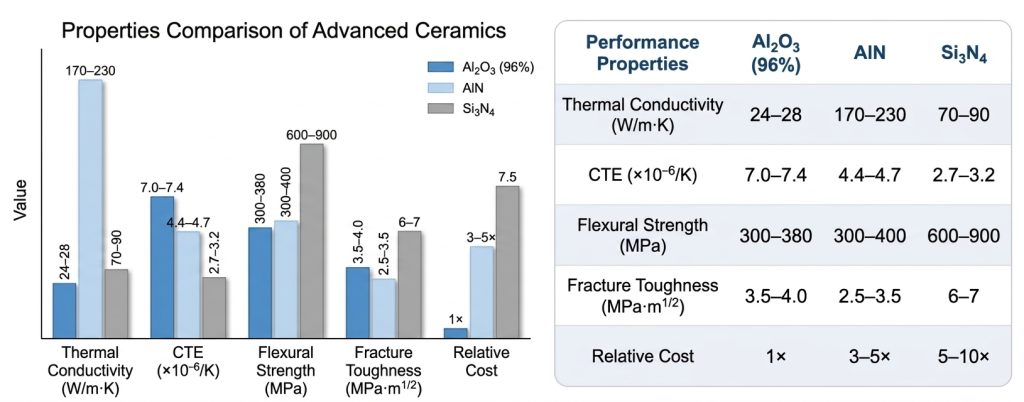
Only after confirming that alumina is thermally insufficient and Si₃N₄ is not required for toughness should AlN enter the shortlist.
Core Material Properties Relevant to Selection
Теплопроводность: Commercial AlN substrates typically achieve 170–230 W/m·K at room temperature (5–7 times that of alumina), with a theoretical value of up to 320 ж/(м·К). Conductivity is primarily controlled by oxygen content, grain-boundary secondary phases, размер зерна, and residual porosity, and it declines with rising temperature.
Electrical properties: Dielectric strength exceeds 15 кВ/мм, volume resistivity is high, and loss tangent is low. Excellent insulation performance is maintained across all grades.
Thermomechanical match is a major advantage. AlN’s CTE of ~4.5 × 10⁻⁶/K closely tracks silicon (~2.6–4 ppm/K) and SiC (~4 ppm/K), reducing solder-joint fatigue and die-attach stress compared with alumina (~7 ppm/K).
Механические свойства: Typical flexural strength is approximately 300 МПа, hardness about 12 ГПа, and fracture toughness is intermediate—adequate for most electronic substrates but lower than that of Si₃N₄.
Ограничения: Bare surfaces are moisture-sensitive (dry storage is required to avoid reaction with water vapor). Oxidation occurs at 700–800 °C in air; continuous long-term operation above this temperature range is not recommended. The material remains stable to much higher temperatures in inert or vacuum atmospheres.
Matching Thermal-Conductivity Tiers to Heat-Dissipation Needs
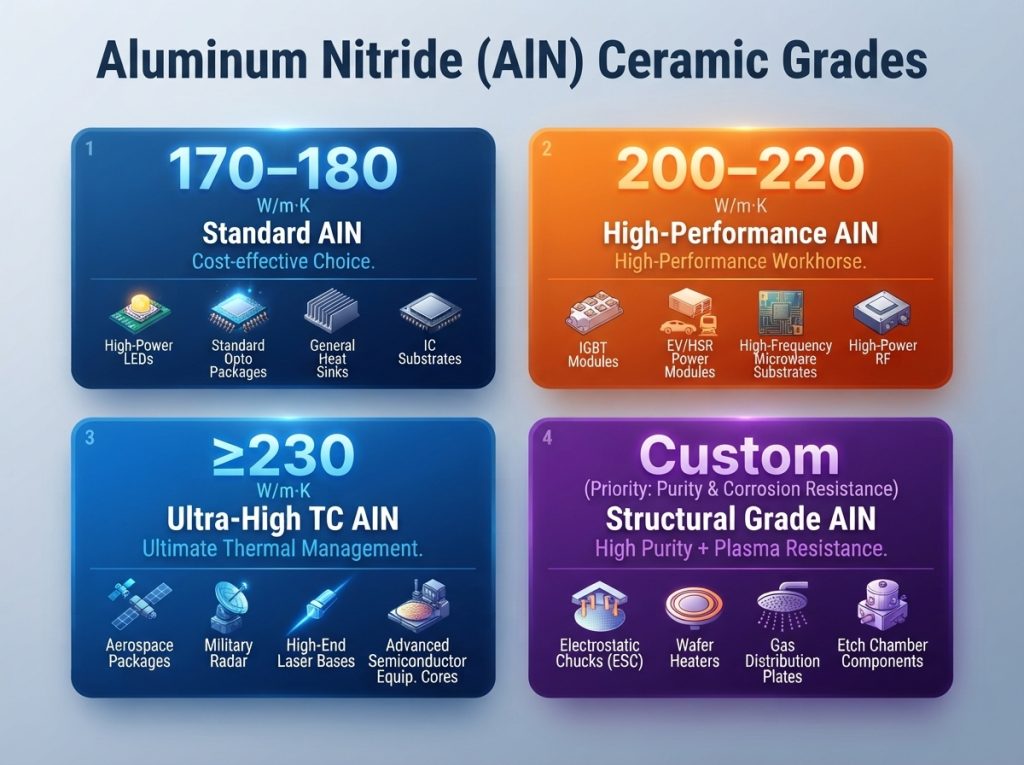
Industry practice and our product portfolio classify commercial AlN into the following practical performance tiers:
- Standard tier (170–180 W/m·K): Combines good thermal conductivity with high insulation voltage resistance and a CTE well-matched to silicon wafers. This is the most cost-effective AlN grade. Suitable for high-power LED heat-dissipation substrates, обычная упаковка оптоэлектронных устройств, базы крупномасштабных интегральных схем, and general heat sinks.
- High-Performance tier (200–220 W/m·K): Offers excellent heat-dissipation capability and high dielectric strength. It is an eco-friendly, perfect substitute for traditional toxic beryllium oxide (БеО) керамика. Ideal for IGBT power modules in new-energy vehicles and high-speed railways, подложки высокочастотной микроволновой связи, and high-power RF device packaging.
- Ultra-High TC tier (≥230 W/m·K): Delivers extremely high heat-conduction efficiency approaching the theoretical limit, together with high mechanical strength, extremely low dielectric loss, and excellent thermal stability. Recommended for aerospace electronic packaging, military-grade radar heat-dissipation components, core parts of advanced semiconductor manufacturing equipment, and high-end laser bases.
- Structural Grade for Semiconductors (Customized): Features ultra-high purity and superior halogen plasma corrosion resistance. Priority is given to corrosion resistance and high purity rather than maximum thermal conductivity. Used for cavity parts in semiconductor etching equipment, например, электростатические патроны (ЭКУ), wafer heaters, and gas distribution plates.
Select the lowest tier that satisfies the system-level thermal-resistance budget. If the ceramic substrate accounts for only a small fraction of the total junction-to-ambient resistance, a higher-conductivity grade yields diminishing returns; improving the thermal-interface material or heat-sink design is often more cost-effective. We supply graded materials according to specific heat-dissipation requirements.
Powder Grade and Process Compatibility
Finished ceramic performance is largely determined by the purity, particle-size distribution, and sintering-process control of the starting powder. We offer Standard, Высокая производительность, Ultra-High TC, and Structural Grade (полупроводник) materials based on thermal conductivity and application focus to meet diverse heat-dissipation and corrosion-resistance requirements.
The forming route must match geometry and production volume:
- Tape casting is economical and fast for thin substrates.
- Изостатическое прессование, сухое прессование, and powder injection molding are preferred for complex three-dimensional shapes. Products from different forming processes should not be mixed for pricing or specification purposes.
Мы поддерживаем ЦОД, ДБК, AMB, and thick-film printing metallization processes. Standard substrate thicknesses include 0.25 мм, 0.38 мм, 0.5 мм, 0.635 мм, и 1.0 мм, with custom sizes available.
Дизайн, Относящийся к окружающей среде, and Assembly Considerations
- Temperature limits — Oxidation occurs at 700–800 °C in air; continuous long-term operation above this range should be avoided, as oxidation degrades properties. Dry storage is required to prevent reaction with water vapor.
- CTE matching — Verify compatibility with the semiconductor die or metal baseplate early. AlN’s inherent match to silicon and SiC is a primary reliability advantage.
- Geometry rules — Avoid sharp corners and excessively thin walls; these concentrate stress and become crack-initiation sites under thermal cycling. Because AlN is hard, direct tapping is impractical—embed metal inserts if threaded features are required.
- Metallization — Direct-bond copper (ДБК), active-metal brazing (AMB), direct-plated copper (DPC), and thin-film stacks (Ti/Pt/Au, и т. д.) are all used. Process windows are narrower than for alumina; confirm paste or plating compatibility with the chosen AlN grade.
- Moisture management — Bare AlN is moisture-sensitive; metallized or passivated surfaces and appropriate packaging mitigate the issue.
Application-Specific Recommendations
New-energy power devices and IGBT modules
Select high-conductivity AlN substrates with good CTE match and demonstrated thermal-shock resistance. Prefer grades that support reliable micro-hole machining and customized metallization to withstand power-cycling stresses.
Laser-diode and high-power optoelectronic packaging
Ultra-thin green tapes or precision-machined AlN structural parts provide the flatness and dimensional accuracy needed to avoid hot spots and signal degradation.
Thermal-interface-material (TIM) fillers
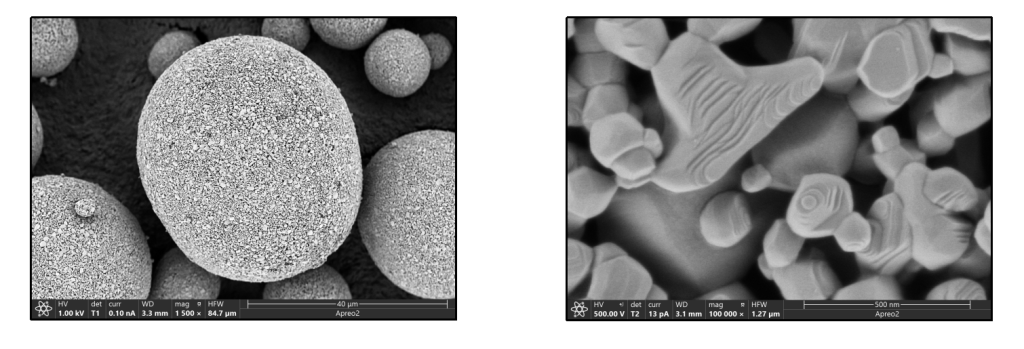
Use spherical or controlled-morphology high-purity or surface-modified AlN powders to maximize packing density and composite thermal conductivity.
Semiconductor process equipment (электростатические патроны, heaters)
Emphasize plasma resistance, thermal uniformity, and controlled resistivity in addition to conductivity.
Расходы, Sourcing, and Qualification Guidance
AlN substrates typically cost 3–5 times more per unit area than 96% глинозем. Price is driven by purity/conductivity tier, размер, metallization complexity, and volume. Procurement should request full datasheets specifying measurement method (laser-flash thermal conductivity, ASTM flexural strength, и т. д.), oxygen content or equivalent purity metrics, and recommended storage/handling procedures. Qualify suppliers on both material consistency and process capability for the intended metallization route.
Practical Decision Checklist
- Confirm that alumina cannot meet the thermal budget and that Si₃N₄ is not required for toughness.
- Calculate system thermal resistance and identify the minimum AlN conductivity tier that provides adequate junction-temperature margin.
- Match powder grade (E vs. H) and forming process to volume and geometry.
- Verify CTE compatibility, maximum temperature, and metallization process window.
- Apply sound design rules (no sharp corners, embedded inserts for threads, moisture protection).
- Balance performance against total cost of ownership, including yield and long-term reliability.
By following this structured approach—necessity screening first, then systematic matching of thermal tier, powder quality, процесс, дизайн, and cost—engineers and procurement teams can select AlN materials that deliver reliable performance without unnecessary over-specification. AlN remains one of the most effective non-toxic solutions when high thermal conductivity and electrical insulation must coexist under demanding power-density or reliability constraints.
