 JiFeng-Keramik

Auf der automatisierten Produktionslinie, Was die Effizienz oft beeinträchtigt, ist nicht die auffällig große Ausrüstung, but rather some insignificant small parts. The accuracy will be affected if there is some wear on the locating pins; the whole process will come to a halt if the guiding components are jammed; and electrical malfunctions will be frequent if the insulators are damaged. Such small issues, in aggregate, lead to substantial losses in terms of down time, wasted material, and manpower.
Traditional metal parts, under the multiple pressures of continuous operation, frequent start-stop, and precise positioning, are increasingly unable to meet the requirements. While advanced ceramic parts are becoming the key choice for more and more automated production lines to enhance reliability. They are not only a physical substitute but solve the problem areas of the manufacturing process from three angles: physical attributes, accuracy maintenance, and complete process adaptability.
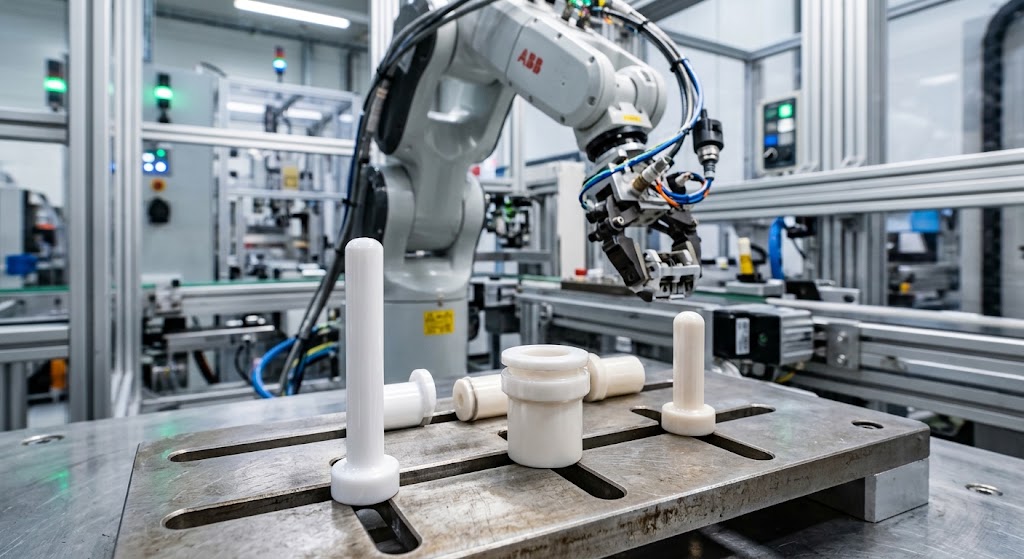
Three Core Pathways: How Ceramics Systematically Boost Reliability
Pathway 1: Material Properties That Outperform Metal — Solving Wear, Korrosion, and Insulation at the Source
Ceramic materials are very hard compared to regular steel, and their wear resistance is higher by many times than that of other materials. When subjected to conditions of high friction and impact, metal parts have to be replaced every couple of months, but good quality ceramic parts last much longer. Ceramic materials are resistant to corrosion and chemically inert, meaning that they do not react with coolants, weld spatter, and process materials. The high level of electrical insulation and lack of magnetism in ceramics ensure that there is no risk of short-circuiting and interference.
Pathway 2: High-Precision Tolerances and Dimensional Stability — Making Accuracy a Long-Term Capability
More and more repeatable accuracy is required for automation purposes. Metal components have a tendency to move, because of their properties such as thermal expansion and constant wear. Ceramics have very small thermal expansion and are very stiff, hence their tolerance values remain accurate for a much longer period. The locating pins and guiding members retain their shape longer than before.
Pathway 3: Full Compatibility with Automated Equipment — From Single-Point Upgrades to Line-Wide Synergy
Ceramic parts include such crucial elements as guides, locators, sliders, Isolierung, and supports. Ceramic parts go well together with robots, conveyors, fixtures, welding units, and inspection systems. When the most vulnerable parts of an assembly line are made from ceramics, then uptime, reliability, and predictability also increase.
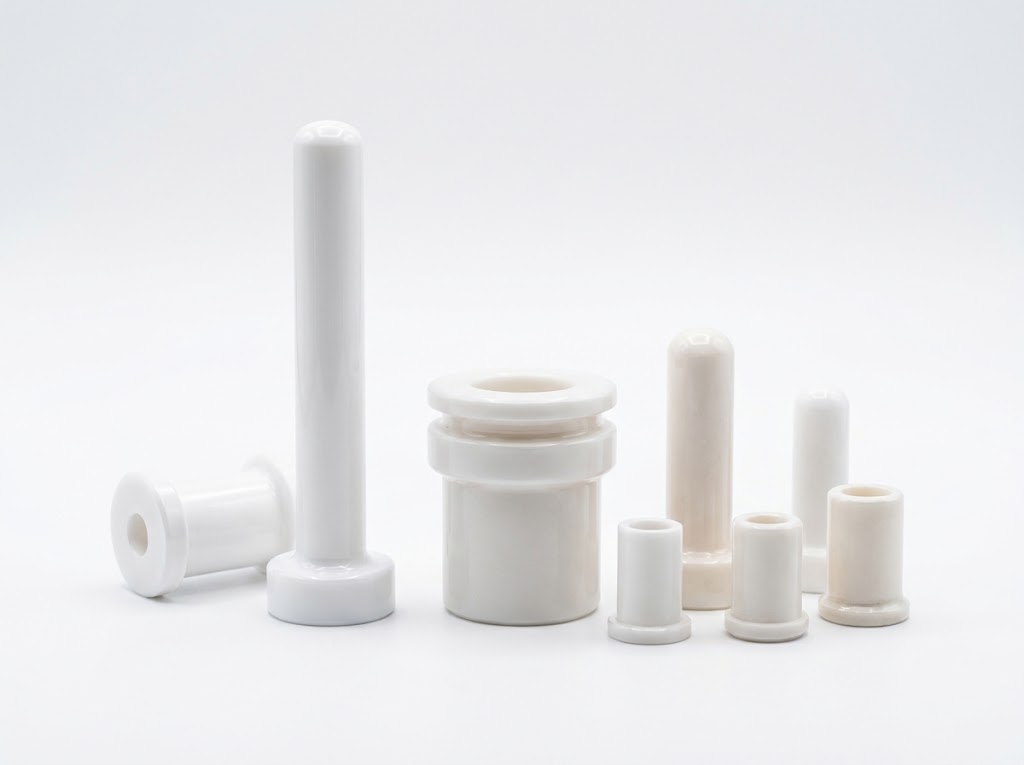
Practical Breakdown: The Role of Four Key Ceramic Components
1. Guiding Elements (Buchsen, Pins, Rails, usw.)
Under conditions of constant movement with high speed, metal guides become worn out, form clearance or get jammed. On the contrary, ceramic guides are distinguished by high wear resistance and low coefficient of friction; they provide constant and accurate movements with reduced vibrations and excessive energy consumption – which makes them suitable for robotic axes, slide tables and fast conveyor systems.
2. Locating / Positioning Pins
Locating pins can be regarded as “guardians of precision” in the process of assembling, welding and inspection. Metal locating pins wear out, become deformed and get covered with weld spatter after multiple insertions and removals. Ceramic locating pins, on the contrary, are characterized by high hardness, resistance to weld spatter adhesion and electrical insulation; they maintain their original geometry throughout the entire period of usage and, consequently, decrease the amount of waste and rework due to inaccurate positioning.
3. Wear-Resistant Components (Buchsen, Wear Plates, Sliding Pads, usw.)
High friction and impact areas are the main reasons of downtime in a production line. Ceramic wear-resistant components increase service life and minimize replacements, thus reducing unexpected downtime and allowing more predictable maintenance work.4. Insulating Components
Failure in insulation can cause sudden electric faults in the electromechanical automated system. Insulators made of ceramics are good insulators since they provide stability in dielectric properties, resistance to high temperature and moisture, thus insulating electrical systems from mechanical systems in order to prevent any fault due to interference.
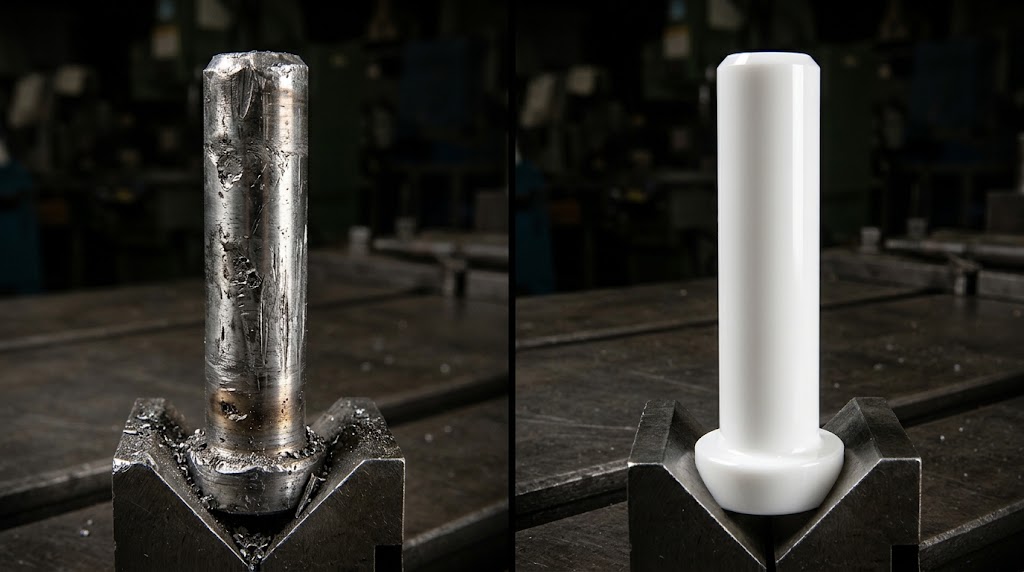
System-Level Benefits: From “Replacing Parts” to “Changing Outcomes”
Replacing key components with high-quality ceramic parts often leads not just to an improvement in a single metric, but to an enhancement in the reliability of the entire line:
- Fewer stoppages and part changes → higher Overall Equipment Effectiveness (OEE)
- Longer-lasting precision → lower scrap and rework costs
- More predictable maintenance → reduced inventory pressure on spare parts
- Although unit cost is higher than standard metal parts, total cost of ownership (Gesamtbetriebskosten) is usually lower over the full lifecycle
Many enterprises report that launching pilot projects at specific points—those prone to the fastest wear, requiring the highest precision, or incurring the greatest costs during downtime—often yields quick, visible results, which can then be scaled up to the entire production line.
Selection and Implementation Tips
Match the ceramic material to the actual working conditions: Zirkonoxid for higher toughness under impact; alumina or silicon nitride for pure abrasive wear; silicon nitride for elevated temperatures. Pay attention to proper design to avoid sharp impact edges, ensure correct mounting, and prioritize surface finish quality.
Begin with small-scale pilots on the most painful points, validate results with data, then scale. Materialreinheit, machining precision, and batch consistency directly determine real-world performance.
Jifeng Tech Ceramic specialize in high-quality ceramic guiding elements, locating pins, wear-resistant parts, and insulating components, with full support for custom non-standard solutions. If your automated lines are struggling with frequent wear, positioning drift, or unexpected downtime, we invite you to discuss tailored selection advice and practical solutions.
Closing
In essence, the reliability of an automatic production line depends on the performance of their key parts in the long term. Ceramics enhance continuous operation, repeated starting and stopping, and accurate positioning in three ways – material characteristics, size stability, and compatibility throughout the process. Ceramics are not a cure-all, but the right part used at the right moment transforms production lines from reactively responding to problems into designing for reliability.
If you want to learn how to increase the reliability of your lines practically, then you should check out your opportunities to use ceramics.
