 JiFeng-Keramik

Selecting the right ceramic components for an industrial application involves more than choosing a material with high hardness or temperature resistance. The component must perform reliably under its actual operating conditions, including mechanical loads, Temperaturänderungen, chemische Belastung, electrical requirements, dimensional tolerances, and surface finish.
For engineers and industrial buyers, der beste ceramic component is the one that provides the required performance while remaining practical to manufacture and cost-effective at the required production volume.
This guide explains the key factors to consider when selecting ceramic components for industrial applications, from operating conditions and material selection to precision machining and supplier capabilities.
Start With the Operating Environment
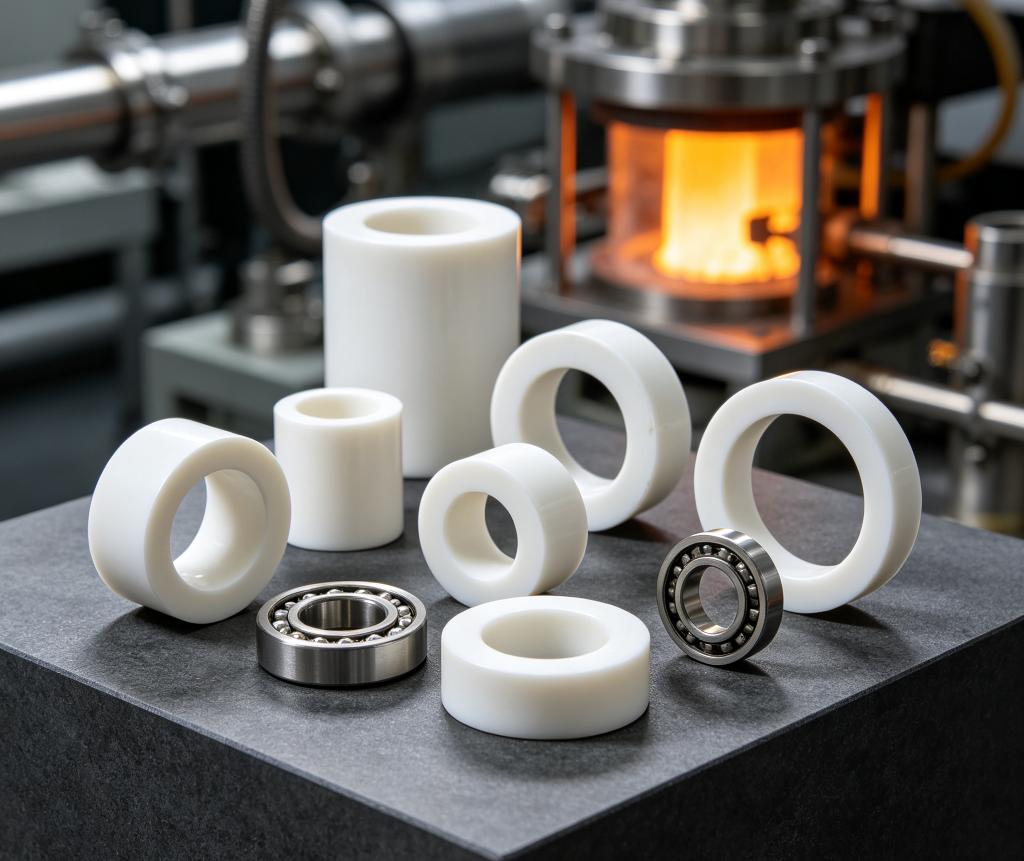
The operating environment should be the starting point for ceramic component selection. Before choosing a ceramic material, define exactly how and where the component will be used.
Operating Temperature
Temperature matters a lot for ceramic components. You need to find the usual working temperature. You also need the highest temperature the part might see.
It is also important to consider whether the component will undergo repeated heating and cooling cycles. While certain ceramic materials perform well in sustained high-temperature environments, frequent exposure to rapid temperature fluctuations can lead to performance degradation or even damage.
For applications involving thermal cycling, halten:
- Continuous operating temperature
- Maximum temperature
- Heating and cooling rates
- Thermal cycling frequency
- Thermoschockbeständigkeit
Mechanical Loads
Ceramic materials usually possess high hardness, compressive strength and wear resistance. Jedoch, their brittle nature implies that the mechanical load must be evaluated specifically.
It is necessary to determine whether the component will be subjected to pressure, Biegen, Vibration, shock or friction during use. Zum Beispiel, the performance requirements for ceramics used in shaft sleeves, Führer, gaskets, wear-resistant parts or structural components may be completely different.
Chemical and Environmental Exposure
Industrial ceramic components may be exposed to chemicals, moisture, gases or other corrosive environments for a long period of time.
The selection process should consider:
- Chemical corrosion
- Moisture and humidity
- Oxidizing or reducing atmospheres
- Vacuum conditions
- Particles and contamination
- Exposure duration
Choose the Right Ceramic Material
After determining the working environment, the next step is to select the appropriate ceramic materials based on their actual application.
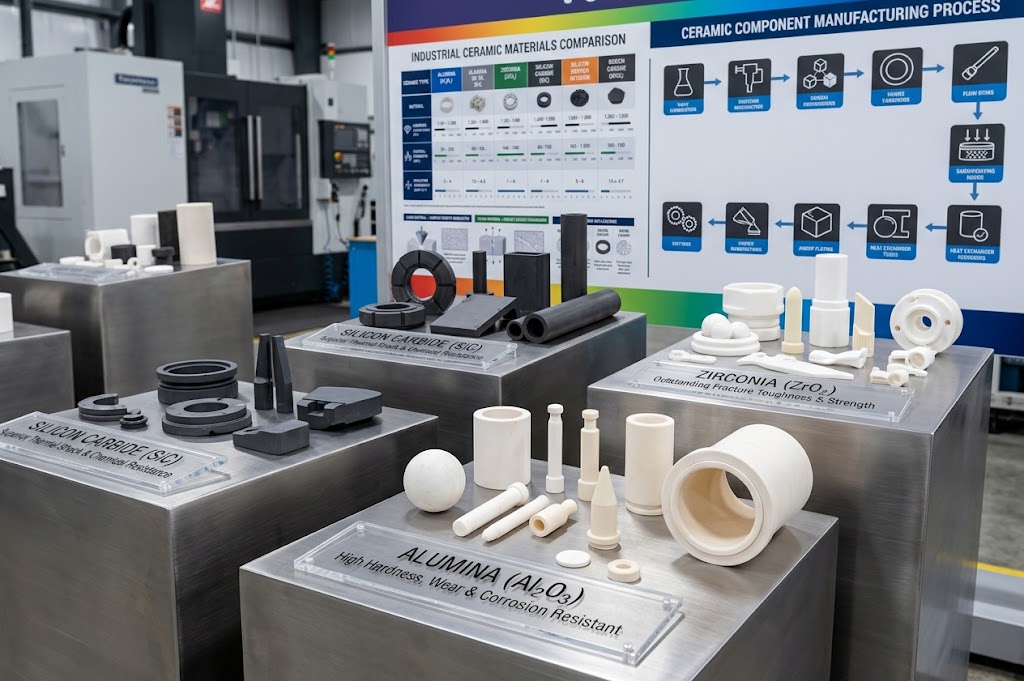
Different ceramic materials vary in mechanical properties, thermal properties, electrical properties, and chemical corrosion resistance. daher, no single material can be suitable for all industrial applications.
Aluminiumoxid (Al₂O₃)
Aluminiumoxid is one of the most widely used technical ceramics because it provides a balanced combination of mechanical strength, Härte, elektrische Isolierung, Verschleißfestigkeit, and temperature stability.
Alumina ceramic components are commonly considered for:
- Elektrische Isolatoren
- Wear-resistant parts
- High-temperature components
- Industrial machinery
- Semiconductor equipment
- Laborausrüstung
Different alumina grades can provide different performance characteristics, so the required purity and grade should be matched to the application.
Siliziumkarbid (SiC)
Siliziumkarbid is suitable for industrial environments with high requirements for thermal performance, wear resistance and chemical corrosion resistance. Its main features include high hardness, hervorragende Verschleißfestigkeit, good thermal conductivity and high temperature stability.
SiC ceramic components can be considered for applications involving:
- High temperatures
- Severe abrasion
- Corrosive environments
- Thermal management
- High-speed or high-wear conditions
When heat dissipation and dimensional stability at elevated temperatures are important, silicon carbide can provide advantages over conventional ceramic materials.
Zirkonoxid (ZrO₂)
Zirkonoxid is often selected when fracture toughness and mechanical durability are important. Compared with many conventional ceramics, zirconia offers higher toughness while maintaining excellent hardness and wear resistance.
Zirconia components are suitable for applications requiring:
- High wear resistance
- Improved fracture resistance
- Precision movement
- Mechanical durability
- Complex industrial components
The appropriate zirconia grade should be selected based on the specific mechanical and environmental requirements.
Other Advanced Ceramics
Depending on the application, engineers may also consider materials such as silicon nitride or aluminum nitride.
Zum Beispiel, silicon nitride is suitable for applications that require high mechanical properties and thermal shock resistance, while aluminum nitride is suitable for scenarios that require high thermal conductivity and electrical insulation.
The focus of material selection is not to choose the “highest performance” Material, but to find the material that best matches the actual application needs.
Define the Required Component Properties
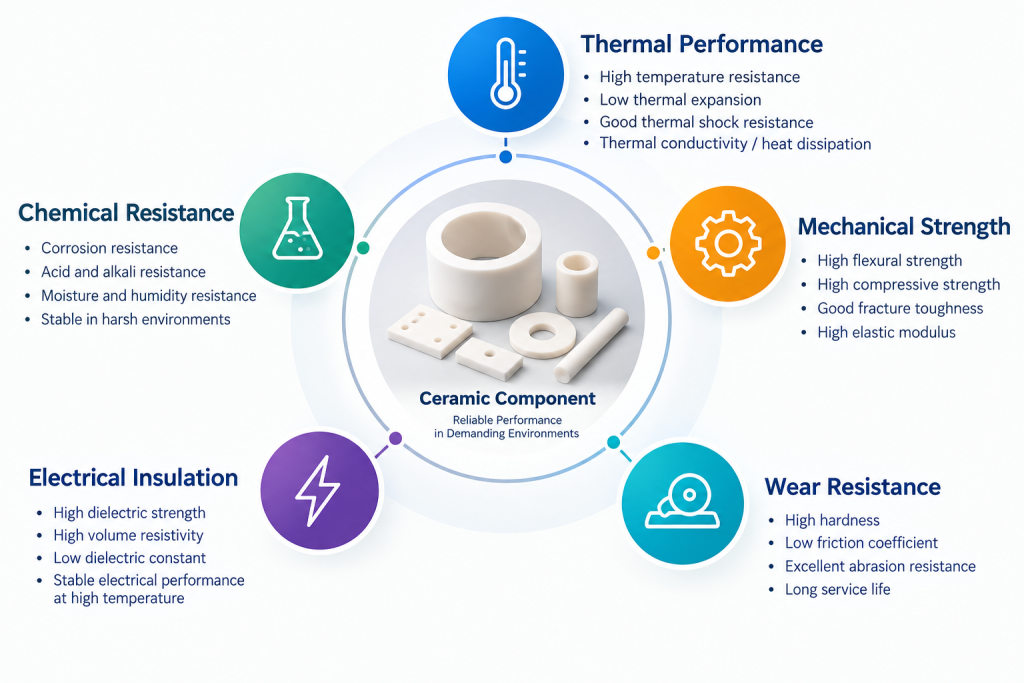
Material selection should be based on the properties that directly affect component performance.
Strength and Toughness
Strength and toughness are particularly important for ceramic parts exposed to mechanical stress.
Consider properties such as:
- Biegefestigkeit
- Compressive strength
- Bruchzähigkeit
- Elastic modulus
A component that experiences primarily compressive loading may have different requirements from one subjected to bending or impact.
Härte und Verschleißfestigkeit
Hardness is important for components that experience continuous contact, sliding, or abrasive conditions.
Wear resistance can be especially important for:
- Bushings
- Guides
- Seals
- Nozzles
- Wear plates
- Positioning components
Jedoch, hardness should not be considered in isolation. The friction conditions, mating material, contact pressure, Oberflächenbeschaffenheit, and operating temperature can all affect actual wear performance.
Elektrische Eigenschaften
For electrical and electronic applications, mechanical strength may not be the primary selection criterion.
Stattdessen, engineers may need to evaluate:
- Dielectric strength
- Electrical resistivity
- Dielektrizitätskonstante
- Insulation performance
- High-temperature electrical stability
Ceramic materials are widely used as electrical insulators because they can maintain their insulating properties under demanding conditions.
Thermische Eigenschaften
Thermal performance should be evaluated when components operate near heat sources or experience rapid temperature changes.
Important properties include:
- Wärmeleitfähigkeit
- Wärmeausdehnungskoeffizient
- Specific heat
- Thermoschockbeständigkeit
The coefficient of thermal expansion is especially important when ceramic components are assembled with metals or other materials. A significant difference in thermal expansion can create stress during temperature changes.
Consider Component Geometry and Design Requirements
Material selection is only one part of the process. The geometry of the ceramic component can have a major influence on manufacturing difficulty, Stärke, and final cost.
Shape and Size
Define the required dimensions and geometry before production.
Consider:
- Overall dimensions
- Wall thickness
- Holes and slots
- Grooves
- Internal cavities
- Complex profiles
- Edge geometry
Thin walls, small holes, sharp corners, and complex geometries may require more advanced manufacturing or machining processes.
Maßtoleranz
The required tolerance should be based on the actual function of the component.
Precision ceramic components may require tight dimensional control for applications involving alignment, positioning, sealing, or integration with other precision parts.
Jedoch, specifying extremely tight tolerances for every dimension can increase machining time and production costs. Critical dimensions should therefore be identified separately from non-critical dimensions.
Oberflächenbeschaffenheit
Surface finish can directly affect the performance of ceramic components used for sliding, sealing, positioning, or optical applications.
Depending on the application, requirements may include:
- Surface roughness
- Ebenheit
- Parallelism
- Roundness
- Edge quality
The required surface finish should be specified according to the component’s actual contact and functional requirements.
Evaluate Manufacturing and Machining Requirements
Ceramic manufacturing is different from conventional metal machining. The production process should therefore be considered during the design stage.
Ceramic Manufacturing Methods
Depending on the material, Geometrie, Menge, and required precision, manufacturers may use processes such as:
- Trockenpressen
- Isostatisches Pressen
- Spritzguss
- Extrusion
- Sintern
- Schleifen
- CNC-Bearbeitung
- Polieren
For high-volume components with relatively simple geometries, forming processes may provide better production efficiency. Complex or highly precise parts may require additional machining after sintering.
Präzisionskeramikbearbeitung
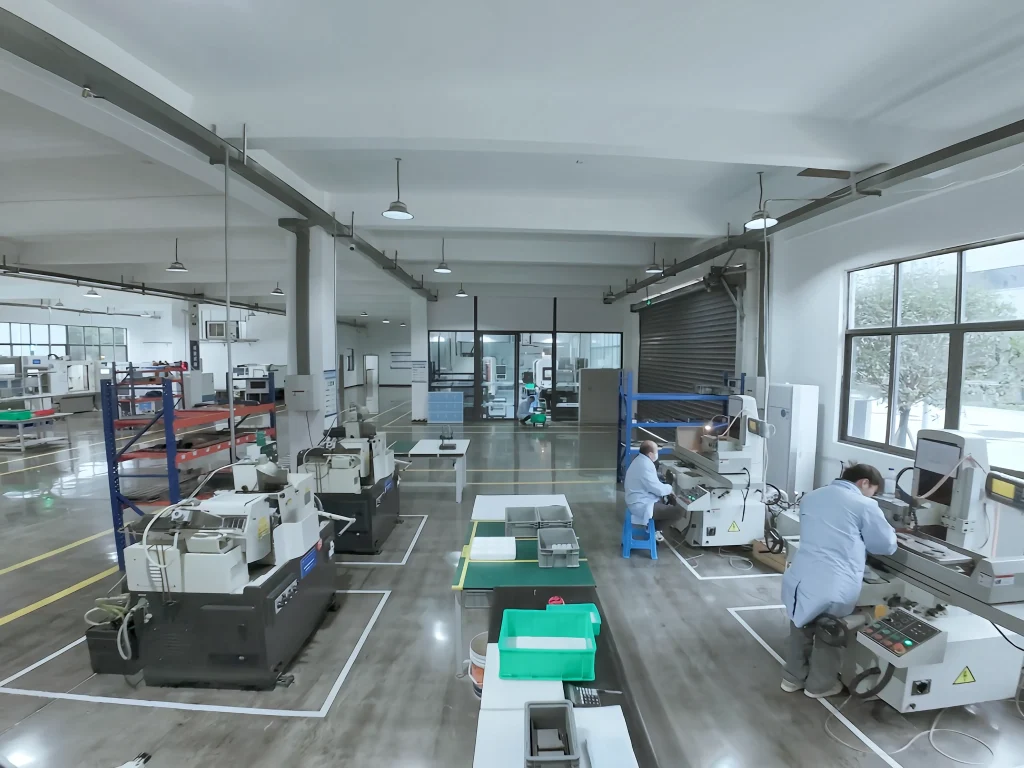
When components require tight tolerances or complex features, precision ceramic machining becomes an important part of the manufacturing process.
Schleifen, diamond machining, CNC processing, and polishing may be used to achieve the required dimensions and surface finish.
When evaluating a machining supplier, ask whether they can consistently control:
- Dimensional tolerances
- Hole diameter and position
- Ebenheit
- Surface roughness
- Concentricity
- Edge geometry
It is also useful to provide detailed engineering drawings or 3D models so that manufacturing requirements can be evaluated before production.
Match Ceramic Components to the Application
The best material and manufacturing process will depend heavily on the application.
Semiconductor and Electronics Equipment
Semiconductor and electronic equipment often requires ceramic components with excellent electrical insulation, Dimensionsstabilität, cleanliness, and thermal performance.
Components may be used in insulation, positioning, support, handling, or high-temperature processing applications.
For these environments, material purity and contamination control can be just as important as mechanical performance.
Medical and Laboratory Equipment
Ceramic components used in medical and laboratory equipment may require chemical resistance, dimensional precision, Verschleißfestigkeit, and stable performance.
The appropriate material depends on the specific environment and regulatory requirements of the final application.
Industrial Machinery
Industrial machinery commonly uses ceramic components where conventional materials may experience excessive wear, Korrosion, or temperature-related problems.
Zu den typischen Anwendungen gehören::
- Wear-resistant components
- Bushings
- Guides
- Sealing components
- Insulators
- Nozzles
- Precision positioning parts
Optical and Precision Equipment
Precision equipment places greater emphasis on dimensional accuracy, Oberflächenbeschaffenheit, thermische Stabilität, and long-term consistency.
In these applications, small dimensional variations can affect the performance of the complete assembly, making manufacturing control particularly important.
Decide Between Standard and Custom Ceramic Components
Another important decision is whether to use standard ceramic components or develop a custom part.
Standard components may be appropriate when the required dimensions and performance characteristics match an existing product. They can simplify procurement and may offer shorter lead times.
Custom ceramic components are more appropriate when the application requires:
- Non-standard dimensions
- Complex geometries
- Tight tolerances
- Special ceramic grades
- Specific surface finishes
- Application-specific performance
For custom projects, suppliers should be able to review technical drawings, Proben, or 3D models and recommend an appropriate manufacturing process.
Evaluate the Ceramic Component Supplier
Choosing the right supplier is just as important as selecting the right ceramic material.
Material Capability
Confirm the supplier offers the required ceramic materials and can provide complete, standards-based property data.
Fertigungskapazität
Look for in-house or tightly controlled capabilities in forming, Sintern, CNC-Bearbeitung, Schleifen, and polishing.
Qualitätskontrolle
Verify dimensional inspection, material testing, surface inspection, and batch-to-batch consistency. Traceability and documented processes are essential for critical applications.
Customization and Engineering Support
For custom ceramic parts, technical communication is critical.
A supplier should be able to understand engineering drawings, evaluate manufacturability, recommend suitable materials, and identify potential production issues before manufacturing begins.
This can help reduce unnecessary tooling, Bearbeitung, and development costs.
Abschluss
Selecting ceramic components for industrial applications requires a balance between material properties, operating conditions, component design, manufacturing requirements, und Kosten.
Start with the actual application environment, then identify the mechanical, Thermal-, elektrisch, and chemical requirements. From there, select an appropriate ceramic material such as alumina, Siliziumkarbid, oder Zirkonoxid, and define the geometry, Toleranzen, and surface finish according to the component’s function.
For demanding industrial applications, working with an experienced technical ceramic manufacturer can also help optimize material selection, component design, Präzisionsbearbeitung, and quality control before production begins.
The right ceramic component is not necessarily the one with the highest performance in every category. It is the one whose Material, Design, Präzision, and manufacturing process are properly matched to the application’s real requirements.
